2b. Exchange rates
Exchange rates
The rate at which one currency can be exchanged for another. For instance how many euros a pound could buy
If a currency becomes more valuable, we say it has strengthened
If a currency becomes less valuable, we say it has weakened
Equilibrium exchange rates
Currency is bought and sold on the Foreign Exchange Markets (FOREX).
Governments may buy and sell their own currency in order to influence its price.
At the moment we assume that govs don’t do this and the price is determined by supply and demand. This will change later.
The main reasons foreign currencies are bought and sold:
International trade in goods and services needs to be financed. Exports create demand for currency whilst imports create a supply
Long term capital movements occur. Inward investment to an economy creates demand for its currency. Outward investment creates supply
There is an enormous amount of speculation in the foreign exchange markets
Equilibrium exchange rates
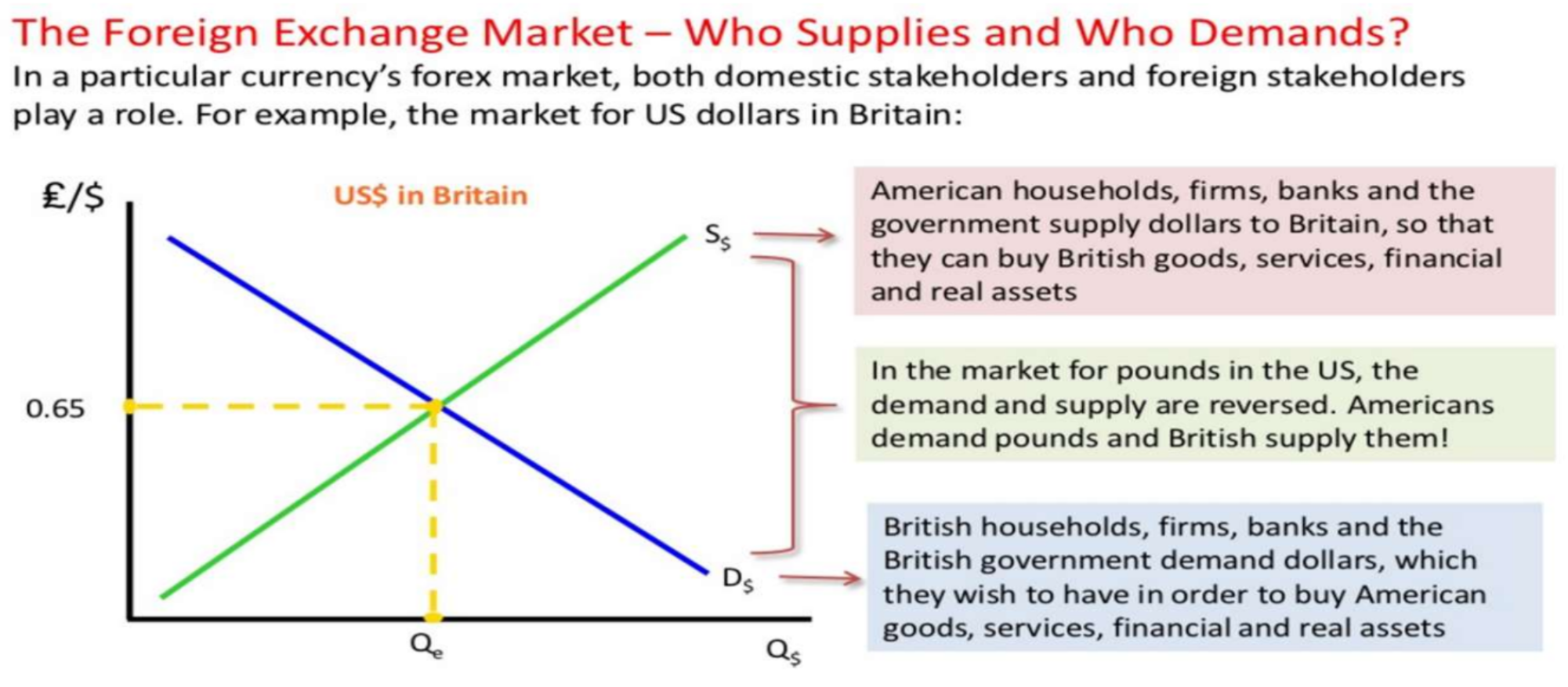
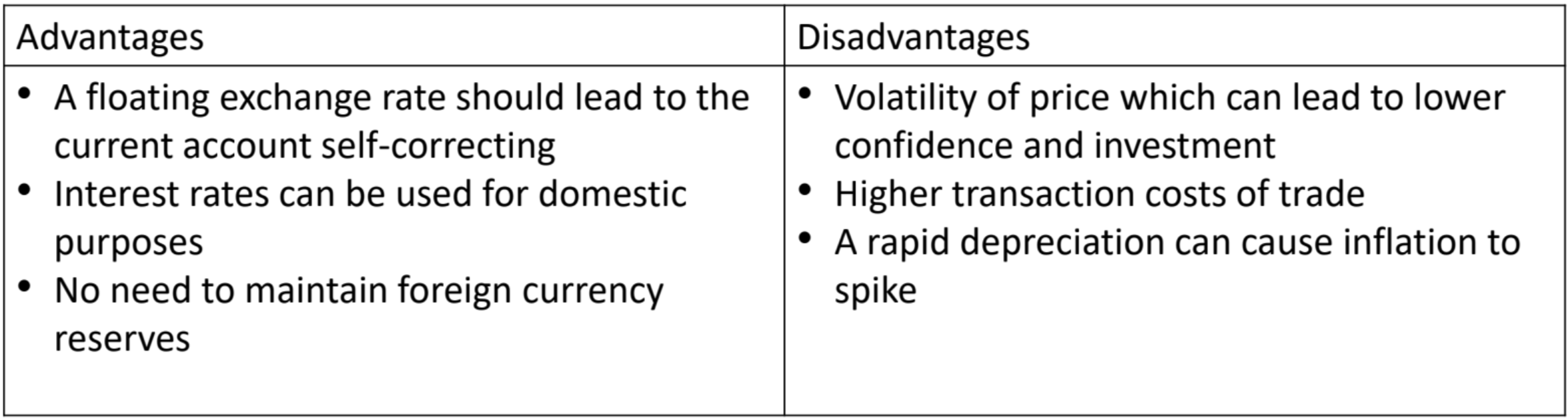
All currencies work in opposites so as pounds to dollars demand increases and the diagram shifts out we can assume there is a decrease in demand for the dollar so that would incur a shift inwards.
Causes of changes in exchange rates
An increase in exports increasing demand for a currency
An increase in imports increasing supply for a currency
High interest rates attracting savings from abroad
Rising demand due to speculation
Foreign multinational investing in a country
The government buying its own currency to supports its value
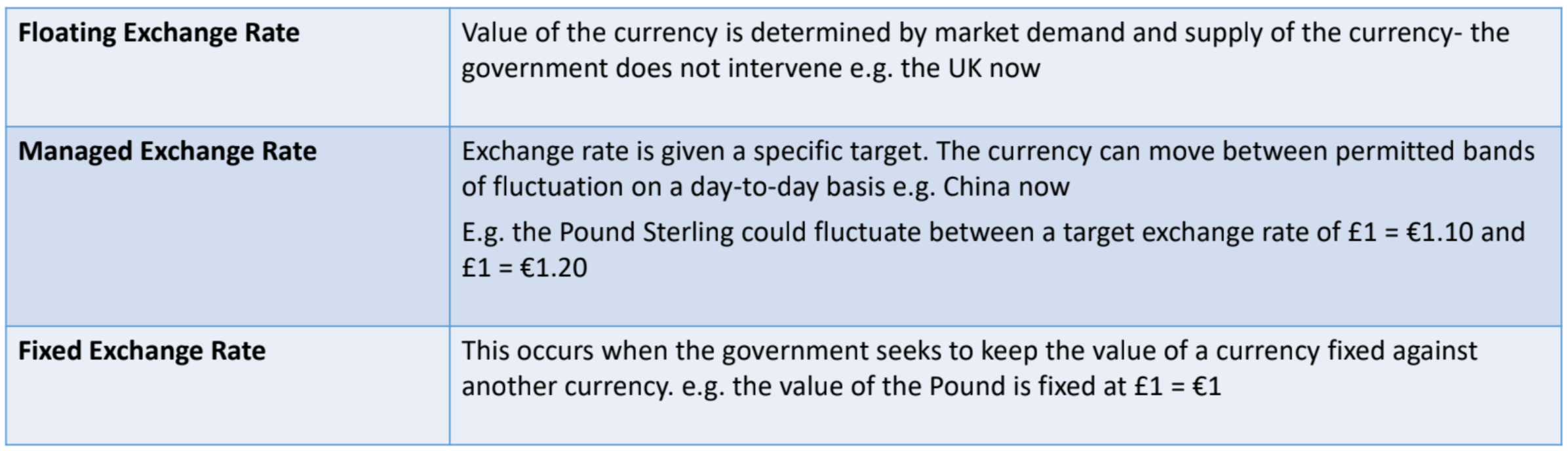
Management of exchange rates
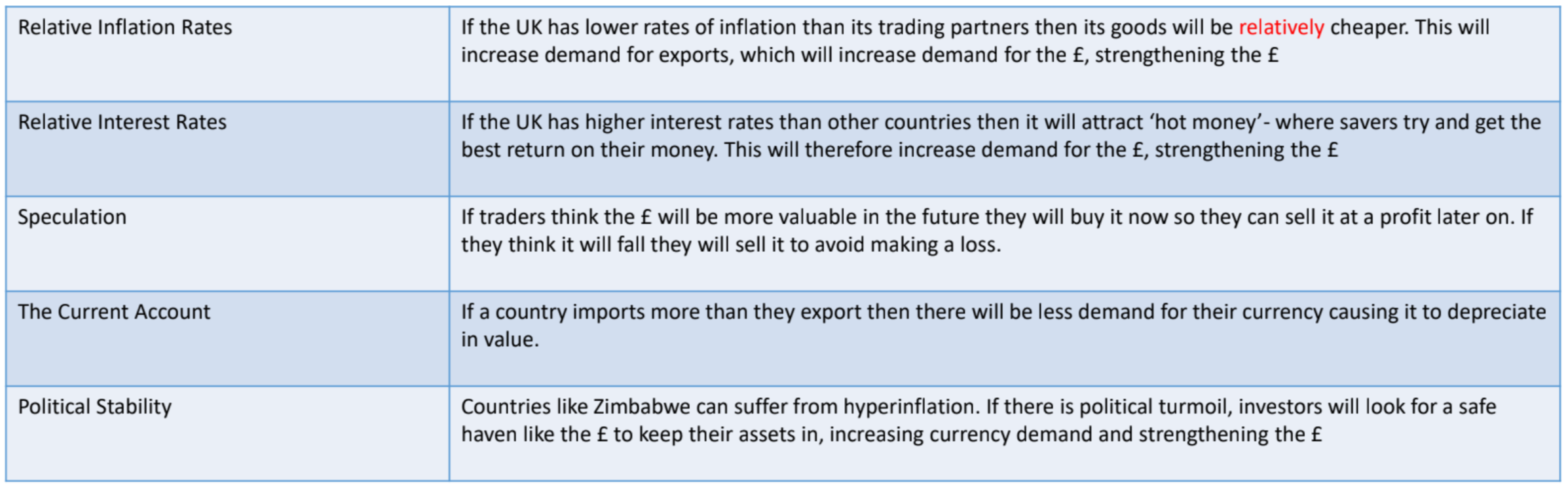
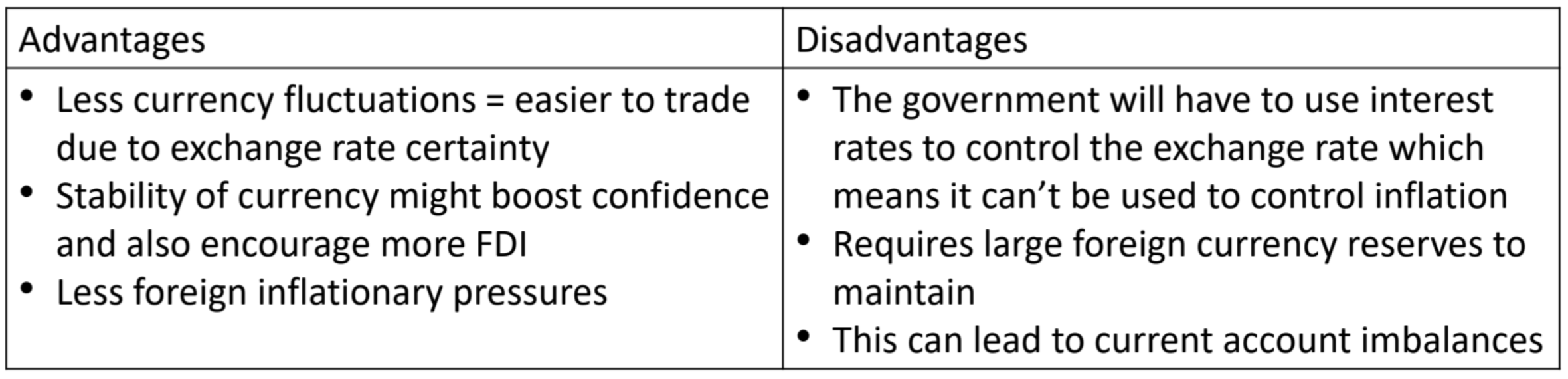
Factors which affect floating exchange rates
Exchange rates and the current account
If a country has an equal amount of exports and imports it is unlikely their exchange rate will change
However, if a country has more exports than imports their currency will rise due to the demand for the currency to pay exporters.
Speculation may cause the rate to fluctuate randomly in the short term if exchange rates are floating but over time there is likely to be an upward trend.
If a country runs a persistent deficit, its exchange rate will fall
Managed exchange rate systems
Free market determines the value of a currency but the central banks intervenes from time to time to change the value of their currency
Currency appreciation
In a floating exchange rate when the demand for a currency exceeds supply then there will be an appreciation (strengthening) in the value of the currency...
...A revaluation is when a country with a fixed exchange rate make a conscious choice to raise the value of the currency e.g. £1 was $1, now £1 is $2
Currency depreciation
In a floating exchange rate when the supply of a currency exceeds demand then there will be a depreciation (weakening) in the value of the currency...
...A devaluation is when a country with a fixed exchange rate make a conscious choice to lower the value of the currency e.g. £1 was $2, now £1 is $1
Effects :
At $2=f1 a US car sold to the UK will cost £10,000
If there is a devaluation of the £ by 10% the exchange rate will be $1.80=1 and the car will cost £11,111
If the demand for these cars is elastic, the change in the value of the currency will be more than offset by the change in demand for the imported US cars. Therefore the total sterling value of imported cars will fall
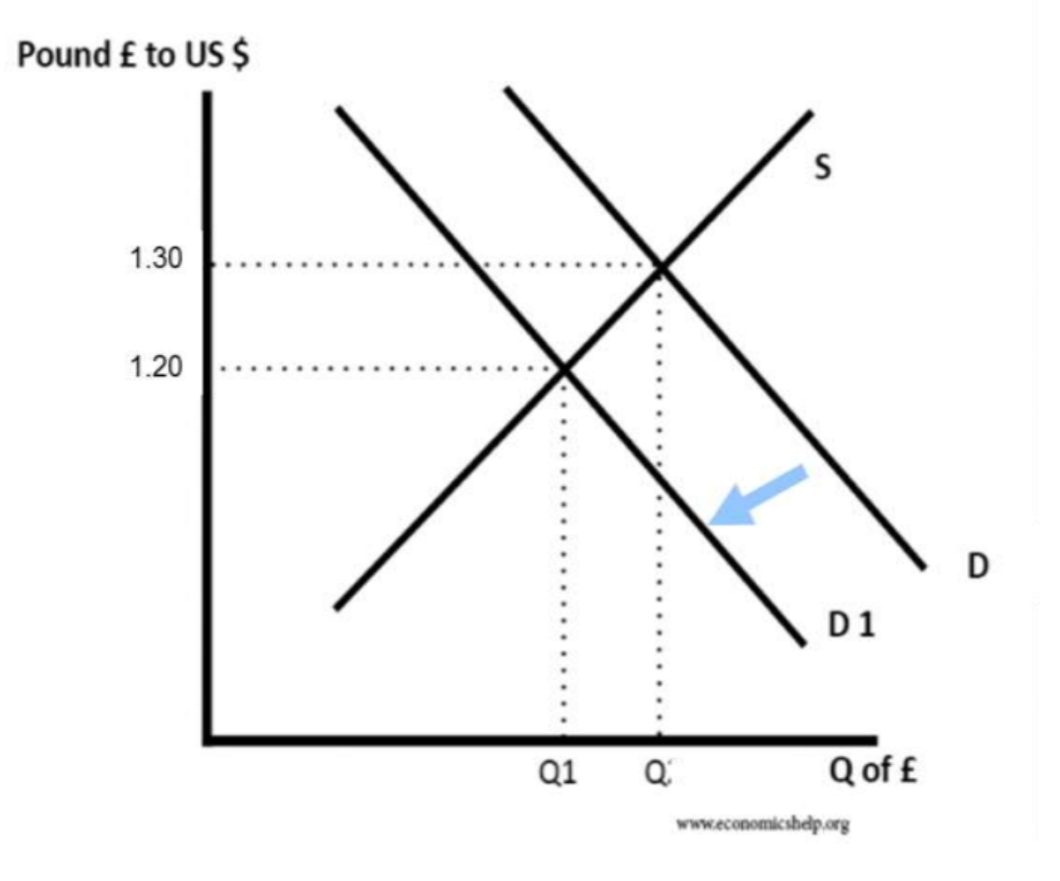
Maintaining a fixed exchange rate
A fixed exchange rate is either fixed against the rate of another currency or controlled by the central bank
Your currency’s value is still determined by supply and demand so you must change the supply or demand to maintain the value.
This is through two methods
Buying and selling foreign currency
Using interest rates
Maintaining a fixed exchange rate
A floating exchange rate allows the forces of supply and demand to dictate the value of the currency
Foreign currency transactions
If the UK wanted to devalue their currency they could sell more £ in foreign exchange markets, increasing supply and therefore reducing the price
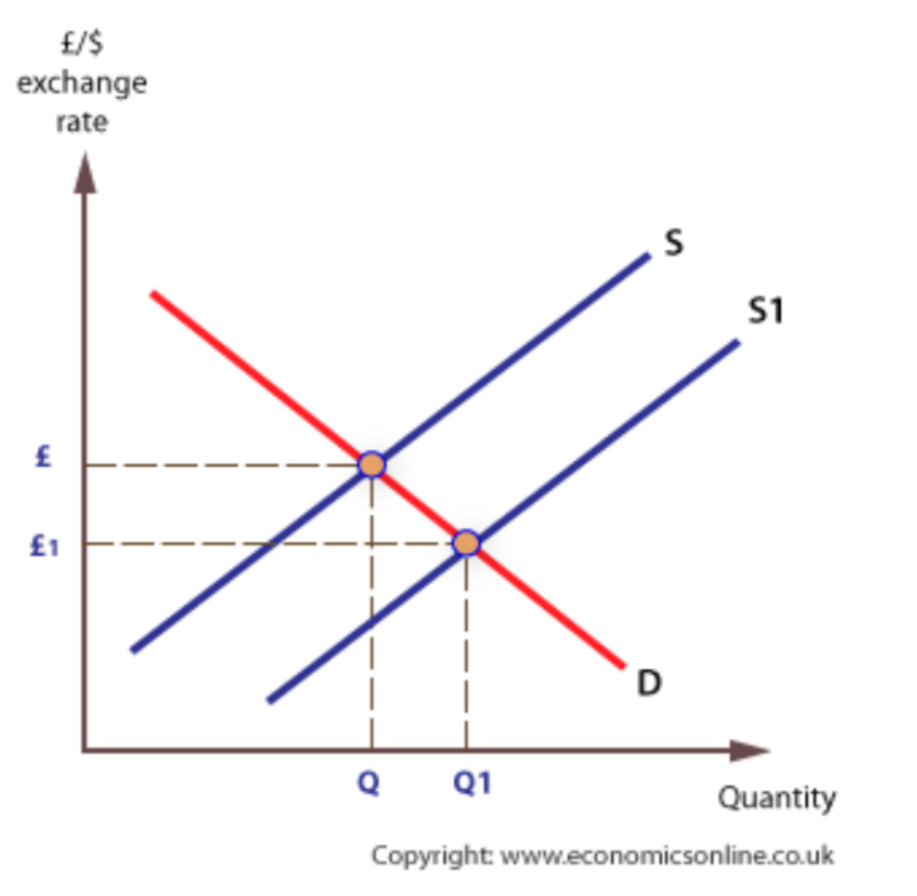
Maintaining a fixed exchange rate
Interest rates
If the UK wanted to devalue their currency they could reduce interest rates, thereby reducing hot money flows and lowering demand for the £
Fixed exchange rate
Floating exchange rate
Devaluing a currency
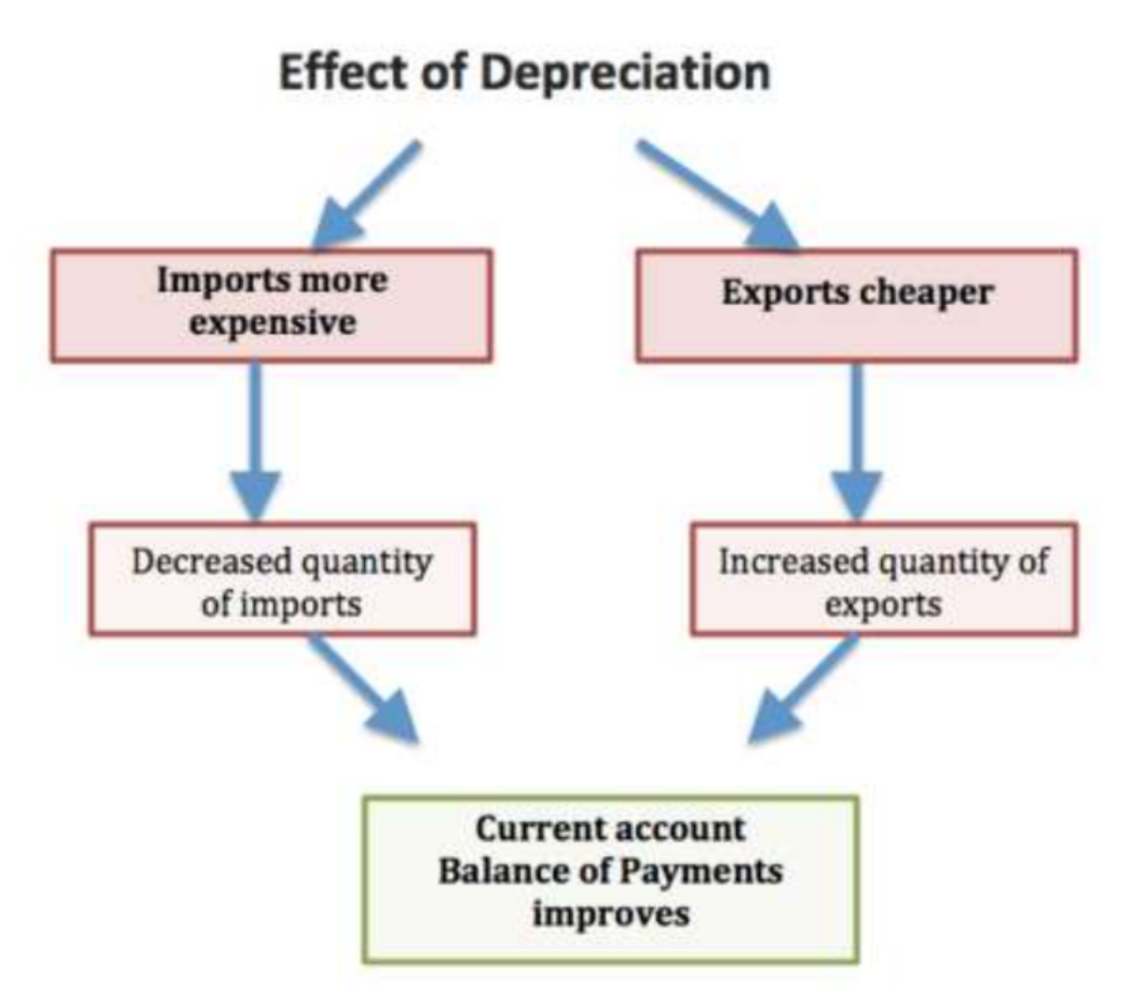
A weaker currency makes your products more affordable for foreigners boosting exports and therefore AD, this can increase economic growth and reduce unemployment
It also reduces imports, protecting domestic firms
If a country retaliates to a devaluation by carrying out a devaluation of their own this can cause a currency war
Devaluing a currency
Devaluing a currency
S- Stronger
P- Pound
I- Imports
C- Cheaper
E- Exports
E- Expensive
W- Weaker
P- Pound
I- Imports
D- Dearer
E- Exports
C- Cheaper
So a low exchange rate = Higher exports (as cheaper) and less imports (as more
expensive) = Current Account Surplus
Why would a country want to manage their currency?
For example an attempt to bring about a devaluation to:
1. Improve the balance of trade in goods and services / improve the current account position
2. Reduce the risk of a deflationary recession - a lower currency increases export demand and increases the domestic price level
3. To rebalance the economy away from domestic consumption towards exports and investment
4. Selling foreign currencies to overseas investors as a way of reducing the size of government debt
The impact of devaluation
Foreign Direct Investment
A devaluation / depreciation is to likely to increase the level of Foreign Direct Investment as it will be cheaper for the multinational to purchase assets. However, exchange rate volatility could discourage investment.
Economic Growth
A devaluation / depreciation is to likely to increase the level of economic growth as more exports will increase AD, leading to economic growth (if the economy is not at full-capacity)
Employment / unemployment
A devaluation / depreciation is to likely to reduce the level of unemployment as higher economic growth will mean more workers are needed.
Inflation
A devaluation / depreciation is to likely to increase the level of inflation as exports increase and imports decrease, leading to AD rising and demand-pull inflation. Imported raw materials will also be more expensive.
The Marshall-Lerner condition
If the price elasticity for combined exports and imports is greater than 1, a devaluation will result in an improvement in the current account.
If it is less than 1 then the correct policy response to improve a current account deficit would be a revaluation (opposite of devaluation)
Let us say that PEDX and PEDM = -0.1
Originally the exchange rate is £1 = $1
Let us say that the UK imports 100 hats at $10 each (£10 each at £1 = $1). Total M = £1,000
If the government devalues the currency so £1 = $0.5 the hats now cost the equivalent of £20
We would expect demand to fall by 10% as price has risen by 100% and PEDM is -0.1
This means we would buy 90 hats @ £20 each so Total M now = £1,800
The Marshall-Lerner condition
If the government depreciates the currency so £1 = $0.5 the hats now cost foreigners the equivalent of $5
We would expect demand to rise by 5% as price has fallen by 50% and PEDX is -0.1
This means we would sell 105 hats @ £10 each so Total X now = £1,050
Total M now £1,800 (was £1,000) Total X now £1,050 (was £1,000)
Current Account Deficit now £750 (was £0)
Depreciating the currency has caused the current account to worsen (in the short-term)
In the long-term the current account will improve as contracts to buy goods and services from abroad expire and domestic producers are able to undercut expensive imports
E.g. If UK hats cost £15, originally we would buy cheaper imports from abroad as US hats cost $10 and at an exchange rate of £1=$1 this costs £10, cheaper than the UK hat.
However, when the exchange rate changes to £1=$0.5, the hats now cost £20, more expensive than what a UK hat would cost.
In the short-term we are committed to buying US hats but in the long-run we would boost UK hat production to replace expensive imports.
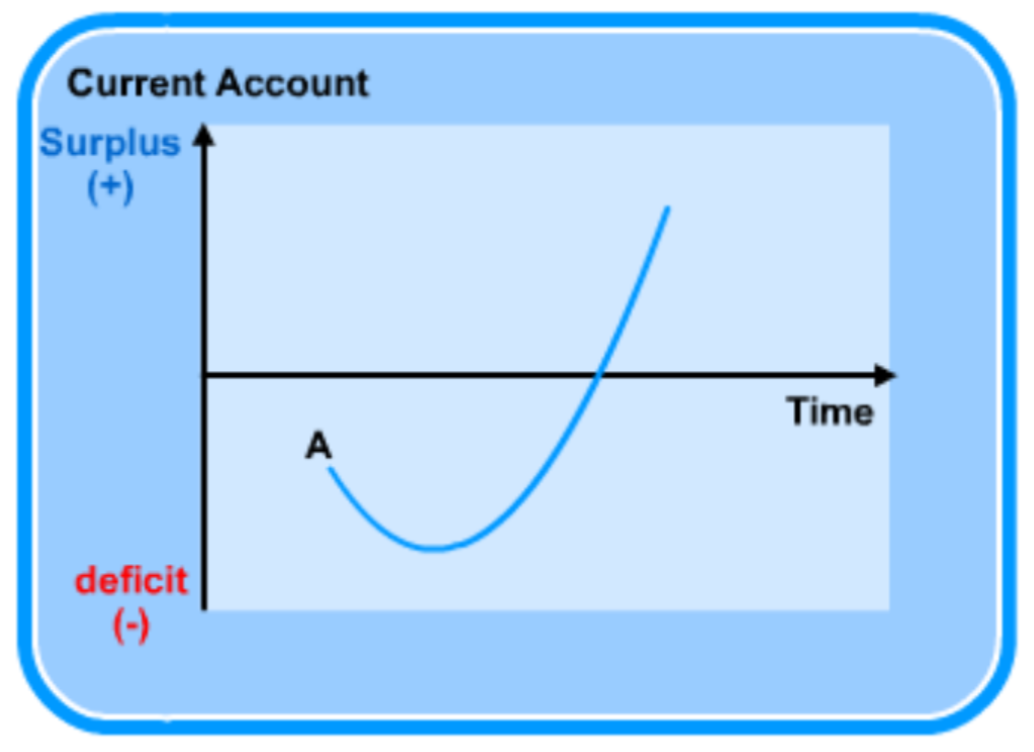
The J curve
In the short run demand for exports and imports is likely to be inelastic. Therefore things get worse before they get better.
Foreign currency price of UK exports will fall but it takes time for other countries to react to the change. The volume of exports will remain the same in the short term before increasing in the long term.
Similarly, although it is more expensive for the UK to import since the devaluation, UK buyers may be in contracts with firms abroad or we might lack the domestic supply and would need to continue buying imports. In the short term import values will rise. In the long term the volume of imports will reduce.
Other problems with devaluation
Cost push inflation due to the rising price of imports.
To solve this the government might seek to create deflation by reducing AD would mean people are less likely to import and UK prices become more competitive
This has been successful in the UK in reducing imports due to our high marginal propensity to import, but has had little impact on exports