Psychometrics
The most common way to measure behavioral science is by asking questions
Measurement is rooted in theory- eg, stopping smoking from attitude + social norm resulting in the intention to stop
PLUS control (if you think you acc can, even if you want to)
Bogardus social distance scale (using Guttman scaling where each question is a more specific- pushing vtersion of the previous. Oh you’re ok w that? What if its even worse. Or even worse. - to see when you’ll stop saying yes). Can’t say “not ok” at first question and yes to sth after.
Week 1
1a
Apgar score: first test for babies (0-10 need for medical attention)
Low = later disability risks
A test is a standardized procedure for sampling behavior and describing it with categories or scores
Standardized procedure
Behavior sample
Scores or categories
Norms or standards
Prediction of non-test behavior
Criterion-referenced tests: measure what a person can do rather than comparing results to the performance levels of others.
True score is always the observed one + a measurement error (X = T + e)
Standardization sample = norm scores = good for comparing later ones
Assessments are more comprehensive than tests, referring to the entire process of compiling info about ppl to predict behavior
Compare subjective data
Group tests (paper, pencil, everyone at once) vs individual tests (1-1)
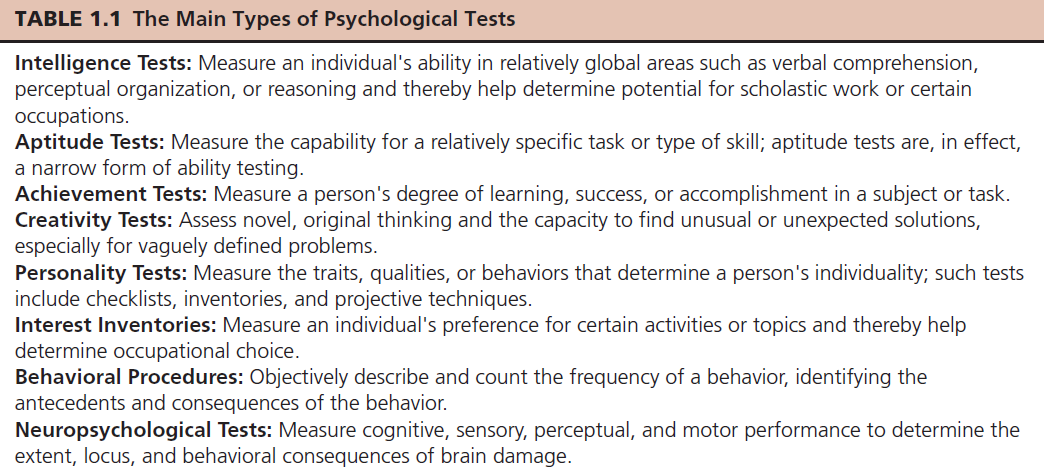
image of the 8 main test types
Purpose of testing = classification
Placement (into a group)
Screening (identify certain ppl from group)
Certification (pass/fail- exams)
Diagnosis
WAIS-IV: The materials for the subtest include nine blocks (cubes) colored red on two sides, white on two sides, and red/white on two sides. The examinee’s task is to use the blocks to construct patterns depicted on cards. For the initial designs, four blocks are needed, while for more difficult designs, all nine blocks are provided.