8 - Electromagnetic Waves (Schley)
Page 1: Agenda
Announcements: Review miscellaneous updates and reminders.
Finish from Last Class: Complete outstanding worksheets on previous topics.
Electromagnetic Waves Notes: Lecture on electromagnetic waves; duration: 25 minutes.
Brain Break: Short activity to refresh and engage (5-10 minutes).
Spectroscope Activity: Hands-on analysis of data collected from various light sources; duration: 25 minutes.
Day 8 Focus: Detailed exploration of the Electromagnetic (EM) Spectrum.
Page 2: Electromagnetic Waves
Definition:
Electromagnetic (EM) waves are transverse waves that transport electromagnetic energy through space.
Characteristics:
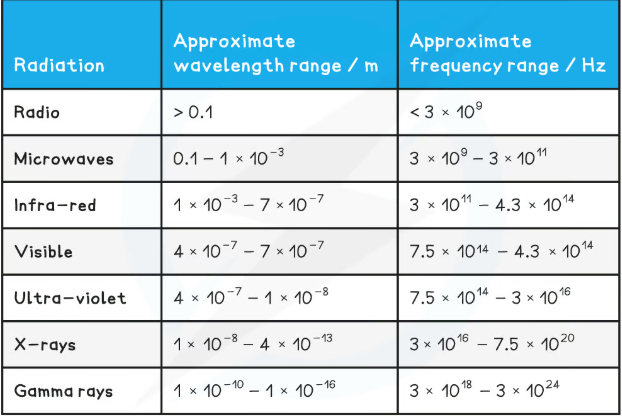
Wavelength Range: Embraces a broad spectrum from long-wavelength radio waves to short-wavelength gamma rays.
Medium of Travel: Unlike mechanical waves, EM waves have the unique ability to travel through the vacuum of space, making them essential for cosmic communication.
Speed of Light: All EM waves propagate at the speed of light in a vacuum, approximately 3 x 10^8 meters per second.
Visible Light Detection: The human eye is equipped to detect only a narrow portion of the EM spectrum called visible light, which ranges from approximately 400 nm (violet) to 700 nm (red).
Page 3: The EM Spectrum
EM Spectrum Overview:
Illustrates the entire range of electromagnetic waves categorized by their wavelength.
Drawing Task:
Create a detailed drawing of the EM spectrum in your notebook, and be sure to indicate:
Waves with the longest wavelength (Radio waves).
Waves with the shortest wavelength (Gamma rays).
The precise wavelength range of visible light.
Page 4: Wavelength and Frequency
Discussion Task:
Utilize provided data tables to investigate the inverse relationship between wavelength and frequency in the EM spectrum.
Explanation Example:
"As wavelength decreases, frequency correspondingly increases due to the constant speed of light. For instance, radio waves with longer wavelengths have lower frequencies, while gamma rays with shorter wavelengths have much higher frequencies."
Page 5: What is an Electromagnetic Wave?
Composition:
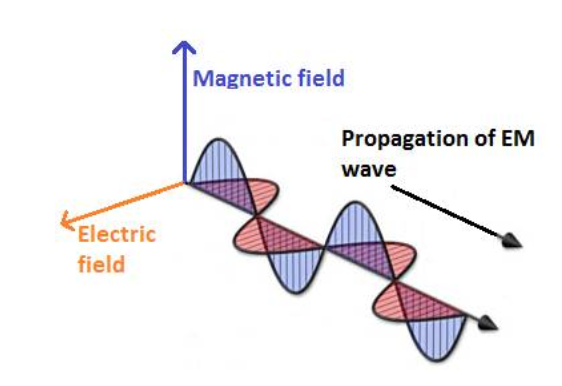
EM waves consist of oscillating electric and magnetic fields, which oscillate perpendicularly to each other and to the direction of wave propagation.
Generation:
An electric field is generated when charged particles, such as protons in a nucleus, undergo motion.
A changing electric field induces a changing magnetic field, establishing an interlinked relationship between the two fields.
Page 6: EM Waves Interact with Matter
Types of Interaction:
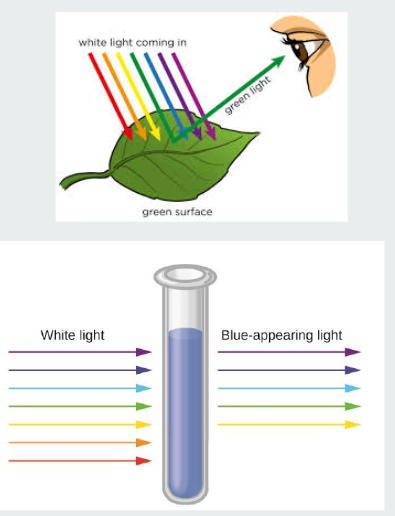
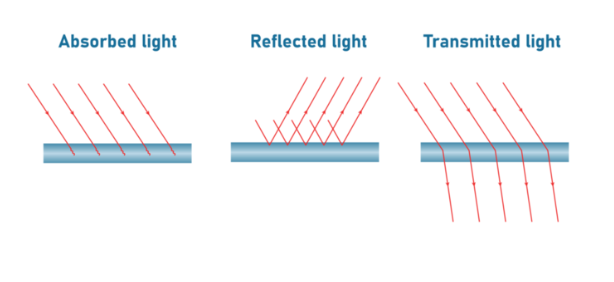
Reflection: The phenomenon where visible light bounces off surfaces, allowing visibility.
Absorption: When light is absorbed by a material, it often generates thermal energy (heat).
Transmission: The capacity of light to pass through a medium without being absorbed.
Analysis Task:
Examine provided examples and identify instances of absorption, reflection, and transmission.
Page 7: Spectroscope Activity (Analyzing Data)
Function:
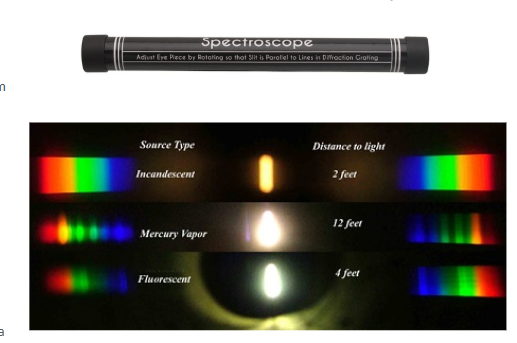
A spectroscope is a crucial observational instrument for analyzing the color components present in various light sources.
Observation Tasks:
Utilize the spectroscope to observe light behavior across different sources, such as:
Fluorescent lights
Incandescent bulbs
Light from computer screens
Reflections on surfaces
Light transmitted through various liquids
Natural light from the sky.
Caution: Avoid looking directly at the sun or lasers through the spectroscope to prevent eye injuries.
Make comprehensive written observations along with sketches of each light source, and respond to three specific analysis questions from your handout in your notebook.
Page 8: Interaction of Solar EM Waves with Earth
Question:
How do the electromagnetic waves emanating from the sun interact with various forms of matter present on Earth?
Page 9: Solar EM Waves and Earth's Atmosphere
Components of Solar EM Waves:
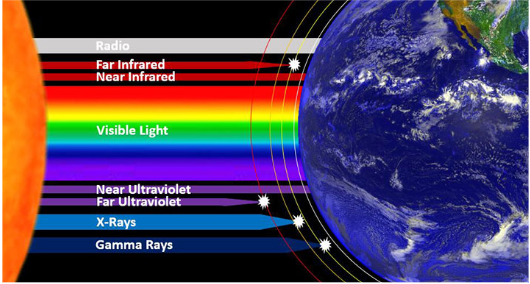
Include wavelengths such as Gamma rays, X-rays, Ultraviolet (UV) light, Visible light, Infrared (IR), and Radio waves.
Atmospheric Blockage:
Certain wavelengths are obstructed by Earth’s atmosphere and magnetic field, limiting some types of radiation.
Reachable Radiation: UV light, visible light, infrared, and radio waves successfully reach Earth's surface.
Discussion Task: Elaborate on the various forms of solar radiation that reach Earth with regard to their respective wavelengths and frequencies.
Page 10: The Ozone Layer
Function:
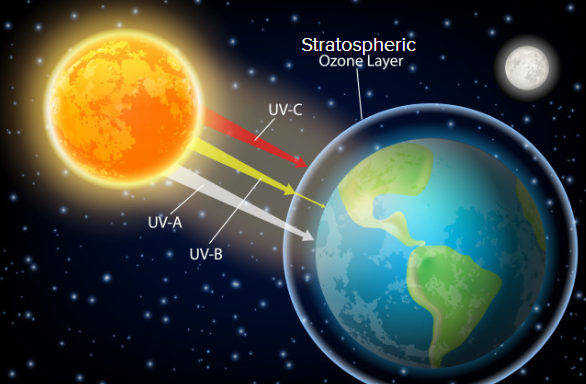
The ozone layer located in the stratosphere serves a critical role by absorbing the majority of harmful ultraviolet (UV) radiation from the sun.
Risks of UV Radiation:
Ultraviolet light is categorized as ionizing radiation and poses risks such as:
Skin cancer
Damage to plant life
Development of cataracts and other eye conditions.
Discussion: Explore the potential consequences for life on Earth if the ozone layer were to sustain damage.
Page 11: The Greenhouse Effect
Process:
Infrared radiation (IR) is emitted from the Earth’s surface, where it is subsequently absorbed by greenhouse gases such as carbon dioxide (CO2). These gases then re-emit IR energy, causing warming of the atmosphere.
Discussion: Contemplate the implications for Earth’s atmosphere if concentrations of greenhouse gases were to increase significantly.
Page 12: Albedo and Light Reflection
Concept:
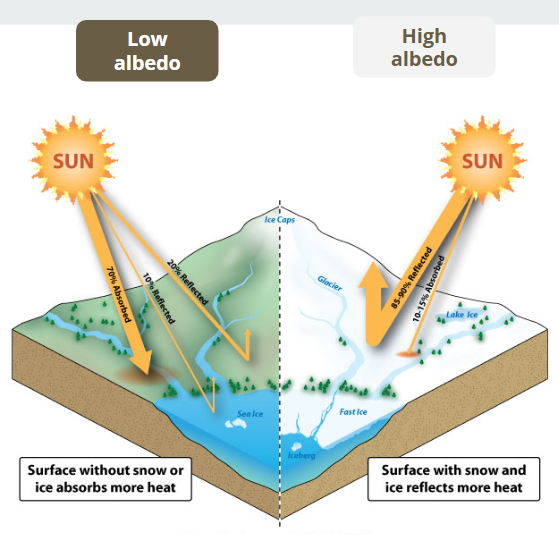
Lighter surfaces, such as snow and ice, tend to reflect light more effectively than darker surfaces, which absorb light.
Albedo:
High albedo is noted with snow and ice as they reflect a significant portion of light away from Earth.
In contrast, dark surfaces exhibit low albedo and absorb considerable light and heat, contributing to temperature increases.
Discussion: Consider the effects on Earth’s climate if the polar ice caps were to melt significantly, altering the natural albedo effect.