Chapter 19 Demand for Money
Overview
This chapter examines the quantity theory of money and its connection to the demand for money.
It addresses the relationship between interest rates and the demand for money.
It poses the question: What is your money demand?
Understanding inflation necessitates modeling both the supply and demand for money.
Learning Outcomes
Assess the relationship between money growth and inflation in both the short run and long run as indicated by the quantity theory of money.
Identify under what circumstances budget deficits can lead to an inflationary monetary policy.
Summarize the three motives that underpin the liquidity preference theory of money demand.
Identify the factors inherent in the portfolio choice theory of money demand.
Assess and interpret the empirical evidence regarding the validity of both the liquidity preference and portfolio theories of money demand.
Reasons for Holding Money
Convenience: People hold money for ease of transactions.
Opportunity Cost: Holding money carries an opportunity cost.
The chapter fundamentally discusses the balance between these two factors.
Factors Affecting Demand for Money
The demand for money can be influenced by various factors:
Transaction Costs:
Higher ATM fees lead individuals to withdraw more money per transaction.
The internet reduces transaction costs, leading to lower cash balances in checking accounts.
Real GDP:
As money is used for purchases, an increase in GDP increases the demand for money corresponding to more goods to buy.
Real Interest Rates:
As nominal interest rates rise (inflation + real rates), the opportunity cost of holding money increases.
Inflation Rates:
An apparent counterintuitive point: if prices double, a person needs double the amount of money to purchase the same basket of goods.
Price Level:
The relationship between price levels and money demand maintains that higher prices necessitate higher money holdings.
Money Market Dynamics
Money Market Graph representation shows supply and demand for money:
Supply of Money (Ms)
Demand for Money (Md)
Price Level (P)
The equilibrium price level (P*) aligns the demand for money and the supply of money.
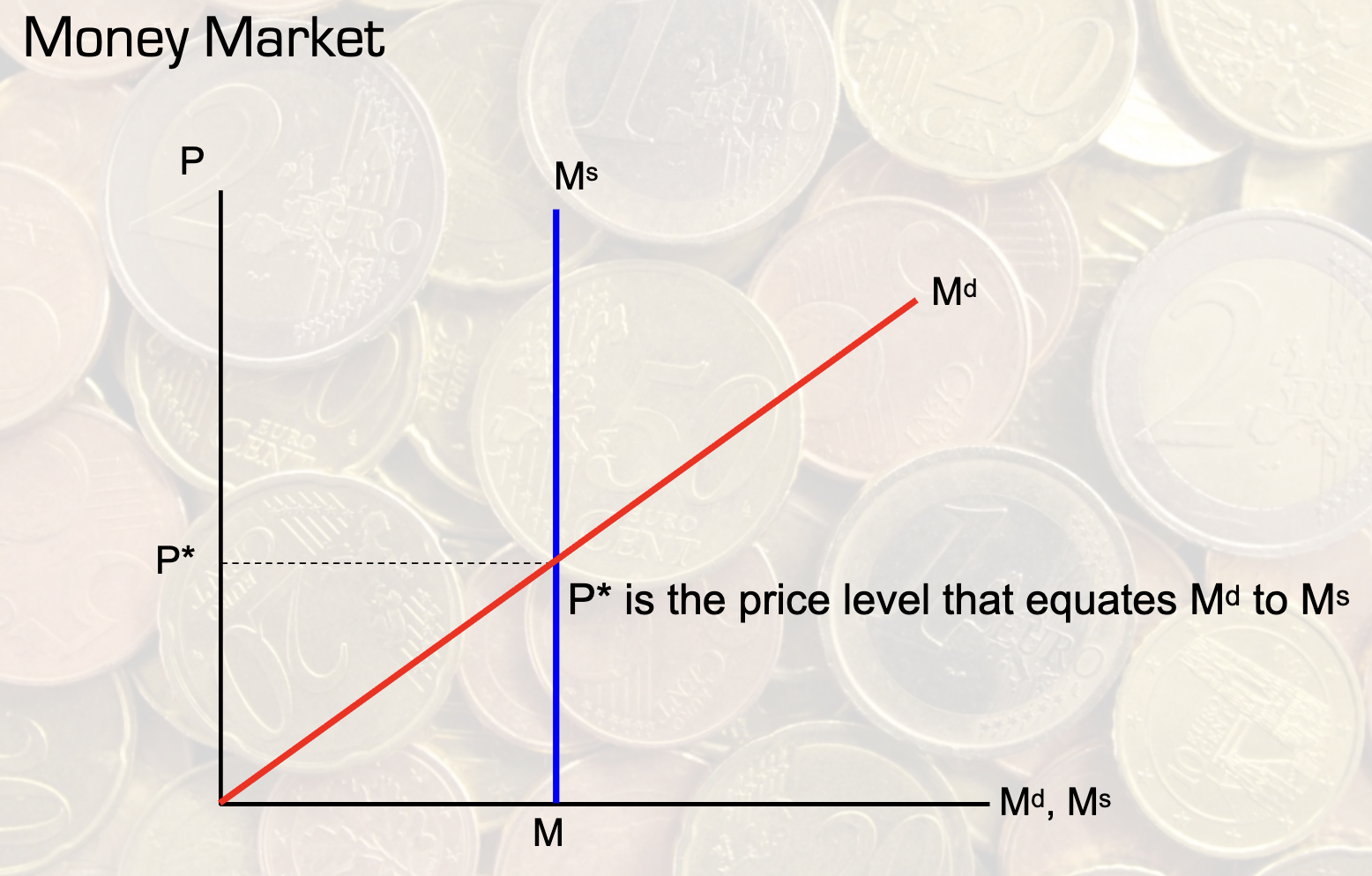
Price Level Definition: The average price of all goods and services, equilibriating the money supply and demand.
Adjustments occur to restore equilibrium when the market is out of balance.
Effects of Increased Money Supply
If the money supply increases without a corresponding increase in money demand, people will attempt to spend excess money, increasing overall prices and potentially the price level.
Impact of Economic Growth on Demand for Money
An increase in RGDP generally raises money demand.
If money supply does not change, the price level must fall accordingly to restore balance.
Importance of an independent central bank to control the money supply and address price level fluctuations caused by sudden increases in money.
Monetary Policy Implications
The Federal Reserve closely monitors changes in money demand to adjust the money supply accordingly to maintain stable prices.
Strategies employed by the Fed:
To increase money supply: Buy bonds
To decrease money supply: Sell bonds
Quantity Theory of Money
The quantity theory of money posits the relationship described in the equation:
Where:
= Money Supply
= Velocity of Money
= Price Level
= Aggregate Output (Income)
Variations in money demand directly influence the velocity of money (V).
With fixed V and Y, an increase in necessitates a rise in .
The theory posits that variations in money supply affect only the price level in the long run, thus showing that changes in the money supply lead to price level adjustments without affecting output in the long-run scenario.
Inflation Equation
The relationship linking inflation rate to money and output growth can be formulated:
Recognizing inflation () as the growth rate of the price level, we can derive:
= %\Delta M - %\Delta Y
Testing the Quantity Theory of Inflation
Several observations correlate high money growth rates with elevated inflation rates observed in historical data (1970s, 1980s) indicating a long-term consistency in the theory.
A graphical representation would illustrate how decades of high money growth align with high inflation rates.
Budget Deficits and Inflation
Generally, budget deficits do not result in inflation in countries with independent central banks, provided that the public buys sufficient bonds to finance deficits.
If the Federal Reserve purchases government bonds, it raises the monetary base, subsequently increasing the money supply, possibly creating inflation.
Keynesian Theories of Money Demand
Three motives for holding money according to Keynes:
Transactions Motive: Money held for ordinary transactions.
Precautionary Motive: Money held for unforeseen circumstances.
Speculative Motive: Money held for investment purposes.
The evolving payment technology influences money demand by altering the convenience of liquid forms of wealth.
Keynes allowed variability of velocity in the short term, where shifts in the real interest rate or inflation rate may alter money demand.
Key Determinants of Money Demand
A chart summarizing the factors that impact money demand and the direction of their effects such as changes in interest rates or inflation risk illustrates:
Interest Rates: An increase leads to decreased money demand due to increased opportunity cost.
Income: An increase results in higher money demand (greater transactional value).
Payment Technology: An advancement leads to decreased need for physical money.
Wealth: Higher wealth corresponds to increased money demanded for transactions.
Riskiness of Other Assets: As risk increases for alternative assets, money becomes relatively safer, increasing demand.
Practice Exercises
Draw the Money Market before and after:
An increase in RGDP
The introduction of electronic banking
Expectations of future inflation rises
A decrease in real interest rates
For each, analyze and articulate the anticipated impact on the price level without Federal Reserve intervention.