Lifespan & Development
Development: a branch of psychology that looks at patterns of growth and change occurring throughout life
Challenges Previous belfies of development occurring in infancy and and adolescent (viewed as the only interesting periods of growth and change)
Examines the interaction between unfolding of biologically predetermined patterns of behaviour and the changing, dynamic environment
Examines how our genetics influence our behaviour throughout our lives
What is the current developmental psychology perspective on the relationship between nature and nurture (genes and environment)?
Rather than asking nature vs nurturing, we how ask/should be asking what degree do environment and heredity both produce their effects
Heredity: influences based on the genetic makeup of an individual which influences growth and development
Environment: influences of parents, sibling, friends, schooling, nutrition, and all other experiences which the child is exposed to
Twin studies and nature/nurture
Twins are important information relating heredity and environment
If identical twins (share 100% same genetic makeup) display different patterns of development, this is because of variations in environment
Most useful data comes from identical twins who were separated from birth
Both genes and environment have an influence on development
Developmental psychology research techniques (cross-sectional, longitudinal, sequential).
Cross sectional research: compares people of different ages at the same point in time (snapshot)
It provides information about different in development between different age groups
Longitudinal: traces the behaviour of the same groups of participants over a period of time as they age
Difficult
Time constraints
Expensive
Participants drop out of the study
Despite this, this is the most Ideal form of study
Sequential research: combine scores-sectional and longitudinal approaches by taking a number of different age groups and examining them several points at time
The key variable of development research which is difficult to control is age being fixed
Stages of prenatal development (germinal, embryonic, fetal).
Zygote: the new cell formed by the union of an egg and sperm at the time of conception.
The germinal period = first 2 weeks after conception where the zygote increases to 100–150 cells within a week after fertilization.
Embryo: developed zygote with heart, brain, other organs.
Develops through an intricate, preprogrammed process of cell division during the embryonic period (week 2 through week 8).
By week 4, it has a rudimentary beating heart, brain, intestinal tract, and several other organs.
Fetus (the fetal period) is a developing individual from 8 weeks after conception until birth
Age of viability: point at which a fetus can survive if born prematurely (about prenatal age of 22 weeks).
Severely early, needs a lot of support after birth, possibility of birth defects
If born at this age, it can open and close its eyes; suck; cry; look up, down, and around; and even grasp objects placed in its hands.
Preterm infants are those who are born before week 38.
Because they have not been able to develop fully, they are at higher risk for illness, future problems, and even death.
Critical periods of development and the impact of teratogens like drugs, infections, and malnutrition).
Before birth, a fetus passes through several sensitive periods, which are times during development when specific events (or stimuli) have their greatest impact. These are also environmental effects for development (nurture)
/
Certain developing systems are vulnerable to a mother’s use of drugs, for instance, during certain sensitive periods before birth, and less so before or after that sensitive period.
Teratogens = legal and illegal drugs, alcohol, and radiation can alter or harm the development of the unborn baby’s body or brain.
Timing of exposure may determine the significance of the impact, and which bodily systems are affected.
Illness: Diseases that have a relatively minor effect on the mother can have devastating consequences for a fetus if they are contracted during the early part of a pregnancy.
Drug use: Mothers who take illegal, physically addictive drugs run the risk of giving birth to babies who are similarly addicted.
Alcohol use: Fetal Alcohol Spectrum Disorder (FASD) effects range from mild to severe and include physical abnormalities, sensory integration variables, learning disabilities, and/or behavioural issues, which are incurable.
There is no safe level of alcohol intake during pregnancy
Affects 9 out of 1000 babies born in Canada
Reflexes in neonates/newborns.
Reflexes
Unlearned, involuntary responses that occur automatically through the presence of stimuli
Rooting reflex: causes newborn (neonates) to turn their heads towards whatever touches their cheek
Sucking reflex: prompts infant to suck things that touches it’s lips
Gag reflex: clearing of throat
Startle reflex: series of movement where an infant flings its arms out, fans out its fingers, and arches it back in response to a sudden noise
/
Attachment: what it is, how it is formed with primary caregivers, types of attachment styles, etc. Lorenz’s work on importing. Harlow’s monkey studies. Bowlby’s Attachment Behavioral System. Ainsworth’s strange Situation Task. Hazan and Shaver’s adult attachment styles.
Attachment: emotional bonds with another evidenced by seeking closeness to the caregiver and displaying distress on separation.
Evolutionary advantageous to bond with those who feed you, change your diapers, comfort you.
Profound deprivation of attachment associated with cognitive and emotional impairment.
Causes for attachment
Proximity
Imprinting
Likeness
Imprinting and attachment: Ethologist Konrad Lorenz
Focused on newborn goslings, who instinctively follow their mother, the first moving object to which they are exposed.
Found goslings whose eggs were raised in an incubator and who viewed him immediately after hatching would follow his every movement, as if he were their mother.
He labeled this process imprinting: behaviour that takes place during a critical period and involves attachment to the first moving object that is observed.
Harlow's Monkeys: Importance of contact
Studied infant rhesus monkeys (our close genetic relatives) which he separated from their mothers only hours after birth.
Placed them in a cage with two fake mothers:
one wire mom, and one terrycloth mom.
Would feed from wire mom, preferred contact with cloth mom
When frightened, they sought out the contact comfort of a cloth mom.
Bowlby on Attachment
Infants must be biologically programmed to emit behaviours that trigger affectionate responses from caregivers (e.g., crying, clinging).
Adults/caregivers must be biologically programmed to respond to such behaviours with care and nurturance.
The greater the responsiveness of the caregiver to the child's signals, the more likely the child will become securely attached.
The infant plays just as active a role as the caregiver forming bonds.
Reciprocity builds attachment = Infants who respond positively to a caregiver produce more positive behaviour from caregiver, which in turn produces an even stronger degree of attachment in the child.
When babies cry, their brain is flooding with stress hormones, parents also response with stress hormones. It is not good for parents to let babies cry it out as babies are still flooded with stress hormones as their emission of cries did not work. They cannot self-soothe. This interferes with reciprocal attachment.
Ainsworth’s The Strange situation: Used separation anxiety as a proxy or measure of attachment.
Sequence of events involving a child and their mother, where the child's reactions to the experimental situation vary drastically, depending on their attachment to the mother:
Securely attached: explore independently but returning to their mother occasionally, exhibit distress when she leaves, and go to her when she returns.
Avoidant: do not cry when the mother leaves, avoid her when she returns, as if they were indifferent to her.
Ambivalent: display anxiety before separation and are upset when the mother leaves, but they may show ambivalent reactions to her return.
Disorganized-disoriented: show inconsistent, contradictory behaviour.
Hazan and Shaver’s adult attachment styles
Infant attachment relationships lead to internal working models about adult relationships.
Securely attached children grow into well-adjusted adults with positive schemas about relationships, solid sense of self worth. e.g. set healthy boundaries & expectations, not codependent
Insecurely attached children struggle with adult relationships, as their schemas are flawed, sense of self worth is inconsistent or absent. e.g., have porous boundaries, low expectations, have enmeshed or co-dependent relationships
Erikson’s psychosocial stages (e.g., what is the crisis or challenge that must be resolved at each stage). Piaget’s stages of cognitive development (e.g., what is the key challenge they should effectively navigate by the end of each stage).
Erikson’s Stages of Psychosocial Development
Erikson viewed developmental changes occurring throughout life as a series of 8 stages of psychosocial development, of which 4 occur during childhood.
Psychosocial development = changes in our interactions and understanding of one another as well as in our knowledge and understanding of ourselves as members of society.
Erikson suggests that passage through each of the stages necessitates the resolution of a crisis or conflict. Each crisis is never resolved entirely, but it has to be resolved sufficiently to equip us to deal with demands made in the next stage.
Trust versus mistrust: (Birth to 1.5 years)
Infants develop feelings of trust or lack of trust, based on interaction w/primary caregivers. Sense of trust to the world.
Autonomy versus shame and doubt: (1.5 to 3 years)
Toddlers stage: develop independence and autonomy if exploration and freedom are encouraged, or shame and self-doubt if they are restricted and overprotected.
Parents are trying to make children potty-trained
Social behaviours like not making inappropriate actions
Independence or restriction
Initiative versus guilt : (3 to 6 years)
Children experience conflict between independence of action and the sometimes-negative results of that action.
Freedom of actions, allowing to learn
Let them learn about actions and the consequences
Industry versus inferiority: (6 to 12 years)
Children may develop positive social interactions with others or may feel socially inadequate.
Friendships and relationships, helping children develop feeling socially adequate like having relationships
Piaget’s Theory of Cognitive Development
Children aren’t mini adults, very different cognitive processees
nor are they passive recipients of experience
Development involves transitional periods (stages) that children must pass through on their way to more adult-like thinking.
Children are motivated to match their experiences with their beliefs about the world (schemas)
They engage in assimilation and accommodation.
Assimilation: incorporating new experiences into current understanding.
qSchema remains unchanged, relatively low cognitive effort required.
For instance, defining things that are in the air are birds.
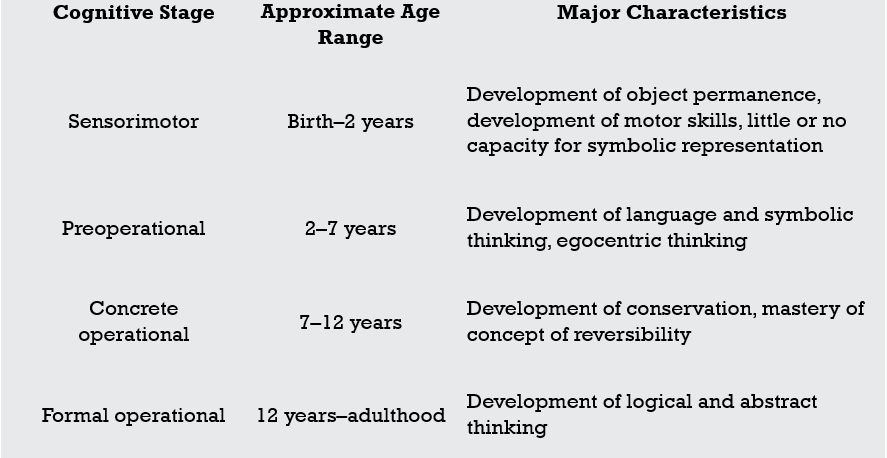
/
Vygotsky’s views on scaffolding and the zone of proximal development.
Vygotsky’s Cognitive Development View: Zone of proximal development: what a children do on their own, what they can do, find a sweet spot and work on it. Cognitive development occurs as a result of social interactions in which children work with others to solve problems.
Through such interactions, children’s cognitive skills increase, and they gain the ability to function intellectually on their own.
Children’s cognitive abilities increase when they encounter information that falls within their zone of proximal development
ZPD = The level at which a child can almost, but not fully, comprehend or perform a task on his or her own.
For instance, parents doing homework for their child
It may seem nice, however, they are not going to learn
Finding the sweet spot, what do they already know, what do they not, and implement both together to learn
Achieved through use of scaffolding of learning
When children receive information that falls within the ZPD, they can increase their understanding or master a new task.
Emerging adulthood and challenges of modern adulthood (see my slides)
Emerging adulthood: The period beginning in the late teenage years and extending into the mid-20s). Different as life now is different
During this period, people are no longer adolescents, but they haven’t fully taken on the responsibilities of adulthood either.
Instead, they’re still engaged in determining who they are and what their life and career paths should be.
Housing more expensive
Education more important
Job market is competitive
Changes in intelligence and memory in older adulthood
Intelligence in older adults remain stable, but some decline
Memory decline occurs during late adulthood
Epsoideic memory loss, semantic and implicit memories retained loss
Disengagement and activity theory in older adults.
Disengagement Theory: aging can produce a gradual withdrawal from the world on physical, psychological, and social levels.
Provides opportunity for increased reflection and decreased emotional investment in people beyond their immediate circle.
Activity Theory: people who age most successfully are those who maintain their interests, activities, and level of social interaction.