The Electromagnetic Spectrum:
{{*The entire range of possible wavelengths → electromagnetic spectrum*{{
The Sun:
In simple terms is a big nuclear furnace. Inside its core, there is an intense gravitational pressure that fuses hydrogen into helium which then releases energy in the form of electromagnetic radiation. → Photons Carry this energy in the form of waves.
Photons:
<<Formulas:<<
| E=hv | c=λv | E= hc/ λ |
|---|
E= Energy (Joules)
h= Planks Constant= 6.626 x 10 ^-34 (J x s)
v= Frequency (Hz)
λ= wavelength (nanometers (10^-9 meters))
c= speed of light = 3 x 10 ^8 (m/s)
{{Photons are particles that carry electromagnetic energy in the form of waves.{{
The more energy a photon carries the faster it oscillates.
Oscillation: to move back and forth in a regular, repeating way
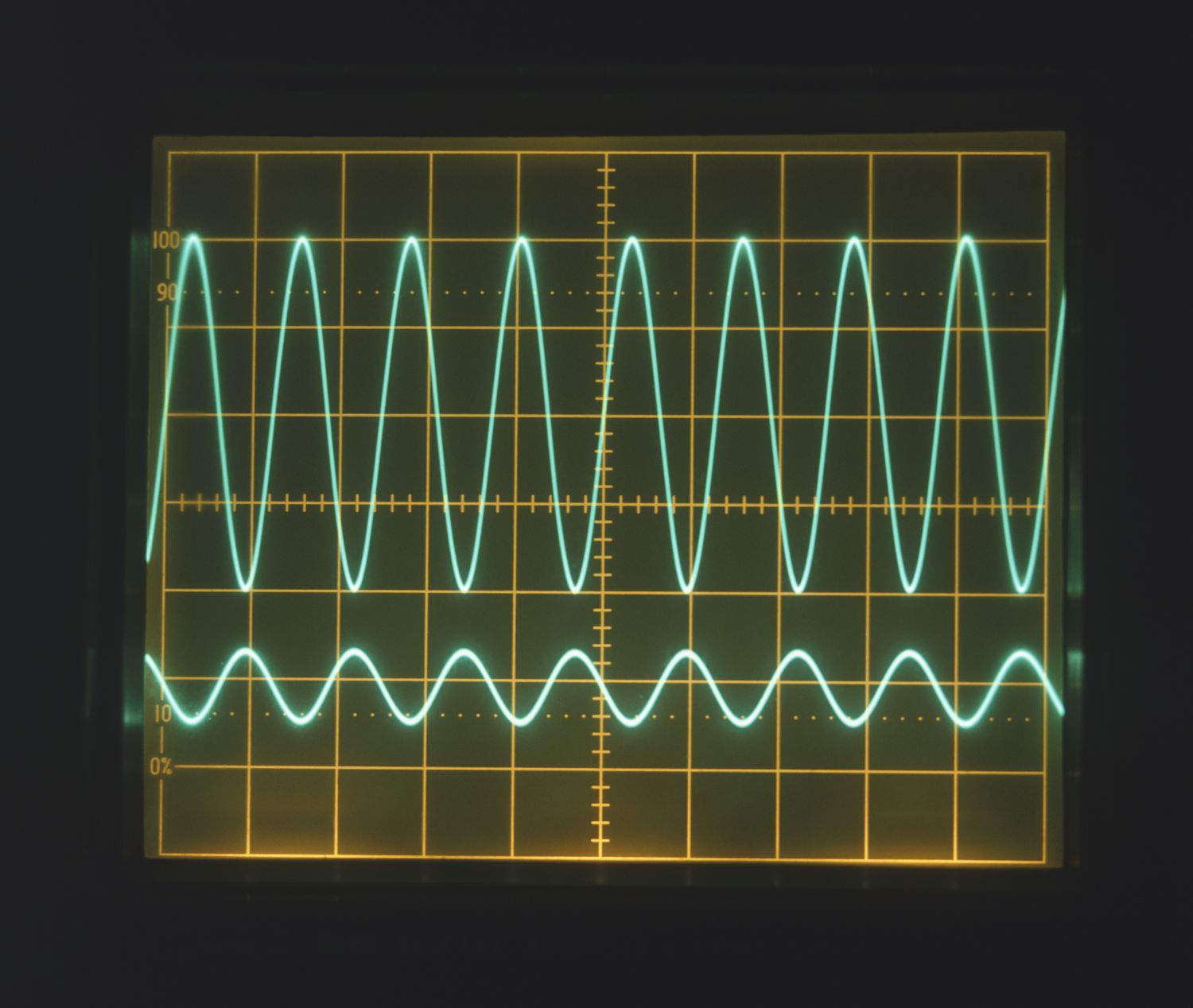
Waves:
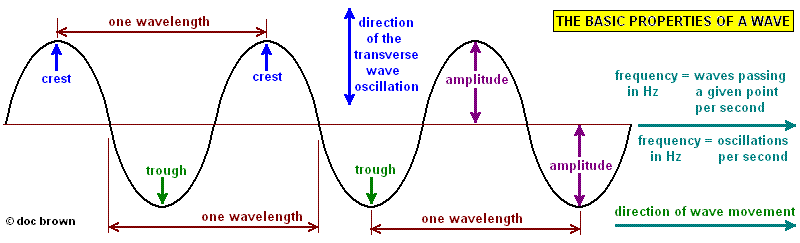
General Facts:
- Wavelength is measured in nanometers (10^-9 meters)
- {{Even though there is a wide range of types of electromagnetic waves, only some are visible to the eye→ “Visible Spectrum”{{
- In the early 1600s scientists first learned to magnify light with glass lenses.
Parts of a Wave:
Crest: the highest point of the wave Trough: the lowest point of the wave Period: the distance between a consecutive crest and trough, measured in unit time Wavelength: the distance between consecutive waves or consecutive troughs Amplitude: the vertical distance between the crest and the trough
Frequency: the number of waves that pass a fixed point in a given amount of time.
*Higher Frequency →Louder → Brighter Light*
Lower Frequency → Quiter → Dimmer light
<<f= 1/ T<<
- \
- <<Frequency→Hz<<
- <<T= period→second<<
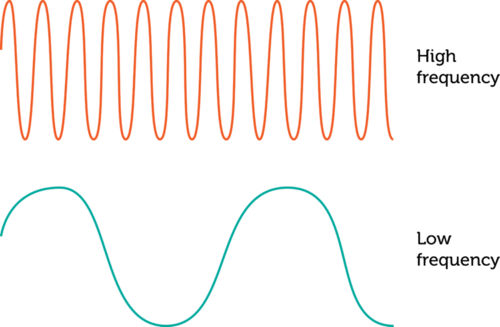
Period: The time it takes for two successive crests (one wavelength) to pass a specified point.
- <<T= 1/f<<
Types Of Waves
Transverse waves: in which the individual particles of the wave move perpendicular to the axis.
Longitudinal waves: in which the individual particles of the wave move parallel to the axis.
Types Of Electromagnetic Radiation
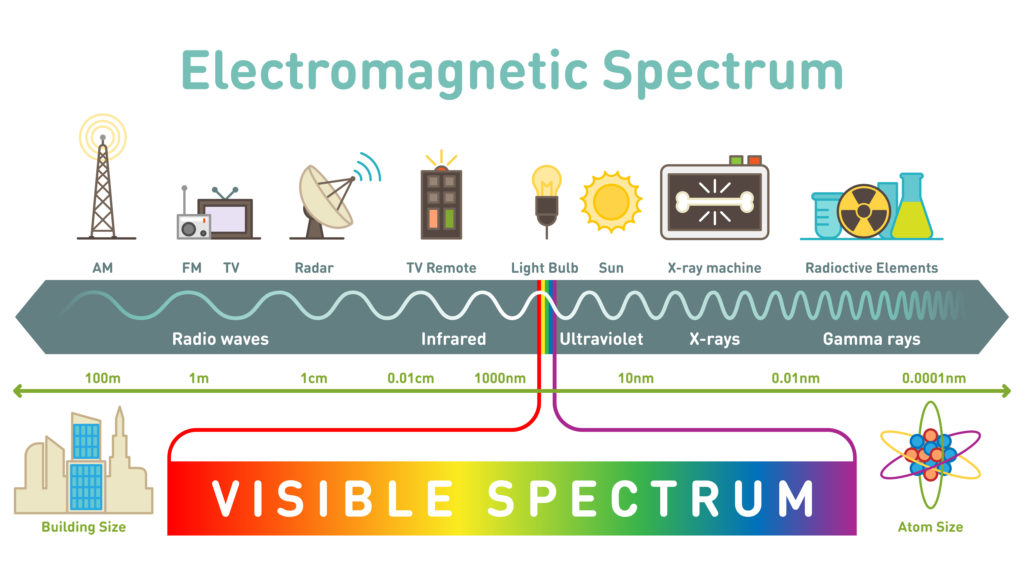
- Radio Waves: Heinrich Hertz proved its existence in the late 1880s.
- They have the least energy→ and safest waves on the spectrum.
- Longest wavelength; 1 mm
- Lowest frequency and range→ 3 KHz to 300 GHz
- They have the least energy→ and safest waves on the spectrum.
ex. T.V., FM and AM, phones, wireless computers,s and networks.
- Microwaves: Right after radio waves, low in energy.
- They can be reflected by metal. Passes through glass, paper, and plastic.
- Wavelength: 1mm to 1m
- Frequency: 300 GHz to 300 MHz
ex. Cell phones and microwaves <- high frequency/ energy causes any item to heat electrical and magnetic waves that are often used to heat things.
- Visible Light: Infrared and ultraviolet are slightly different versions of red and violet light respectively; the visible light range fits in between them.
- A change in heat can change color.
- Visible light can be found all around us since it comes from the sun.
- Wavelength: 400 nm-700nm
- Frequency: 400THz-700THz
ex. Photography, phones, laptop, and T.V.s
- Ultraviolet Rays: between visible light and x-rays; towards the left.
- 2 types of UV:
- UVA: longer wavelengths
1. cause skin aging and eye damage, lowering your body’s ability to fight off illness and skin cancer. 2. UVB: shorter wavelengths
- Wavelength: 10-400 nm
- Frequency: 800 THz
ex. Lamps, lasers, and medication
- Gamma Rays: Far right of the spectrum.
- Highest energy
- The strongest form of radiation
- Wavelength: <10^-12
- Frequency: 3x 10^-18 → 5 x 10 ^22
ex. found in supernova explosions, neutrons stars, and around black holes. Can be used in medicine; radiotherapy and sterilization.