EARTH SCIENCE.docx
Notes
Introduction
Earth science studies the dynamic Earth and its processes, properties, structures, and relationship with its neighbors in space.
It can be condensed down into four main disciplines: geology (the study of earth materials), meteorology (the study of the atmosphere), oceanography (the study of oceans), and astronomy (the study of celestial bodies).
1. Earth’s Vital Statistics and Earth Systems
- Age: 4.543 billion years old
- Equatorial circumference: 40,075 km
- Equatorial radius: 6,378 km
- Polar radius: 6,356 km
- Total mass: 5.972 x 10^24 kg
- Total volume: 1.08 x 10^12 km^3
- Total surface area: 5.10 x 10^8 km^2
- Average density: 5.513 g/cm^3
a. Atmosphere
- A collective layer of gas that envelops the Earth.
- The atmosphere is essential to life on Earth because (1) It shields the Earth and its inhabitants from harmful ultraviolet (UV) radiation from the Sun; (2) it maintains the warmth of the Earth’s surface; and (3) it contains all of the essential gases needed to support life.
b. Hydrosphere
- It refers to the bodies of water consisting of freely flowing bodies of water found on the surface of the Earth, as well as water reservoirs stored below the ground as groundwater.
- This sphere covers nearly 71% of the Earth’s surface.
- 97.4% are salt water. 2.6% comprises fresh water, and only 1.2% of which is drinkable.
c. Biosphere
- The biosphere refers to the narrow band on the Earth’s surface where all biological life resides.
d. Geosphere
- The geosphere is the largest out of all the spheres, extending from the surface of the Earth down to its center.
FUN FACT:
- Soil can be considered the interface of the four spheres. It is made up of weathered or broken down rock (geosphere), organic matter or humus (biosphere), moisture (hydrosphere), and air (atmosphere).
2. The Layers of the Earth and Its Composition
- The Earth can be subdivided into layers based on two criteria: (1) (chemical) composition (density) differences and (2) physical properties.
a. Based on Compositional Differences (CHEMICAL LAYER)
- Crust
- This is the thinnest and outermost layer of the Earth. There are two types of crust– the continental and oceanic crust.
- The continental crust is the older and more buoyant type of crust. It has an average composition of granite with a 2.7 g/cm3 density. (COG)
- The oceanic crust is the younger and denser type of crust. It comprises a 3.0 g/cm3 density of basalt and gabbro. (OYBG)
- Mantlec
- It comprises most of the Earth’s volume (more than 80%).
- Mohorovicic discontinuity is the boundary between the crust and mantle.
- The upper and lower mantle are separated by the Repetti discontinuity.
- Core
- The boundary between mantle and core is the Gutenberg discontinuity.
- Its composition comprises a Fe-Ni (iron and nickel) alloy.
b. Based on Physical Properties (PHYSICAL LAYER)
- Lithosphere (C&UM)
- It came from the Greek word lithos meaning “stone”.
- A thick and brittle layer comprising the entire crust and uppermost layer of the upper mantle.
- Asthenosphere (LUM)
- It came from the Greek word asthenēs meaning “weak”.
- A mechanically weak layer consisting of the lower portion of the upper mantle.
- It is not a “sea of molten rock.” It comprises an Mg- and Fe-rich rock called peridotite.
- Plate tectonics is driven by the movement and flow in the asthenosphere.
- Mesosphere (LM)
- It came from the Greek word mesos meaning “middle”.
- It comprised the lower mantle.
- The dominant rock type in this layer is a silicate rock called perovskite.
- Outer Core
- It is the only one made out of liquid - melted Fe-Ni alloy.
- The flow of liquid metals is responsible for the Earth’s magnetic field. (Geodynamo)
- The outer-inner core boundary is also known as the Lehmann discontinuity.
- Inner Core
- Despite the extreme temperature, the overwhelming pressure in this layer forces the inner core to be a solid ball of mostly Fe.
- Temperatures in the inner core are similar to the temperatures of the surface of the Sun—around more than 5400°C.
3. Minerals
These are the building blocks of rocks. To be considered a mineral, it must be the following:
- Naturally-occurring: Man-made materials cannot be considered real minerals.
- Inorganic: Organic materials such as pearls or sugar are not minerals.
- Homogeneous solid: Minerals should be crystalline solids. Mercury occurs as a liquid in its natural state and is regarded as a mineraloid.
- Has definite chemical composition: You should be able to describe a mineral’s composition using a chemical formula.
- Ordered crystalline structure: Atoms in a mineral are placed in a repetitive and orderly manner. Substances that lack this kind of atomic structure, such as obsidian (volcanic glass) or plastic, are not considered minerals.
Properties of Minerals
- Color: It refers to the wavelengths of light reflected by the minerals. It is the least valuable property because many minerals can occur in different colors.
- Luster: It describes how light is reflected from the mineral’s surface. A mineral could have a metallic luster or nonmetallic luster. Brilliantly cut gems are described to have an adamantine luster.
- Crystal Habit or Shape: This refers to the shape of each crystal or an aggregate of crystals.
- Streak: This is the color of the mineral when it is powdered. Some minerals have different streak colors than their apparent color.
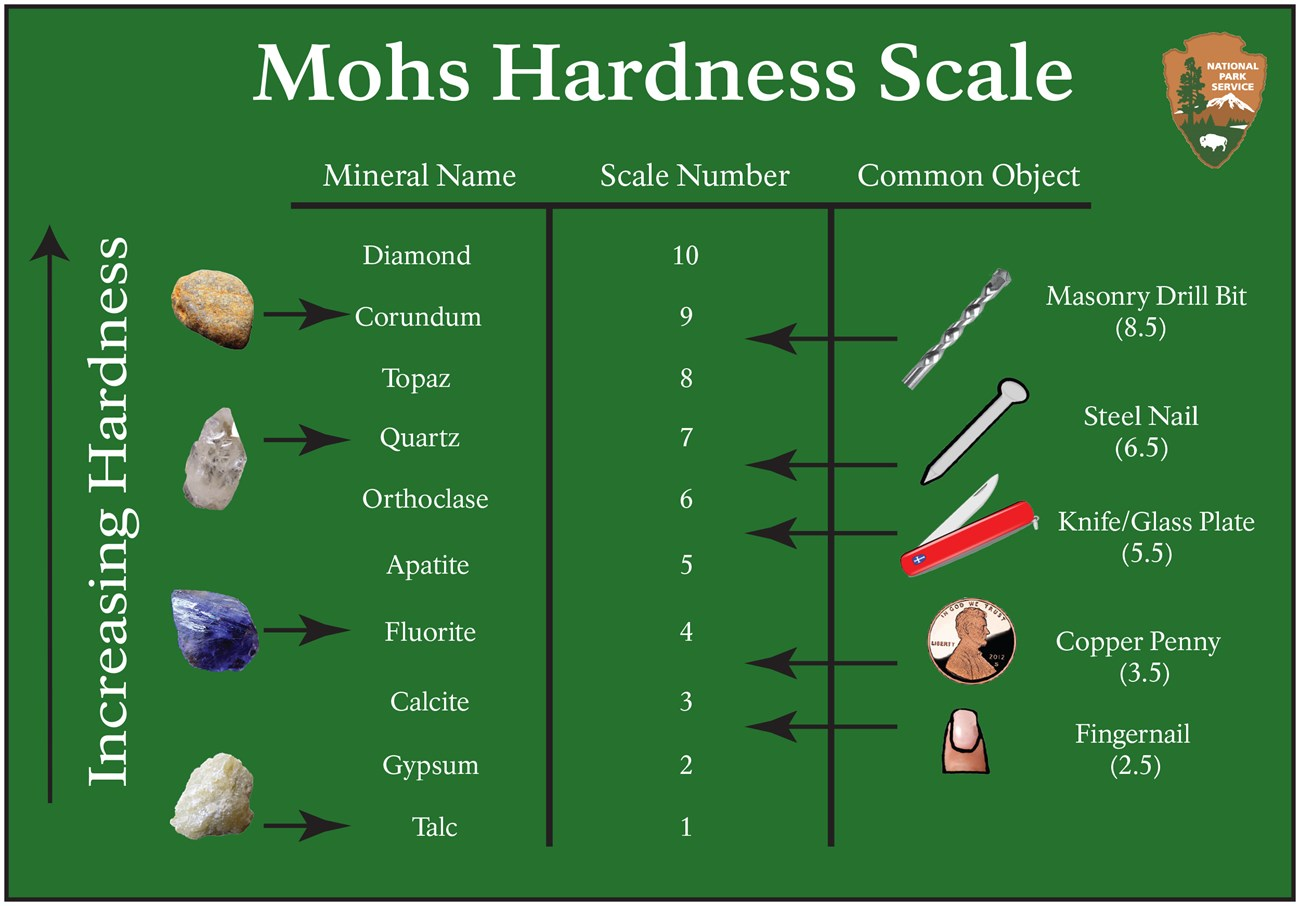
- Hardness: This refers to how resistant a mineral is to scratching. The Mohs’ Hardness Scale is a tool used to describe a mineral’s hardness.
- Cleavage or Fracture: Cleavage refers to the tendency of a mineral to break along preferred planes called zones of weakness. A fracture is produced if a mineral doesn’t break along zones of weakness.
- Density or Specific Gravity: This refers to the ratio between a mineral’s weight and the weight of a specific volume of water (Water has a specific gravity of 1). It is directly proportional to a mineral’s weight.
- Tenacity: This describes how well a mineral handles stress, such as breaking, crushing, bending, or tearing. Minerals susceptible to cracking or breaking are called brittle . A mineral that deforms under stress but snaps back to its original shape after the pressure is removed is called elastic. On the other hand, if a mineral is deformed under stress but doesn’t go back to its original shape, it is then called flexible. Metallic minerals such as gold, copper, or silver are called malleable because they can be flattened into sheets. Copper is also ductile because it can be drawn into thin wires without breaking. Sectile minerals such as gold or gypsum can be carved into thin sheets with a knife.
- Diaphaneity (transparency): This refers to how well light travels through a mineral.
- Magnetism: This describes the magnetic property of a mineral.
- Effervescence: This describes a mineral’s reaction to a strong acid such as HCl.
- Odor and Taste
MOST ABUNDANT ELEMENTS ON THE EARTH’S CRUST (ROCK-FORMING MINERALS)
- Oxygen - 46.6%

- Silicon - 27.7% SILICATES

- Aluminum - 8.1%
- Iron - 8.5% NON- SILICATES
THE MOHS HARDNESS SCALE MNEMONICS
- The Girls Can Flirt And Other Queer Things Can Do
4. Rocks
Rocks are naturally-occurring aggregates of minerals and mineraloids.
CLASSIFICATIONS OF ROCKS
- Igneous Rocks
- It came from the Latin word ignis meaning “fire”.
- They are formed when molten material cools and solidifies.
- When igneous rocks form below the surface of the Earth, they are called intrusive igneous rocks or plutonic rocks. When they form on the surface, they are called extrusive igneous or volcanic rocks.
- Intrusive rocks have bigger or coarser grain crystals, while extrusive rocks have smaller or finer crystals. (IBES)
- The composition of magma depends on the amount of SILICA (SIO2).
- Sedimentary Rocks
- They are formed from loose material called sediments that have been eroded in weathering and then buried and compacted in a process called diagenesis.
- They can come from pre-existing rocks and materials or the remains of living things. (MOST FOSSILS CAN BE FOUND IN SEDIMENTARY ROCKS)
CLASSIFICATION OF SEDIMENTARY ROCKS
- Clastic Sedimentary Rocks
- These occur when sediments come from pre-existing rocks.Clastic sedimentary rocks are classified based on the characteristics of their clasts, such as size, angularity/roundedness, and sorting.
- Non-clastic Sedimentary Rocks
- Chemical sedimentary rocks are formed when water evaporates, leaving behind dissolved minerals.
- Biochemical or organic sedimentary rocks are composed of the remains of living things. Examples of which are fossiliferous limestone (contains fossils), chalk (coccolithophores and foraminifera), coquina (shell fragments and grains), and coal (altered rock from remains of plant life).
3. Metamorphic Rocks
- When a rock is subjected to certain chemical or physical change (temp. and pressure) processes that alter its chemical composition, mineralogy, and/or texture, a metamorphic rock is formed.
- The original rock or “parent rock” that was altered is called a protolith.
TYPES OF METAMORPHIC ROCKS
- Foliated Rocks
- Foliation in rock is the result of deformation; the more foliated a rock, the higher the grade of metamorphism.
- Nonfoliated Rocks
- They usually develop in environments where deformation is minimal and other factors, such as chemically-active fluids, play a larger part in altering the rock.
5. Depositional Environments, Landforms, and Waterforms
- Depositional environments combine chemical, physical, and biological aspects that dictate what type of sediments, rock types, and landforms are deposited or formed.
- Weathering is the mechanical and chemical hammer that breaks down and sculpts the rocks. Erosion transports the fragments away. Erosional agents such as water, wind, ice, or animals and humans are responsible for transporting these materials.
- Deposition is the placing or dropping off of the eroded material in a new location.
DEPOSITIONAL ENVIRONMENTS
- Terrestrial Environments
- Land and water forms in this environment can be found on land and usually involve freshwater. Here are some depositional environments that fall under this category:
- Fluvial: rivers and streams
- Eolian: deserts and arid environments
- Alluvial: mountainous environments
- Glacial: ice caps and glaciers
- Lacustrine: lakes
Associated landforms and waterforms:
- Mountains – These are elevated areas of land. Hills are similar to mountains but with lesser steepness.
- Plains – These are relatively flat expanses of land that lie above sea level. Plains can occur between two mountains as a valley. A plateau is a plain that is relatively elevated than the surrounding land.
- Desserts – These areas receive little rainfall and have high evaporation rates. Despite this, the most dominant agent of erosion in these areas is running water.
- Glacial environments – These are areas where the most dominant erosional agent is ice. Glaciers are large masses of moving ice over land.
- Rivers – Long bodies of water that originate from high elevation (such as mountains or hills) and flow down to lower elevation (such as plains, mountain slopes, etc.).
2. Transitional Environments
- Transitional environments represent the interface between land and sea. It is here where freshwater meets with seawater.
- Here are some depositional environments that fall under transitional environments:
- Beach: where land meets the sea in shallow waters
- Deltaic: where the river flows into the sea; freshwater mixes with seawater
- Tidal flat: low-lying areas affected by tides
- Lagoonal: a small body of water closed off from a larger body of water (the ocean)
- Associated landforms and waterforms:
- Deltas are areas at the end of the mouth of a river where freshwater mixes with seawater.
- Wetlands are areas near rivers or coastlines where soils are saturated or submerged in water. Swamps are wetlands where trees dominate plant life. Marshes are wetlands where moss and soft-stemmed vegetation are most prominent.
c. Marine Environments
- These environments can be found in the open waters, from the shallow depths to the deepest portions of the ocean.
- Here are examples of marine environments:
- Shallow marine/reefal: a region where sunlight penetrates the water; high energy environment and teeming with life
- Continental shelf: extensions of continental crust submerged by water
- Continental slope: steep slope between the shallow continental shelf and the deep ocean basin
- Deep marine: a region where sunlight does not reach; low energy environment
- Associated landforms and waterforms:
- Oceans – These are large bodies of water that surround continents. Seas are smaller bodies of saltwater enclosed or partially enclosed by land and are connected to the ocean.
- Atolls are rings or partial rings of coral that usually form around a volcanic island or volcano that has receded or been eroded.
- Guyots are elevated platforms with flat tops formed by volcanic activity near the ocean floor. These can be massive and reach heights of up to more than 600 m. They are also known as seamounts.
6. Basics of Stratigraphy
Stratigraphy is a branch of geology that studies rock layers, beds, or strata (singular: stratum). It is a discipline that correlates rocks and time, helping us understand how, why, and when a certain configuration of strata came to be.
Principles of Stratigraphy
In the 17th century, a Catholic priest named Nicolaus Steno formulated the guiding principles of stratigraphy.
A. Law of Superposition: If the sequence is undisturbed, the layers on the bottom are the oldest, while the layers above are younger.
B. Law of Lateral Continuity: Each stratum extends laterally until it encounters a barrier or obstacle.
C. Law of Original Horizontality: Strata are deposited horizontally.
D. Law of Cross-cutting Relationships: If a geologic body (like an intrusion) or discontinuity (like a fault) cuts across strata, it must be younger than the strata it cuts. An intrusion is an igneous rock body that forms when magma cuts through sedimentary layers and solidifies before it reaches the surface.
In the 19th century, William Smith produced the first geological map of Britain. He has been regarded as the Father of English Geology.
E. Principle of Faunal Succession. Sedimentary strata may contain fossils of plants and animals in a definite and invariable sequence. Thus, the age of a stratum and another stratum in a different location can be correlated if they share the same fossil assemblage.
Sometimes, different processes can lead to a gap in a rock sequence called an unconformity. A hiatus is the “missing time” represented by the unconformity in a rock sequence.
- Disconformity: This type of unconformity is present when there is a missing stratum or strata in the sequence, usually due to a period of non-deposition or erosion.
- Nonconformity: This occurs when sedimentary strata are deposited on top of igneous or metamorphic rock bodies.
- Angular unconformity: When strata are disturbed by forces that cause folding, tilting, and/or faulting, they no longer appear horizontal. The surface is then exposed to erosion, and another set of sedimentary strata is soon deposited on top of the disturbed sequence.
These principles and unconformities can be used to identify the age of strata in relation to other strata in a method called relative dating. However, this method cannot identify a stratum’s specific or absolute age.
Absolute Dating
It determines the absolute age of a layer. One of the best ways to date the numerical age of a rock is to use radioisotopic dating or radiometric dating.
7. Fossils and the Geologic Time Scale
Fossils are the remains of life that are preserved within sediments and sedimentary rocks.
Paleontology is the study of fossils linking concepts of geology and biology to understand prehistoric life over geologic time.
To produce a fossil, two conditions must be observed:
- The organism must possess hard parts (bones, teeth, etc.), and
- Rapid burial of the remains increases the chance of preservation.
Different Ways a Fossil Can Be Preserved
- Permineralization
- This occurs when pores and open spaces in tissue (such as bone and wood) are filled with minerals precipitated from mineral-rich solutions such as groundwater.
- Molds and Cast
- When organisms buried in sediment dissolve or decay away, it leaves behind a hollow space called mold in the organism’s shape. If minerals eventually fill in this hollow space, a cast is made.
- Amber
- Organisms in amber are exceptionally preserved well, often still containing their soft parts. These organisms are preserved when they fall into a viscous tree sap which hardens into amber.
- Carbonization
- Soft-bodied organisms and delicate plant parts can be conserved via carbonization. This happens when these organisms are buried in sediment and eventually dissolve, leaving behind a thin layer of carbon outlining the organism’s shape.
- Freezing
- Organisms can also be exceptionally preserved when they are encased in ice.
- Trace fossils
- A fossil doesn’t only pertain to the actual organism. A fossil can preserve records of its activities such as tracks, burrows, coprolites (fossilized poop), and gastroliths (stomach stones).
The Geologic Time Scale
The geologic time scale (GTS) is a tool geologists use to classify and date rocks and fossils. Instead of numerical ages, time is divided into eons, eras, periods, epochs, and ages (in descending order of duration). An international body called the International Commission on Stratigraphy (ICS) maintains the GTS.
Condensed History of the Earth:
- Hadean Eon: The formation of the Earth; magma ocean; intense bombardment of space bodies (“Late Heavy Bombardment”)
- Archean Eon: Life begins as prokaryotic bacteria; Blue-green algae start to produce oxygen in the atmosphere
- Proterozoic Eon: Multicellular life emerges
- Cambrian Period: Multicellular life flourishes and diversifies (“Cambrian Explosion”)
- Ordovician Period: “Age of Invertebrates”
- Silurian Period: Emergence of plants on land
- Devonian Period: “Age of Fishes”; Towards the end, true amphibians emerged
- Carboniferous Period: “Age of Amphibians”
- Mississippian: Amphibians diversified; large coal swamps formed
- Pennsylvanian: Emergence of reptiles
- Permian Period: Existence of Pangaea; the largest mass extinction in Earth’s history occurred towards the end (“The Great Paleozoic Extinction”)
- Triassic Period: Dinosaurs emerged; start of the Age of Reptiles; first true mammals (therapsids) emerged as well
- Jurassic Period: Dinosaurs dominated the Earth; the first birds emerged
- Cretaceous Period: first flowering plants emerged (angiosperms); marked the end of the Age of Reptiles with the Cretaceous-Tertiary Extinction (“K-T Extinction”)
- Paleogene Period: start of the Age of Mammals
- Neogene Period: Mammals and birds evolved into modern forms; hominids, the ancestors of humans, appeared towards the end
- Quaternary Period: current period; a cycle of glacial and interglacial periods
8. Plate Tectonics
The Continental Drift hypothesis paved the way for the emergence and acceptance of the plate tectonics theory. It was proposed by a German meteorologist and geophysicist named Alfred Wegener.
There was a supercontinent that consisted of all landmasses on Earth. He named this supercontinent Pangaea (from the Greek words pan meaning “all” and gaia meaning “land”).
Evidence of the Continental Drift Hypothesis
- Evidence #1. Continental Jigsaw Puzzle
- If you take the boundaries of each continent and try to fit them together, you’d get a landmass similar to the configuration of Pangaea. Wegener argued that the excellent fit of the continents was more than a coincidence, citing the almost perfect fit of South America and Africa.
- Evidence #2. Fossils
- Similar fossil remains of plants and animals were found on continents currently separated by large bodies of water.
- Evidence #3. Similar Rock Types and Geologic Features
- Large mountain belts of similar ages and rock types could be matched with each other across continents.
- Evidence #4. Ancient Climates
- There were glaciers before in present-day continents.
The scientific community still did not accept the continental drift hypothesis primarily because of one problem: Wegener could not explain how the continents drifted. Also, it is because Wegener wasn’t a geologist but a meteorologist.
The Development of the Plate Tectonics Theory
- The oceanic ridge system (mid-ocean ridges) is the longest mountain range.
- Seafloor spreading is the process by which new oceanic crust is formed through volcanic activity at mid-ocean ridges. It was coined by Harry Hess and Robert Dietz.
- The plate tectonics model states that the lithosphere is broken into rigid slabs called tectonic plates or simply plates. These plates overlie the ductile asthenosphere, allowing them to be in constant motion concerning one another.
- The major plates, which covers 94% of the Earth’s surface area, are the African Plate, Antarctic Plate, Eurasian Plate, Indo-Australian Plate, North American Plate, South American Plate, and Pacific Plate.
- There are also minor plates such as the Philippine Sea plate, Juan de Fuca plate, Cocos plate, Nazca plate, Scotia plate, and Arabian plate.
- The regions where tectonic plates meet are called plate boundaries.
Three Main Types of Plate Boundaries
a. Divergent Plate Boundaries (Constructive Margins)
- Divergent plate boundaries are formed when two plates move apart relative to each other. Divergent boundaries on the ocean floor manifest as the oceanic ridge system, which was discussed earlier. It creates a mid-ocean ridge.
b. Convergent Boundaries (Destructive Margins)
- Convergent boundaries are the sites where plates move towards each other, resulting in a collision or one plate going under the other in a subduction process.
- Oceanic-Continental Plates Convergence
- The denser oceanic crust sinks beneath the lighter continental crust at a subduction zone.
- Oceanic-Oceanic Plates Convergence
- When two oceanic plates collide, the older and denser one subducts.
- Continental-Continental Plates Convergence (FORMS MOUNTAIN RANGE)
- Because continental crust is too thick and buoyant to be subducted, most crustal material is deformed and pushed up instead. This results in the accumulation of sediments and rocks along the margin, forming mountain belts in a process called orogeny.
c. Transform Plate Boundaries (Conservative Margins)
- These plate boundaries are characterized by two plates sliding past each other, not destroying or producing new crustal material. They are also called transform faults and are usually found in fracture zones.
- Fracture zones are linear breaks on the ocean floor that run perpendicular to oceanic ridges. An active transform fault lies between the two offset oceanic ridges, while the areas beyond the ridge zones are inactive zones.
9. Earthquakes
- Earthquakes occur when one block of earth slips past another block along surfaces called faults or fault planes and generates ground shaking. The area under the earth where the slippage originates is called the hypocenter or focus. The epicenter is the point on the Earth’s surface directly above the focus.
Seismic Waves
When slippage happens, the stored energy is released as seismic waves. The seismic waves travel through the earth and cause it to shake. These waves can be classified into two types: body waves and surface waves.
- Body Waves (PS.)
- These are waves that travel through the interior of the Earth. There are two types of body waves: primary waves (P waves) and secondary waves (S waves).
I. Primary Waves (P Waves)
- These are the fastest seismic waves and can travel through solid, liquid, and gas.
- These waves push and pull the rocks in the direction the wave is traveling. They are also called compressional waves because of this behavior.
II. Secondary Waves (S Waves)
- They cause the rocks to shake up and down. S waves are slower than P waves and can only travel through solids.
- They are also called shear waves.
- Surface Waves
- They can only travel on the surface of the Earth. These are the waves that can cause tremendous damage.
- Love Waves
- These waves are responsible for shaking the ground horizontally and vertically in an S-like pattern.
- Rayleigh Waves
- These waves move in a rolling motion similar to ocean waves.
Seismology
- It is the study of earthquakes. Seismologists use seismographs or seismometers to record earthquakes.
- The intensity refers to the qualitative measurement of ground shaking at a particular location, depending on the damage to property, life, and nature. (IGS)
- The Modified Mercalli Intensity Scale is used in countries like the United States. However, the PHIVOLCS Earthquake Intensity Scale (PEIS) is used in the Philippines.
- The magnitude refers to the quantitative measurement of energy released at the earthquake’s source.
- Before, the Richter Scale was used. Now, seismologists use the Moment Magnitude (Mw) Scale.
Faults
- Nearly 81% of earthquakes occur in the circum-Pacific belt (Pacific Ring of Fire).
- The next most tectonically-active seismic belt is the Alpine-Himalayan Belt, where 17% of the world’s earthquakes occur. The rest of the earthquakes occur along the Mid-Atlantic Ridge in the Atlantic Ocean.
- Earthquakes caused by the eruption of volcanoes are called volcanic earthquakes. Generally, small earthquakes called collapse earthquakes occur when underground caves or mines collapse. The detonation of explosives can also cause earthquakes called explosion earthquakes.
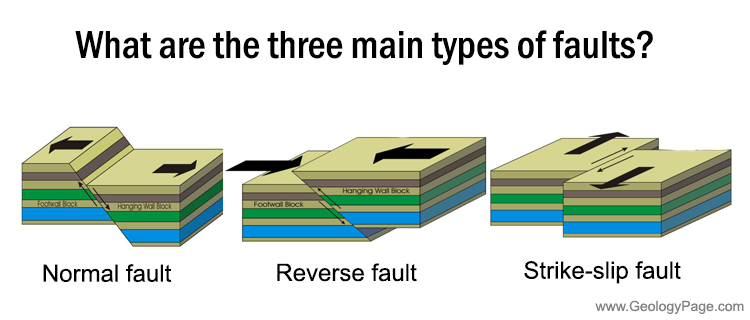
- The most common type of earthquake, tectonic earthquakes, are caused by fault movement. There are main types of faults:
- Normal Faults
- Normal faults result from tensional forces that pull the two slabs apart.
- Reverse Faults
- In a reverse fault, the hanging wall moves up relative to the footwall
- Strike-Slip Faults
- In a strike-slip fault, blocks move horizontally to one another due to shearing forces.
- Left-lateral strike-slip faults (or sinistral faults) occur when one block moves to the left relative to the other. Right-lateral strike-slip faults (or dextral faults) occur when the block moves to the right.
- Oblique-Slip Faults
- Combining shearing and tensional or compressional forces would result in an oblique-slip fault.
Earthquake-related Hazards
a. Landslides and Ground Subsidence
- These are caused by ground shaking during an earthquake.
- A landslide is a form of mass wasting where large amounts of earth move down a slope under the influence of gravity.
- Subsidence is the sudden sinking of the Earth’s surface due to the movement of the earth underneath. Liquefaction is similar to subsidence but occurs when sediments are saturated with water.
b. Flooding and Water-related Hazards
- In enclosed bodies of water such as lakes or reservoirs, waves called seiches may occur.
- Tsunamis are giant waves that are produced when a fault displaces a large slab of the ocean floor. They are nearly undetectable in the open ocean.
c. Damage to Man-made Structures
- Damage can range from cracks in the walls to the destruction of property.
10. Volcanoes
- Volcanism is a geological process where hot molten rock from underneath the earth reaches the surface through an opening in the ground. A volcano is the most recognizable form of an opening, where molten material flows out onto the surface during a volcanic eruption.
- An eruption describes how the molten material was ejected, whether it was violent (explosive eruptions), non-explosive (effusive eruptions), or what caused the eruption.
- The hot, molten material is called magma when it’s underground and lava when it reaches the surface.
How Volcanoes Are Formed
- Convergent Boundaries
- As previously discussed, partial melting occurs in subduction zones, which are responsible for the heating and partially melting of the rocks in the overlying plate.
- This is caused by introducing volatiles (seawater, water from minerals, and other fluids) from the oceanic lithosphere, lowering the surrounding rocks’ melting temperature. The molten rock then starts to ascend to the surface in the form of volcanic activity.
- Divergent Boundaries
- When plates move apart, pressure in the lithosphere reduces, allowing magma in the asthenosphere to rise and induce partial melting of the surrounding rocks.
- Hotspots and Mantle Plumes
- Mantle plumes are areas where the mantle rises towards the surface, originating deep within the mantle. A hotspot is the surface manifestation of a mantle plume.
Volcano Morphology
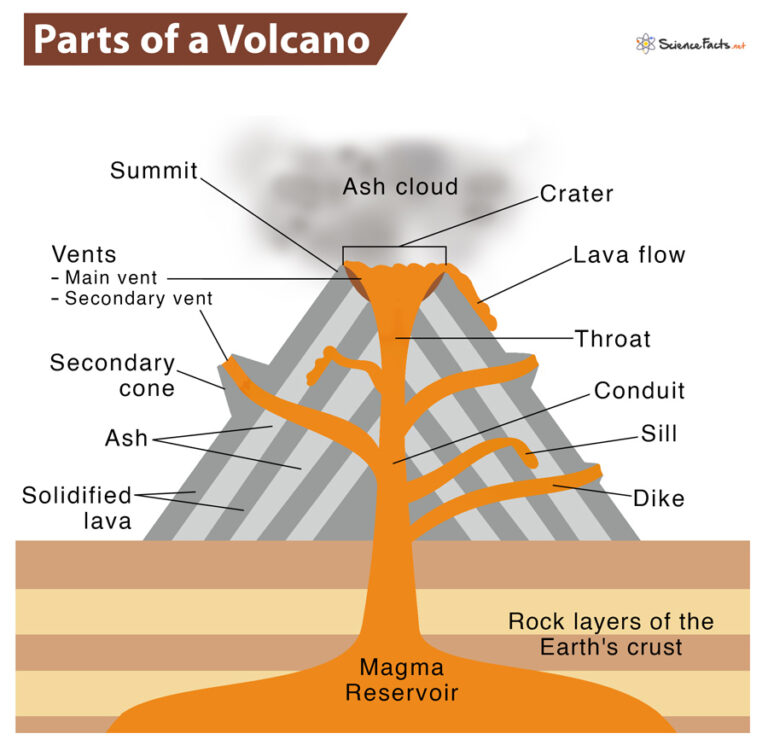
- Magma chamber – the reservoir of molten material in the Earth’s crust, replenished with magma from a deeper reservoir in the mantle
- Main vent – the pathway for magma to come to the surface
- Crater – bowl-shaped depression located at the summit of the volcano that serves as the opening of the volcano to the Earth’s surface
- Secondary cone – smaller parasitic volcanoes that feed on the same magma chamber as the main volcano through secondary vents; usually emit volcanic gas called fumaroles
- Pyroclastic materials – any volcanic material that is extruded by a volcano, such as bombs, blocks, ashes, and others
Types of Volcano
- Shield Volcanoes
- Shield volcanoes are large dome-shaped volcanoes with broad gentle slopes and large craters. The largest volcano on Earth, Mauna Loa in Hawaii, is a shield volcano.
- Shield volcanic eruptions are typically gentle and non-explosive.
- Cinder Cones
- Cinder cones (scoria cones or ash-cinder cones) are steeper and have smaller craters than shield volcanoes. They are usually made up of loose pyroclastic material called scoria.
- They are the most common type of volcanoes.
- Composite Volcanoes or Stratovolcanoes
- Alternating layers of viscous andesitic lava flows, volcanic ash, and cinders are responsible for their shape.
- Eruptions tend to be violently explosive and can cause lava flows, pyroclastic flows, large ash clouds, and even lahar.
- When a particularly explosive eruption occurs, the stratovolcano could collapse, forming a large depression called a caldera.
Volcano-related Hazards
- Pyroclastic Flow
- A pyroclastic flow is a rapidly-moving current of hot gases and tephra (volcanic material) driven by gravity. They are also known as nuée ardentes.
- Pyroclastic flows usually accompany explosive eruptions.
- Lahars
- Lahar flows occur when volcanic material becomes saturated with water, and rapidly descends steep volcano slopes.
- Lava Flows
- There are three main types of lava flows. The first one is called aa flows (pronounced as “ah-ah”) and is characterized by spiky and rough surfaces. The second one is called pahoehoe flows (pronounced as “pa-hoy-hoy”) and is described as having a “ropey” appearance with smooth surfaces. The last occurs when lava is extruded along the oceanic ridge, producing smooth rounded shapes called pillow lavas.
11. Climate, Weather, and the Atmosphere
The atmosphere is a collective layer of gas.
Components of the Atmosphere
- Nitrogen (N2) - 78%
- Oxygen (O2) - 21%
- Argon (O2) - 0.9%
- Others (CO2, Ne, He, CH4, Kr, H2) - 0.10%
Other minor and variable components
- Water Vapor (H2O (g))
- The primary source of precipitation and cloud formation in the atmosphere.
- A significant factor when predicting the weather.
- One of the most critical greenhouse gases because it helps absorb heat that radiates from the Earth, heating the atmosphere. Greenhouse gases (GHG) trap heat in the Earth’s atmosphere. They include other gases such as carbon dioxide (CO2), methane (CH4), nitrous oxide (N2O), and ozone.
- Humidity refers to the amount of water vapor or moisture in the atmosphere.
- Aerosols
- These are minuscule solid and liquid particles that are suspended in the air. Aerosols include smoke, pollen, sea salt, dust, airborne microorganisms, and other natural or man-made sources.
- Because of their size and weight, aerosols can remain suspended in the air for long periods of time (even years!).
- Aerosols have two crucial functions in the atmosphere:
- They can be “cloud seeds” or cloud condensation nuclei upon which clouds form.
- They can also absorb, reflect, and scatter incoming solar radiation from the Sun, preventing harsh amounts of UV rays that can damage Earth’s inhabitants.
- Ozone (O3)
- Like aerosols, ozone is important in absorbing potentially harmful UV radiation from the sun.
- Ozone depletion became a global issue in the 20th century primarily due to the overuse of chlorofluorocarbons (CFCs) that entered the atmosphere and broke down the ozone layer in the stratosphere.
- This problem was addressed with the implementation of the Montreal Protocol by the United Nations to ban the production and use of CFCs starting in 1987 and entered into force on January 1, 1989.
Parts of the Atmosphere
- As you go up in the atmosphere, the pressure decreases.
- Troposphere (W)
- Lowest layer of the atmosphere, temperature decreases with increasing altitude.
- The troposphere is the most crucial layer for meteorologists because all weather phenomena occur here.
- The outermost boundary of the troposphere is called the tropopause.
- Stratosphere (O)
- The temperature increases with altitude because the ozone layer is located here.
- The ozone layer becomes hot due to the absorption and trapping of UV rays from the Sun.
- The end of the stratosphere is marked by stratopause.
- Mesosphere (M.M.)
- The coldest temperatures in the atmosphere can be found at the end of this layer at the mesopause.
- The mesosphere protects us from meteors by burning up most meteors and asteroids before they reach the Earth’s surface.
- Thermosphere (S)
- It is in this layer where satellites orbit around the Earth.
- Exosphere (Ex)
- It is considered the “final frontier” of the atmosphere.
Weather versus Climate
- The science of the atmosphere and its phenomena, including weather and climate is called meteorology.
- Weather refers to the conditions of the atmosphere in a region over a short period of time. On the other hand, climate is the long-term behavior of the atmosphere over a region.
- Meteorologists use humidity, air pressure, temperature, wind, and other factors to understand a region’s weather and climate better.
The Hydrological Cycle (WATER CYCLE)
- Water goes through a constant journey of evaporation and condensation called the hydrological cycle or water cycle, primarily driven by the radiation from the Sun.
- The water cycle is THE PROCESS BY WHICH WATER IS CIRCULATED THROUGHOUT THE EARTH AND THE ATMOSPHERE.
- Precipitation is WATER RELEASED FROM CLOUDS IN THE FORM OF RAIN, FREEZING RAIN,SLEET, SNOW, OR HAIL.
- In the ocean is where the heat from the Sun evaporates water into vapor. Due to rising air currents, these water vapors are transported into the atmosphere, forming clouds. Colder temperatures in the atmosphere encourage clouds to condense and precipitate. Precipitation reaches the surface of the Earth and flows down slopes as runoff. Some of the water seeps into the ground and replenishes the groundwater in aquifers (underground freshwater reservoirs). Eventually, all rivers and streams arrive at their ultimate destination, the ocean, and the cycle repeats.
Cloud Formation
- Clouds start when water vapor in the air changes to liquid in condensation and forms around a “cloud seed” or condensation nuclei (aerosols). Soon, a cloud is formed from millions of tiny cloud droplets.
- Based on height, there are low clouds (0-2000 m), middle clouds (2000-6000 m), and high clouds (over 6000 m).
- There are three main types of clouds based on the form:
- Cirrus clouds (From the Latin word cirrus meaning “lock of hair”). These are thin, wispy, and white clouds that resemble hair.
- Stratus clouds (From the Latin word stratum meaning “layer”). These are thin layers of clouds that cover extensive portions of the sky.
- Cumulus clouds (From the Latin word cumulo meaning “a heap”). These are big, cotton candy-looking clouds that can stack vertically in a tower-like manner.
Wind Formation
- The wind is generated when air flows from regions of high pressure to regions of low pressure caused by the unequal heating of the Earth’s surface. The following factors control it:
- Pressure Gradient Force
- Physics tells us that when an object encounters an unbalanced force in one direction, it will accelerate in the same direction. This is what happens when there are horizontal pressure differences in the air. This variation in air pressure is the driving force of the wind.
- Coriolis Effect
- When the wind moves, it does not go in a straight line. It is deflected from its original path due to the Earth’s rotation in a phenomenon called the Coriolis Effect.
- The Earth spins counterclockwise, so all free-moving objects (including the wind) are deflected to the right in the Northern Hemisphere and the left in the Southern Hemisphere.
- Friction
- It is caused by the terrain the winds encounter.
Other Types of Weather Phenomena
a. Typhoons, hurricanes, and cyclones
- These refer to the same thing: areas of low pressure that form over oceans characterized by a spiral movement of viral winds. The only difference between them is where they formed.
- Typhoons are storms that form in the Western Pacific. Hurricanes are storms in the Atlantic and Eastern Pacific, while cyclones form over the South Pacific and the Indian Ocean.
b. Thunderstorms
- These are associated with cumulonimbus clouds, heavy rainfall, thunder, lightning, and sometimes tornadoes. The upward movement of moist and warm air causes them.
- Lightning is caused by the electric charge that results from the collision of ice crystals (cloud droplets) in the air.
c. Tornadoes
- These are columns of violently spinning air that extend downwards from cumulonimbus clouds.
d. Precipitation
- Precipitation occurs when any form of water particle descends from the atmosphere toward the Earth’s surface.
- The most common form of precipitation is rain (water droplets). Other types of precipitation can include sleet (pellets of ice), hail (lumps of ice), snow (ice crystals), and drizzle (very fine water droplets).
e. El Niño
- This is a weather pattern that affects countries near the Southern Pacific Ocean.
- El Niño is part of a weather cycle called El Niño-Southern Oscillation (ENSO) and is known as the warm phase of ENSO. La Niña, the cold phase, can be considered the opposite of El Niño.
The Philippine Atmospheric, Geophysical, and Astronomical Services Administration (PAGASA) is the authority on all meteorological, climatological, and astronomical phenomena related to the Philippines. PAGASA monitors tropical cyclone activity within the Philippine Area of Responsibility (PAR).
12. A Brief History of Astronomy
- Astronomy is the study of celestial objects and phenomena in space.
Early Astronomy
- The early astronomy can be traced back to Ancient Greece during the “Golden Age” of astronomy.” Early Greeks developed geometry and trigonometry.
- They believed in the geometric model of the universe, where Earth was the center of the universe. Aristarchus offered the possibility of a heliocentric model.
- Greek philosophers such as Parmenides believed in a spherical Earth.
- Aristotle used science by observing the shape of the Earth’s shadow that is cast upon the moon during eclipses.
- Eratosthenes successfully established the circumference of the Earth by observing the angles of the Sun’s rays at noon in two Egyptian cities.
- Hipparchus is known for his significant contributions to the field of astronomy: the development of trigonometry, accurately estimating the distance between the Moon and Earth, near accurate estimation of the length of a year, and a star catalog of nearly 850 stars classified according to their brightness.
- Claudius Ptolemy developed the Ptolemaic system, a geocentric model of the universe. Despite using an incorrect model, he could still predict the planets’ positions using a combination of large circles (deferents) and small circles (epicycles) to represent the planets’ orbits.
The Emergence of Modern Astronomy
- Nicolaus Copernicus was a Polish astronomer who advocated for a heliocentric universe model, later called the Copernican system, after discovering Aristarchus’ works. Copernicus could not account for planetary motion.
- Johannes Kepler served as an assistant to Tycho Brahe. Keppler formulated the three laws of planetary motion:
- All the planets move around the Sun in an elliptical orbit, not circular as previously believed. This is also known as the Law of Ellipses.
- If you trace an imaginary line from a point in the orbit to the Sun as a planet revolves, the line sweeps over equal areas in equal time intervals. This is also known as the Law of Equal Areas and explains the variation in the speed at which planets orbit around the Sun. The perihelion refers to a point where the planet’s orbit is closest to the Sun, while the aphelion refers to when it is farthest. Varying speeds do not equate to varying areas. (PCAF)
- Kepler's Third Law states that the square of a planet's orbital period (how long it takes to orbit the Sun) is directly proportional to the cube of its average distance from the Sun. This is also known as the Law of Harmonies.
- Galileo Galilei was an Italian astronomer who built several telescopes, which aided him in making more detailed observations of heavenly bodies. He observed that the moon's craters are not smooth, Jupiter had four moons, and the existence of sunspots. Unfortunately, prolonged observation of the Sun damaged his eyesight and eventually completely blinded him.
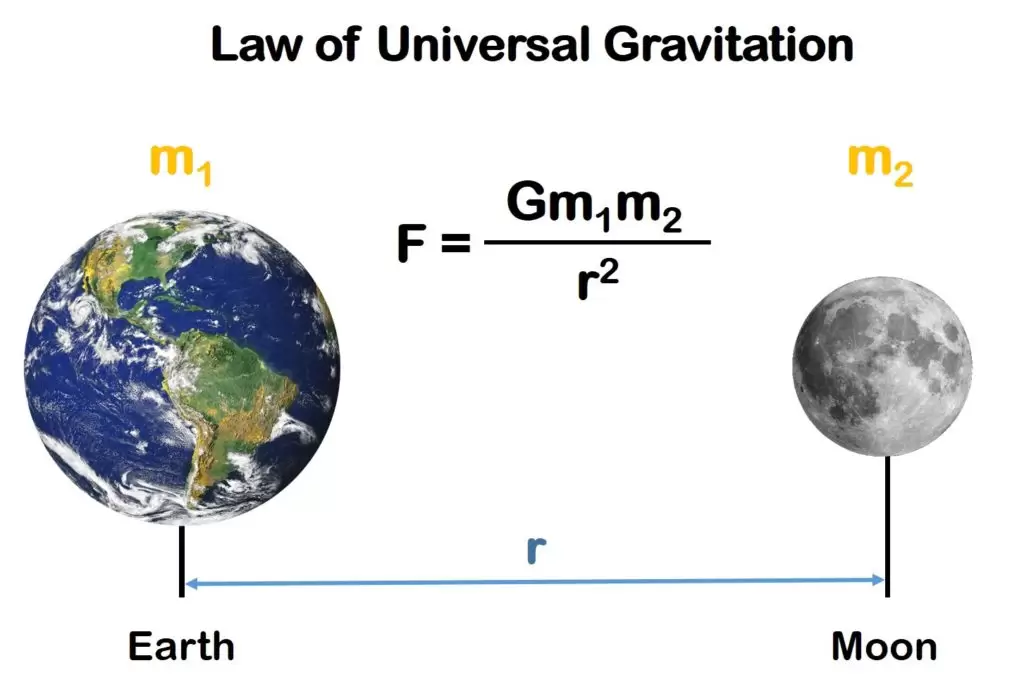
- Sir Isaac Newton answered the question of what kept planets in orbit: the Law of Universal Gravitation. According to the law, everybody in the universe attracts every other body with a force proportional to the mass of the bodies and inversely proportional to the square of the distance between the bodies. The larger the mass of an object, the stronger its gravitational pull. The farther apart two objects are, the weaker the gravitational pull between them. On Earth, gravity pulls objects downward, keeping us grounded. Planets orbit the Sun because of the Sun's gravitational pull. Moons orbit planets because of the planets' gravitational pull. Without the pull of gravity, the planets would move forward in a straight line out into space. Without the tendency of the planet to move in a straight line, the planets would fall into the Sun because of its immense gravitational pull.
13. The Origin of the Universe and the Solar System
- Cosmology is the study of the origin and evolution of the universe.
The Big Bang Theory: Origin of the Universe
- According to the BBT, before the universe (or anything and everything) existed, all matter and energy were condensed into high-temperature and high-density states. Suddenly, rapid expansion occurred, resulting in an explosion (hence the name, Big Bang), which generated all matter and energy, including space and time.
- The temperatures cooled down and allowed for the formation of light elements such as hydrogen and helium.
- Due to the force of gravity, clumps of matter began to form and grow through accretion. Accretion would eventually produce large masses of matter, forming into the first stars 400 million years after the Big Bang.
- A supernova occurs at the end of a star’s life cycle. Supernovas occur when a star’s core collapses and generates spectacularly powerful explosions. Large masses eventually form into planets, asteroids, and other space bodies. Gravity would also affect these space bodies and come together to form galaxies.
- Based on the joint effort of NASA and ESA, the most accepted age of the Universe is 13.8 billion years old. They determined this by measuring the leftover radiation from the Big Bang called cosmic microwave background (CMB).
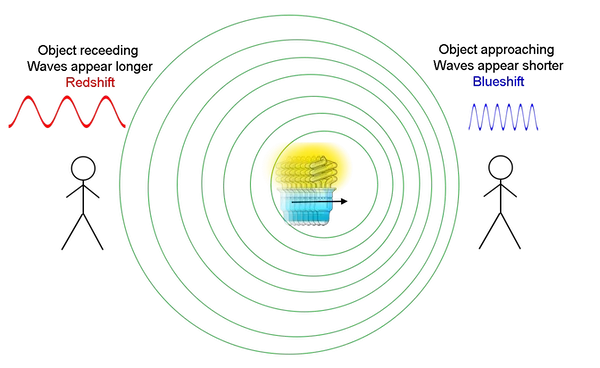
- Edwin Hubble noted that galaxies seemed to be moving away from each other and did so with incredible velocity. (expansion has not stopped and persists)
- He also noted that galaxies farther away from the Earth move away at a more incredible velocity.
The Nebular Theory: Origin of the Solar System
- The Nebular Theory was proposed and developed by several proponents (namely Emanual Swedenborg, Immanuel Kant, Pierre-Simon Laplace, and Victor Safronov) throughout the years until it became the accepted model of the origin of the solar system in the 20th century.
- According to the theory, our solar system formed from an enormous rotating cloud of dust and gas called the solar nebula nearly 4.6 billion years ago.
- Over time, the solar nebula began to contract and flatten due to gravity. As contraction continues, gravitational energy is converted into thermal energy, generating high temperatures. High temperatures and the inward pull of gravity in the center of the cloud led to the formation of a proto-Sun.
- As contraction declined, the temperatures began to cool, condensing rock-forming elements such as Fe, Ni, Si, Ca, Na, and others. Particles began to collide and accrete into masses called planetesimals (proto-planets) which eventually formed planets.
- Due to higher temperatures within the center of the solar system, heavier rock-forming elements condensed to form the inner planets (terrestrial planets). Planets within the outer ring of the solar system are called outer planets (jovian or gaseous planets) and are formed with small, rocky cores but are primarily composed of ice and gas such as CO2, H2O, NH3, and CH4.
14. The Solar System and Its Planets
- Our Solar System is part of the Milky Way Galaxy. It consists of the Sun, eight planets, five dwarf planets, and more than 200 moons.
- The first four planets from the Sun are called the inner planets. They are separated from the outer planets by the asteroid belt, a region between Mars and Jupiter primarily composed of irregularly shaped and sized asteroids.
CELESTIAL BODIES
- The Sun
- The Sun is a yellow dwarf star and the center of our solar system. It is so massive that it constitutes nearly 99.8% of all the mass in the solar system, while 0.2% is only represented by the planets.
- It is 4.6 billion years old, as old as our solar system. It is a big ball of gas composed of 92.1% hydrogen and 7.8% helium. The surface of the Sun is the coolest portion with temperatures of 5,600℃. The hottest temperatures can be observed in the core, where temperatures can go as high as 15,000,000℃.
- Distances in the solar system are based on the distance between the Sun and the Earth, called 1 astronomical unit (AU), which is equivalent to 150 million km.
The Terrestrial Planets (ROCKY PLANETS)
- Mercury
- The smallest of all planets, slightly larger than the moon. It is the second densest planet after the Earth. It has no known moons.
- Venus
- The hottest planet in the solar system. Out of all the atmosphere-bearing planets, it has the densest atmosphere composed primarily of CO2.
- Venus spins in the opposite direction (retrograde motion) compared to other planets. The longest-known lava channel in the solar system, Baltis Vallis, can be found here. It has no known moons.
- Earth
- As far as we know, it is the only planet in the solar system suitable for life due to the presence of liquid water on the surface. It has one moon, aptly named Moon.
- Mars
- Earth’s closest neighbor. Out of all the planets, Mars is the closest to being Earth-like. It is the second most explored planet in the solar system.
- It is also known as the “red planet” because of the iron oxide in its rocks, giving it a reddish hue.
- The largest volcano in the solar system, Olympus Mons, can be found here.
- It has two known moons, Phobos and Deimos.
The Jovian Planets (GAS GIANTS)
- Jupiter
- Largest planet in the solar system. The Great Red Spot is a noticeable area on Jupiter’s surface, representing the largest storm on the planet and the solar system.
- Jupiter has more than 75 known moons and a ring system.
- Saturn
- Second-largest planet from the Sun. It also exhibits the most spectacular ring system of all the gas giants. Its seven rings and thousands of ringlets comprise rocks, ice, and other space debris. It has 62 known moons.
- Uranus
- It is uniquely known as the “sideways planet” because of the sideways orientation of its axis, as opposed to the rest of the planets.
- It was the first planet to be discovered using a telescope in the 18th century.
- It has 27 known moons.
- Neptune
- It is known as the “windiest planet” in the solar system. It has 14 known moons.
- Beyond Neptune is a vast donut-shaped region containing icy bodies called the Kuiper Belt. The icy bodies are Kuiper Belt Objects (KBOs) or trans-Neptunian objects (TNOst
Dwarf Planets
- According to the International Astronomical Union (IAU), to be classified as a planet, a celestial body must:
- Be in orbit around the Sun
- Have sufficient mass to assume hydrostatic equilibrium (Its gravitational pull must be strong enough to assume a rounded shape)
- Have cleared the neighborhood around its orbit (It has to be the dominant gravitational body in its orbit and either attract or push away smaller bodies intersecting its orbit)
Celestial bodies that pass one or two conditions but fail the rest are called dwarf planets.
- Ceres – is the largest object in the asteroid belt that separates the inner and outer planets. It is also the smallest and the earliest known dwarf planet, being discovered in 1801.
- Pluto – Pluto was considered the 9th planet until it was stripped of its planet status in 2006 because it could not satisfy the third requirement–-it did not “clear the neighborhood” as it revolved around the Sun. Its size is large enough for its gravitational force to maintain five known moons. It is located in the Kuiper Belt.
- Haumea – is a football-shaped dwarf planet in the Kuiper Belt beyond Neptune. Its distorted shape is attributed to its fast spin; it is considered one of the fastest-rotating objects in our solar system.
- Makemake – Like Haumea, Makemake can be found along the Kuiper Belt. Before being designated as a dwarf planet, it was named 2005 FY9.
- Eris – Eris’s diameter is nearly the same as Pluto’s, and they are considered the two largest dwarf planets. It is located nearly three times farther than Pluto, extending beyond the Kuiper Belt. Before being named Eris, it was named 2003 UB313.
15. How the Earth Was Formed
- Earth started 4.6 billion years ago from planetesimals that formed through accretion and gradually formed into planets. This is known as the core accretion model, where the Earth started.
How Earth Formed Its Layers
- Heavier elements like iron and nickel sank to the center of the Earth, forming the core, while lighter elements migrated towards the surface. This allowed the Earth to produce layers in a process called chemical differentiation. During this cooling period, the Earth’s primitive crust started to form, and the magnetic field was produced.
How the Moon Formed and What Caused the Tilt in the Earth’s Axis
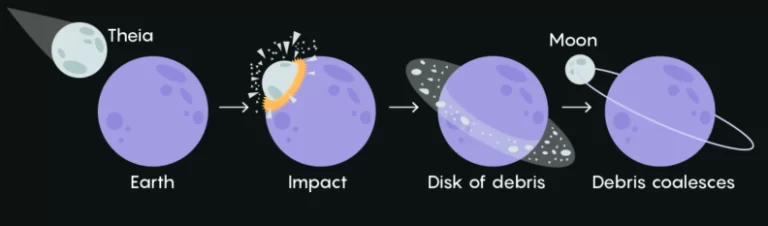
- The Giant Impact Hypothesis states that around 4.5 billion years ago, a large Mars-sized celestial body called Theia impacted the Earth, resulting in the ejection of undifferentiated Earth materials, forming our Moon.
- The impact is also said to have been the cause of the tilt in the Earth’s axis. The tilting of Earth’s axis caused the formation of seasons.
How Life on Earth Started
- Around 4.37 – 4.20 billion years ago, Earth was bombarded by asteroids during the Late Heavy Bombardment stage.
- Cyanobacteria (aerobic bacteria) were essential in producing and increasing O2 in the Earth’s atmosphere. Because of this, aerobic bacteria began to thrive, while anaerobic bacteria declined in the Great Oxidation Event.
- Accelerated weathering of the Earth’s surface introduced elements such as Na, Ca, K, and Si from the land to the oceans, increasing its salinity. Seawater and CaCO3 in the oceans “locked up” large amounts of CO2 in the atmosphere, cooling the Earth significantly.
16. The Motions of the Earth
- The Earth goes through three types of motions: rotation, revolution, and precession.
Earth Rotation
- It is what gives us night and day.
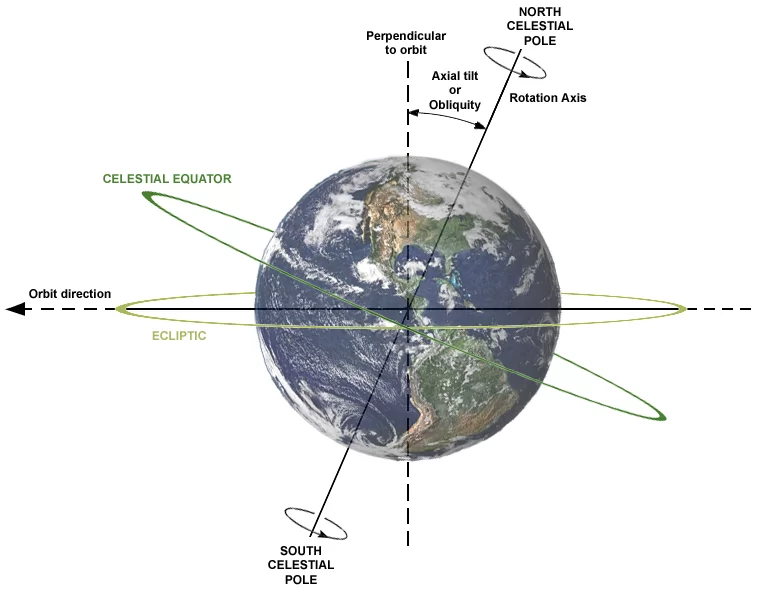
- The rotation occurs when a body, such as the Earth, spins on its axis. The axis is an imaginary line that passes through the center of the Earth, going through the North Pole and exiting through the South Pole.
- One complete Earth rotation equals 23 hours, 56 minutes, and 4 seconds.
- The value changes as the axial tilt varies between 22.1 to 24.5 every 41,000 years (one Milankovitch Cycle). The change in the axial tilt is called obliquity.
- The winter solstice is the shortest day of the year, while the summer solstice is the longest. An equinox occurs when day and night are equal in length.
Earth Revolution
- As the Earth rotates, it orbits around the Sun in a process called revolution.
- One complete Earth revolution requires 365 days, 6 hours, and 9 minutes (365.25) at an average speed of 30 km/s.
- Earth's revolution is synchronized with the calendar year by adding an extra day to the calendar. This is because Earth's orbit around the sun, also known as its revolution, is not exactly 365 days, but rather about 365.25 days.
- When the Earth is at its aphelion, its position in its orbit is farthest from the Sun. Earth is closest to the Sun when it is at its perihelion.
- Axial precession represents the “wobble” of the Earth as it rotates on its axis, much like a spinning top. Throughout 26,000 years, the direction in which the axis points changes until it completes 360 degrees.
17. The Motions of the Moon
- Every month, we observe the Moon go through eight phases. The different phases result from the Moon’s motion and the amount of sunlight reflected off the Moon’s surface.
- As we start from the new moon, more portions of the moon can be seen (waxing). When it reaches the full moon phase, portions of the moon start to decrease in visibility (waning) until it reaches the new moon phase again. (Waxing bigger, Waning smaller)
Eclipses
- A lunar eclipse occurs when the Earth comes between the Moon and the Sun, blocking any sunlight from reaching the Moon’s surface. This happens when the Moon falls within the inner shadow cast by the Earth called the umbra. The penumbra is the outer portion of the Earth’s shadow that only partially blocks the sun’s rays.
- On the other hand, a solar eclipse occurs when the Moon comes between the Sun and the Earth and casts a shadow on the Earth.
- Eclipses are rare because the Moon’s orbit is tilted approximately 5℃. Eclipses can only occur when a full moon or a new moon occurs while the Moon’s orbit crosses the plane of the ecliptic. Because of this, the usual number of eclipses per year is four.
18. Other Celestial Bodies in Space
- Stars
- Stars are considered the building blocks of galaxies. Without stars, elements essential to the formation of life would not exist. Sars form from interstellar clouds of dust and gas that condense due to gravitational pull.
- Nuclear fusion is the driving force behind the life of a star. At the very core of a star, hydrogen undergoes nuclear fusion to form helium, producing an outflow of energy that keeps a star from collapsing under its own weight.
- A star nears the end of its life when it exhausts its fuel supply, leading to collapse and then a spectacular explosion in the form of a supernova. The materials produced by a supernova may be reused again in the formation of another star, repeating the cycle.
- Stars are classified according to the relationship between their absolute luminosities or magnitudes and temperatures in a diagram called the Hertzsprung-Russell diagram (HR diagram).
- Depending on the star, it may be plotted along the middle diagonal line called the Main Sequence or fall above it (giants and supergiants) or below it (white dwarfs).
b. Comets
- Comets are small space bodies of dust, ice, and frozen gases. When comets come close to the Sun, they heat up and release gas through outgassing, leaving long trails of gas and dust as it moves.
- Comets have different orbital periods (the time it takes for a comet to complete one orbit around the Sun). Some famous comets are Halley’s Comet (76-year orbital period), Comet Hale-Bopp (2,533-year orbital period), and Comet Hyakutake (113,782-year orbital period).
c. Asteroids
- These are small rocky bodies (planetesimals) that are leftovers from the formation of the Solar System.
- Most asteroids in the solar system can be found in the asteroid belt region. They are irregularly shaped and greatly vary in diameter.
- When located in space, they are called asteroids (when more than one meter in diameter) or meteoroids (when less than a meter in diameter). When it enters the Earth’s atmosphere, it becomes a meteor. It is called a meteorite if it reaches the Earth’s surface.
d. Galaxies
- Galaxies are large clusters of stars, solar systems, gas, and dust held together by gravity. Using the Hubble Space Telescope, astronomers estimate that there may be 100 billion galaxies and probably more.
- Galaxies are classified based on morphology and divided into three major categories: elliptical, spiral, and irregular. As mentioned in previous chapters, we live in the Milky Way, a spiral-type galaxy.
- Galaxies tend to be bundled together in groups, clusters, and superclusters
e. Black holes
- A black hole refers to a region in space where the force of gravity is strong enough that even light cannot escape.
- The Milky Way’s massive black hole is called the Sagittarius A* (pronounced as “Sag A star”).