Head-To-Toe Assessments
General Appearance
Pt. general appearance occurs during the first few moments of encounter. It gives the nurse a general idea about the pt.’s health, nutrition, mobility, and emotional status. Take note of pt.’s overall appearance, skin color, posture, nutritional status, hygiene, grooming, body language, and mobility alongside their mood, affect, mental status, and ability to head, speak, and follow directions.
Vital Signs and Baseline Measurements
Some assessments can be combined for efficiency:
Observe pt.’s gait and mobility while obtaining the client’s weight and height.
Inspect the skin integrity of the arms while taking pt.’s BP.
Check for orthostatic hypotension when moving from a lying to sitting position.
Assess the capillary refill in the fingers and observing for edema after noting the pt.’s rate, rhythm, and depth of the radial pulse.
Observe the characteristics of respirations while counting the respiratory rate.
After applying the pulse oximeter probe, ask about the pt.’s pain level.
Head and Face
Head
Begin inspection from the top of the head and work your way downward. Observe the general size and shape of the skull. Take note the presence of symmetry at rest and with movement.
Inspect scalp for lesions.
Skin for any alterations in pigmentations of the skin, hair distribution, shininess, smoothness, dryness, or brittleness.
Eyes, Eyelids, and Eyebrows
Check for symmetry, skin conditions, color, and edema
Use a penlight to assess the pupillary response to light and accommodation.
Observe the symmetry of the eye movements and the position of the eyelids when open and closed.
Nose
Inspect general appearance, skin color, and presence of any lesions.
Use penlight to assess the color of the internal nasal mucosa
Note the color, consistency, and odor of any drainage.
Mouth and throat
Observe color and conditions of the lips.
Use a penlight to inspect the color and condition of the oral cavity, the mucosa, tongue, palate, posterior pharynx, and tonsils.
Check for missing and loose teeth.
Ear
Check external ear for color, condition, and presence of any drainage from the canal.
Palpate
Palpate the temporomandibular joints bilaterally while the pt. opens and closes their jaw to assess for pain, crepitus, or difficulty with movement
Palpate the outer ear and mastoid areas for localized tenderness if the pt. reports ear pain; external nose for tenderness; sinus areas if they have nasal congestion or discomfort in those area.
To assess nasal patency: obstruct the nares, one at a time, and instruct the client to inhale.
Hearing
Note the pt.’s ability to hear. If patient is misunderstanding questions, not responding to questions, or leaning towards you to hear, they might have a hearing deficit.
Neck
Check for any lumps, lesions, or signs of trauma.
Assess the pt.’s range of motion to move the head and neck in a forward-backward motion and from side to side.
Observe ability to swallow
Palpate for each carotid individually to compare the strength of the pulses. Do not assess the carotids at the same time (it will restrict blood flow to the brain).
Upper Extremities
Check arm’s appearance (skin color and condition, lesions)
Check for symmetry in size and contour for the shoulders, arms, hands, and fingers
Symmetry and the presence of edema in the joints of the shoulder, elbow, wrist, and fingers
Conditions of the fingernails.
Palpate from the upper arms to the hands; the brachial and radial pulses; the capillary refill on both hands; the shoulder, elbow, wrist, and finger joints.
Observe the pt.’s ability to perform ROM exercises on the the shoulders, elbows, wrist, and finger. Assess and compare bilaterally for the muscle strength of the upper and lower arms.
Anterior Chest
Inspect breathing pattern, posture, shape of the chest.
The coastal margin along the rib cage should be 90 degrees or less.
Observe symmetry of chest expansions during inspiration, depth of the respiration; the point of maximal impulse (PMI) for the presence of pulsation.
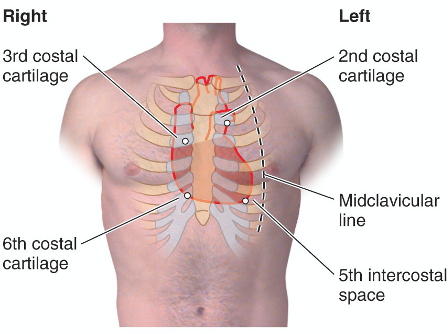
Inspect appearance (color, lesions, scars) and the skin turgor below the clavicles.
Examine the breasts and nipples for symmetry, color, and skin conditions. Note the presence of edema, rashes, venous distention, dimpling, or the lumps of the breast tissue.
For the nipples, inspect for rashes, discharge, new onset retraction.
Axillae: presence of lumps, rashes, and pigmentation changes.
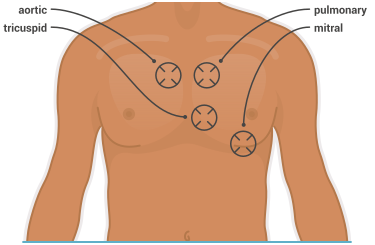
Auscultation
The aortic valve (second intercostal space on the right side of the chest)
The pulmonary
The tricuspid
The mitral at the 5th intercostal space on the left chest.
Auscultation for Breath Sounds
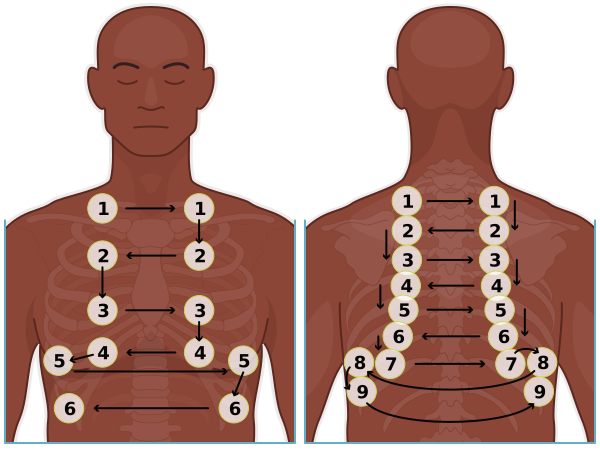
Posterior and Lateral Chest
Assess the posterior chest after the anterior chest unless pt.’s condition necessitate to vary this order. Assist pt. into a side-lying position if pt. cannot sit upright for an assessment of the posterior chest.
Inspect the alignment of the client’s spine and the symmetry of the scapula; breathing posture and pattern; presence of any accessory muscle use and the depth of respiration; and the appearance.
Auscultate and compare the bilateral breath sounds in a ladder configuration. Begin at C7, progress downward at 5cm (2 in) intervals to the level of the lower thoracic spine. Finish with the axillary and midaxillary lines.
Abdomen
Inspect the appearance of the skin, contour, shape, and symmetry of the abdomen; if visible peristalsis, large veins, or pulsations; the umbilicus for protrusions or color alterations.
Auscultate the bowel sounds in the RLQ. There is no need to auscultate the other quadrants if RLQ is audible unless the nurse’s discretion or agency policy requires to do so. Auscultate the other three quadrants if RLQ bowel sounds are absent or hypoactive.
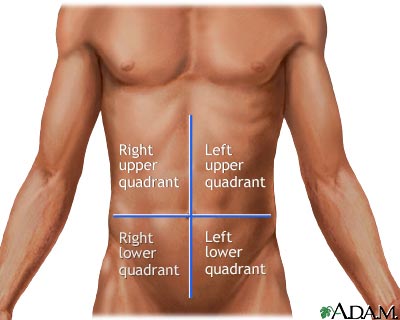
Palpate all four quadrants for any tenderness. Palpate client-identified areas of discomfort last.
Lower Extremities
Inspect the appearance of lower extremities; hair distribution; presence of any venous distention. Inspect the thighs, calves, feet, and toes for symmetry in size and contour and the condition of toenails.
Palpate from thighs down to feet; the posterior tibial and dorsalis pedis pulses bilaterally; and capillary refill on both feet.
Observe the pt.’s ability to perform ROM exercises on the hips, knees, ankles, and feet. Assess and compare bilaterally the muscle strength of the upper and lower legs and the feet.