Fossils and Fossilization
Part I: Fossils and Fossilization
Fossils and Fossilization
Fossils:
Remains, traces, or imprints of once living organisms preserved in the Earth's crust since some past geologic or prehistoric time.
Fossils and Evolution
Fossilization Process
Fossilization is a random process, leading to many gaps in the documentation of evolutionary history.
Types of Fossils
Body Fossil:
Physical remains (exo/endo/basal skeletons)
Trace Fossil:
signs of organic activity, burrowing, motion (track/strails)
Factors Favouring Fossilization
Two key factors:
Possession of hard parts
Quick burial
Types of Preservation/Fossilization
I. Unaltered Remains
hard skeletons or soft parts that remain unchanged.
soft part = insect in amber
hard skeleton = cenozoic shell - bivalve
II. Altered Remains
1. Carbonization
volatile constituents (oxygen, hydrogen, nitrogen) are removed from the organic compound, leaving only carbon as a thin black film.
Commonly found in anaerobic environments (Burgess Shale)
2. Recrystallization
alteration of less stable inorganic compounds (e.g., aragonite) into more stable ones (e.g., calcite) without a chemical or compositional change.
3. Replacement
Original minerals of the skeleton dissolve and are replaced by other mineral substances (e.g., silica, pyrite).
forming a replica of the original structure.
Example: Silicified/petrified wood found in the stone forest in National Park, Arizona.
4. Permineralization
mineral/chemical deposit in holes/pores, most original still there
5. Imprints, Moulds, and Casts
Organic structures can leave impressions if pressed into soft, capable materials (e.g., clay).
Imprints
impression made by thin objects (fish, leaves)
Moulds
impression of skeletal remains on rocks (external or internal).
Casts
organism leaves a mould, filled with sediment/minerals - replica of original
Geological Uses of Fossils
A) Age Determination
Fossils are used to determine the relative ages
certain organisms only existed during certain time periods
B) Correlation
strata connects dif. areas, establishes timeline
C) Paleo-Environmental Analysis
some organisms can only live in certain areas, helps predict climate conditions
D) Record of Life & Evolution
Fossils provide a record of prehistoric life, particularly for forms lacking living representatives, such as dinosaurs.
evidence for organic evolution and the succession of fauna and flora.
Classification of Organisms
Historical Context
Linnaean taxonomy:
Kingdom
Phylum
Class
Order
Family
Genus
Species
Super- or Sub- occasionally used for some groups.
Evolution of Classification Systems
Current classification commonly divides organisms into five kingdoms:
Monera (bacteria)
Protista
Fungi
Plantae
Animalia
Coexists with a system dividing life into two primary divisions: Prokaryote (bacteria) and Eukaryote (animals, plants, fungi, and protists).
Prokaryotes vs Eukaryotes: DNA loosely distributed vs. in nucleus
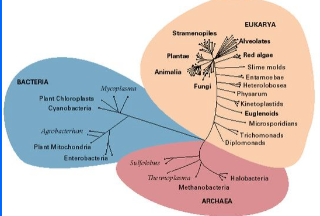
The Three Domain Paradigm of Woese
Archea, Bacteria (P) and Eukarya (E)
Extinctions
Five Notable Mass Extinctions in Earth History:
Late Ordovician (~440 million years ago)
Late Devonian (~370 million years ago)
End Permian (~245 million years ago)
End Triassic (~210 million years ago)
End Cretaceous (~65 million years ago)