Chapter_5
Chapter 5: Individual Level Demand for and Production of Health
Definitions of Health
Health Defined at Individual Level: Health can be understood through two perspectives:
Physiological (Within-the-skin): This defines health as the absence of abnormal physiological functions.
Functional (Beyond-the-skin): This focuses on the ability to perform normal activities, as assessed through objective measures like mortality rates and blood pressure.
Subjective Measures: Health can also be defined based on individual perceptions, including:
Self-assessed health status (e.g., whether a person feels healthy or not)
Self-rated pain levels
Ability to carry out daily activities.
Measures of Health
Mortality-based Measures: These look at whether individuals are alive or dead, along with other statistical measures such as:
Crude Mortality Rate: Number of deaths per 1000 people per year.
Infant Mortality Rate: Deaths in children under 1 year of age per 1000 live births.
Life Expectancy at Birth: Number of years a person can expect to live.
Morbidity-based Measures: These assess the presence or absence of health conditions:
Body Mass Index (BMI): A measure of body fat based on height and weight.
Self-Assessed Health Status: Individual perceptions of their health.
Introduction
Health as an Economic Good: Understanding health is critical for economic analysis as it behaves similarly to traditional goods but with unique characteristics.
Increased health has benefits but can also incur costs. Decisions about health reflect the time, money, and benefits involved in maintaining health.
Health Production Factors
Individual Role in Health: Individuals have significant control over their health production, necessitating a framework to analyze both demand and production of health at an individual level.
Influences on Health: Health decisions are influenced by social factors, such as education and income distribution, which impact health behaviors.
The Grossman Health Capital Model
Health as Stock Variable: According to Grossman's model, health is treated as a stock variable that evolves over time, indicative of a person's health capital.
Investment Decisions: Individuals can improve their health capital by investing in healthy behaviors (like exercise and nutrition) and by utilizing medical care. The model also includes the depreciation of health capital over time due to aging and other factors.
Assumptions of the Grossman Model
Birth and Health Capital Stock: Each individual is born with an initial stock of health that is subject to change based on personal decisions.
Flow of Healthy Time: The health capital yields a flow of healthy time that can be used for work or invested further in health.
Time and Market Constraints
Individuals face constraints regarding time and income when investing in health capital and consumption.
Time Constraints: Limited hours in a day affect how individuals prioritize work, health investments, and leisure.
Income Constraints: Spending on health investments is limited by the individual's total income.
Health Production Function
An overarching equation that attempts to relate health production at the individual level. It faces challenges in measuring outcomes, requiring careful consideration of correlation versus causation, especially in relationships such as income and health.
Further Assumptions of the Grossman Model
Production Constraints: Health investments are made using health care and time, and similar principles apply to other consumption areas.
Depreciation of Health Capital: The model stipulates an increasing depreciation rate of health capital with aging, necessitating greater investments to maintain health capital over time.
Optimal Investment in Health
Individuals must assess the costs and benefits of health investments and determine the optimal level of health capital at any given time.
Optimal Health Capital Trajectory
Each person has a unique optimal health capital level throughout their lifetime, showcasing a dynamic relationship between health investments and consumption of goods.
Grossman’s Consumption and Investment Models
Consumption Model: Highlights indirect utility gained through healthy time that aligns with consumption of goods.
Investment Model: Focuses on health investments leading to future health benefits, stressing the importance of medical care in the present for long-term health.
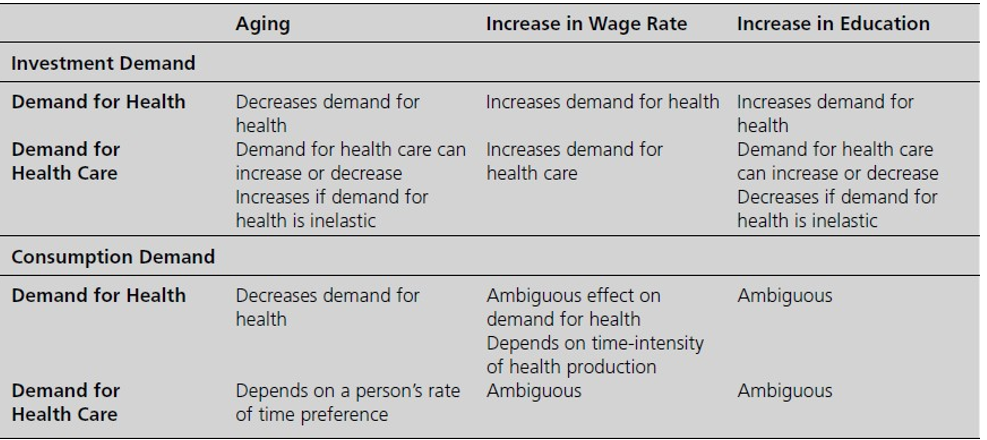
Summary of Grossman Model Predictions
Discusses various factors influencing demand for health, including aging, wage increases, education, and consumption preferences.
Assessment of Human Capital Model
Limitations and Insights: Although prediction may struggle with uncertainty, the model highlights the importance of incentives in health decisions and the derived demand for healthcare. This demand varies significantly by individual characteristics.
Education and Health
Examines vital questions about the relationship between education and health, emphasizing causation, directions, and mechanisms.
Impact of early health on educational attainment: Poor childhood health is often correlated with adverse adult health outcomes.
Education-Health Gradient in Canada
Utilizing statistical data to illustrate the correlation between levels of education and self-assessed health status, chronic conditions, and overall health.
Impact of Education on Health
Explores several channels through which education can affect health, such as the income effect and efficiency in health production.
Health-Related Behaviors
Recognizes the public health implications of behaviors leading to morbidity and mortality, including smoking, poor diet, and lack of exercise.
Economics of Obesity
Charts rising obesity rates across various countries alongside the economic modeling of obesity, emphasizing the importance of caloric intake relative to expenditure.
Suggested Causes for Increased Caloric Consumption
Discusses hypotheses for rising caloric consumption, including price changes and technological advancements in food preparation.
Models of Smoking
Evaluates theories of addiction, specifically the Rational Addiction Model, and its predictions about smoking behaviors relative to price and education.
Quasi-Rational and Irrational Addiction
Addresses limitations of traditional addiction models by incorporating concepts of imperfect rationality and time-inconsistent preferences.