Chapter 13 - Chromatography
13.1 Principles of Chromatography
Widely used technique to separate and analyse substances in a mixture.
Used for inorganic and organic substances (e.g., contaminants in water, toxic gases in air, food additives, drugs in blood).
Three main forms covered: Paper chromatography, Thin-layer chromatography (TLC), Column chromatography
Chemistry in Action: Drug Testing in Sport
Athletes have used performance-enhancing substances since ancient times.
Modern issues: misuse of hormones, manipulation of natural substances.
In horse racing, illegal “go-fast” or “stopper” drugs are rare due to easy detection by gas chromatography.
Urine samples from athletes are routinely tested using gas chromatography + mass spectrometer.
How Chromatography Works
All chromatography methods have:
Stationary phase (solid or liquid)
Mobile phase (moving – liquid or gas)
Simple demonstration (chalk + black ink in water):
Stationary phase = chalk
Mobile phase = water
Produces a chromatogram (pattern of bands/spots).
Key Processes;
Adsorption: adhesion of molecules to the surface of the stationary phase.
Desorption: dissolving back into the mobile phase.
Separation depends on:
How strongly components adsorb to the stationary phase
How readily they dissolve in the mobile phase (solubility/polarity)
Paper and Thin-Layer Chromatography
Paper chromatography: uses high-quality absorbent paper as stationary phase.
Thin-layer chromatography (TLC): thin layer of fine powder (e.g., alumina) on glass/plastic plate as stationary phase.
Both are good for qualitative analysis (identifying what is present).
Paper and Thin-Layer Chromatography in Practice
Small spot of sample placed at the origin.
Paper/plate placed in container with solvent (mobile phase).
Solvent rises up; components move at different rates.
Solvent front: visible wet moving edge of the solvent.
Identifying Components of a Mixture
Two main methods:
Using standards
Run known chemicals (standards) alongside the unknown sample.
Compare positions of spots.
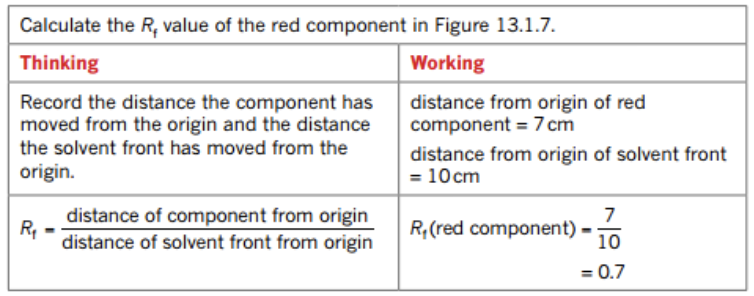
Calculating Rf values (retardation factor)
Rf = distance component travelled from origin / distance solvent front travelled from originRf is always < 1.
More strongly adsorbed (less soluble in mobile phase) = lower Rf.
Each component has a characteristic Rf under identical conditions.
Example
Advantages Comparison (Table 13.1.1)

Thin-Layer Chromatography in Forensic Analysis
Used to analyse materials from crime scenes (chemical weapons, explosives, illicit drugs).
Fast, inexpensive, reliable; portable machines allow on-scene analysis (results in ~30 mins).
High-Performance Thin-Layer Chromatography (HPTLC)
Enhanced TLC with better resolution and accuracy.
Uses smaller samples, specialised equipment.
Can use two solvents (rotate plate 90° for 2D separation).
Column Chromatography
Uses a glass column packed with solid stationary phase.
Sample added to top; solvent (mobile phase) dripped through.
Eluent: solvent leaving the bottom of the column.
Different components move at different speeds and can be collected separately.
Yellow dye in black ink moves fastest (least adsorbed); red and blue move slower.


13.2 Advanced Applications of Chromatography
High-Performance Liquid Chromatography (HPLC)
Also called high-pressure liquid chromatography.
Based on column chromatography but much more sensitive.
Used for separation and identification of complex mixtures (e.g., contaminants in water, drugs in blood, hydrocarbons in oil).
Routine use in environmental, pharmaceutical, and industrial analyses (dioxins, pesticides, oil spills, food pesticides).
Key Features of HPLC
Solid particles in column are 10–20 times smaller than in simple column chromatography → better separation.
High pressure is used to pump solvent (mobile phase) through the column.
Components detected by passing eluent through UV light beam.
Organic compounds absorb UV light → detector records reduced light signal.
Output: chromatogram with peaks (each peak = one component).
How HPLC Works
Sample injected → carried by liquid mobile phase through column.
Components separate based on adsorption/desorption.
Peaks appear on chromatogram at different times (retention times).

Gas Chromatography (GC)
Most sensitive chromatographic technique — detects as little as 10⁻¹² g.
Limited to compounds that vaporise without decomposing (usually relative molecular mass < 300).
Ideal for trace contaminants, tiny amounts of potent compounds, and athlete drug testing (urine samples).
Mobile phase = unreactive carrier gas (usually nitrogen).
Stationary phase = liquid hydrocarbon/ester or solid (e.g., silica gel, alumina).
Gas Chromatography Features
Sample injected and vaporised at injection port.
Carried through heated column by carrier gas.
Components interact differently with stationary phase → separate.
Detected as they exit (e.g., by flame ionisation detector – Australian invention by Ian McWilliam).
Applications of HPLC and GC
Qualitative analysis: Identify what chemicals are present (compare retention times or use standards/spiking).
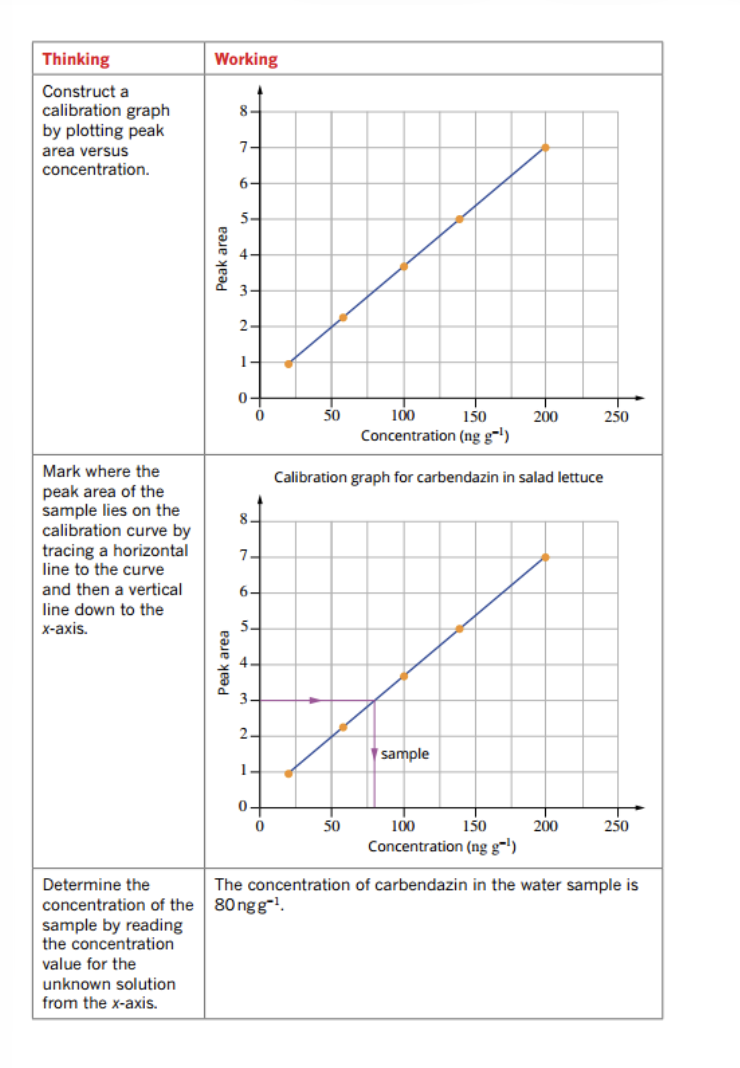
Quantitative analysis: Determine how much of each chemical (peak area compared to standards).
Retention Time (Rt)
Time for a component to pass through the column.
Characteristic for a compound under fixed conditions (like Rf in paper/TLC).
Worked Examples;

Chemistry in Action: What’s in Your Olive Oil?
HPLC used to test olive oil purity.
Pure olive oil has distinct triglyceride peaks.
Impure oil shows extra peaks from cheaper oils (corn, peanut, soybean).
Comparing Chromatographic Techniques (Table 13.2.1 Summary)
Paper/TLC: Cheap, simple, good for polar substances, dyes, drug detection.
HPLC: High sensitivity, small samples, for medium-high mass organic compounds, foods, drugs.
GC: Highest sensitivity, for low mass volatile compounds, gases, biological samples.

Extension: Combining Analytical Techniques
GC-MS and HPLC-MS (mass spectrometry).
Chromatography separates components → mass spectrometer identifies them by mass spectra.
Provides both quantity and structural information.