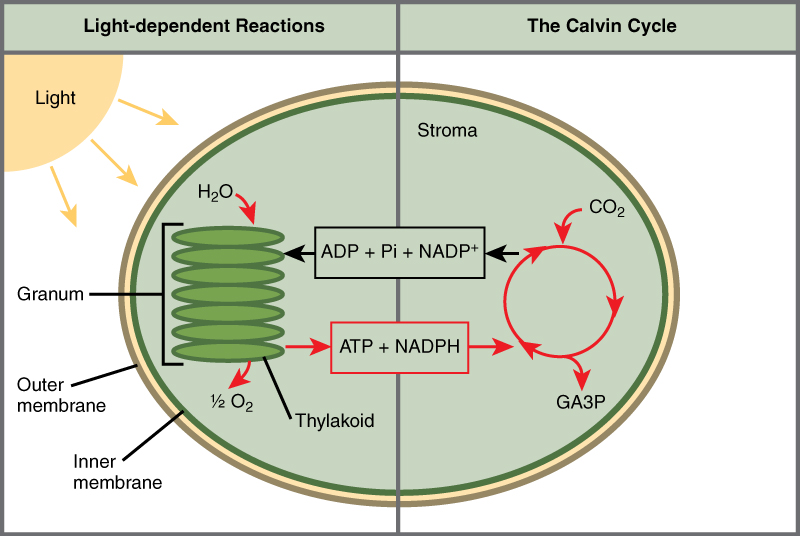
Photosynthetic Redox Pathway
Light Dependant Reactions - Catabolic
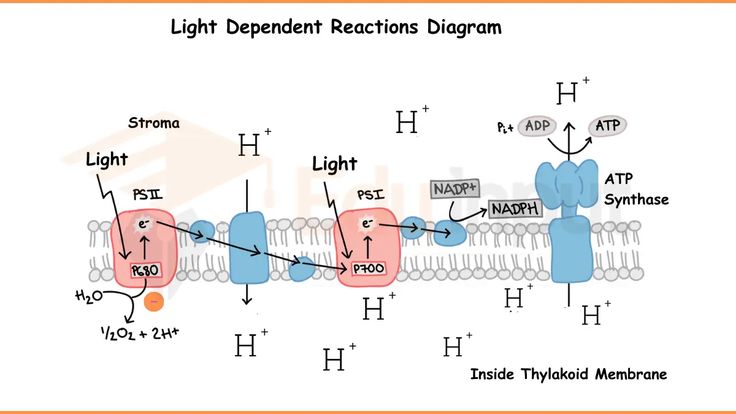
1. Light Absorption - occurs in the thylakoid membranes, where chlorophyll pigments capture sunlight and use its energy to excite electrons.
H2O is oxidized (photolysis), releasing oxygen and hydrogen as a byproduct while providing electrons to PSII that replace those lost by chlorophyll.
2. Electron Transport Chain - The electrons from PSII move through electron carriers. in the thylakoid membrane to NADPH, causing it to be reduced
3. ATP synthesis - The buildup of protons in the thylakoid lumen creates a concentration gradient. The protons flow back into the stroma through an enzyme called ATP synthase, driving the synthesis of ATP from ADP and a phosphate group
Products - ATP, NADPH, and Oxygen
ATP and NADPH from the Light Dependant Reactions are then used to power the Light Independent Reactions.
Light Independent Reactions (The Calvin Cycle) - Anabolic
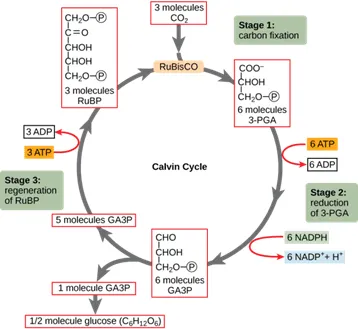
1. Carbon Fixation - An enzyme called RuBisCO attaches a carbon dioxide molecule to a five-carbon molecule called RuBP.
This creates an unstable six-carbon molecule that immediately splits into two three-carbon molecules.
2. Reduction - The three-carbon molecules are then converted into a higher-energy sugar-like molecule (G3P) using energy from ATP and NADPH.
This is where the energy from the light-dependent reactions is converted into chemical energy.
3. Regeneration - Most of the G3P molecules are used to rebuild the starting RuBP molecule. ATP is used to complete this process, allowing the cycle to continue fixing more carbon dioxide.
The few G3P molecules that are not used for regeneration go on to be used to build glucose and other organic compounds.
Products - ADP, NADP+, and Sugars
As these redox reactions are coupled together, they form the process of Photosynthesis, each powering one another to function effectively.
Light Dependant - Catabolic, Oxidation reaction, exergonic
Light Independent - Anabolic, Reduction reaction, endergonic