Protein-Protein Interactions and Methods of Study
Protein-Protein Interactions
Overview
Protein-protein interactions (PPIs) are crucial for various cellular processes.
Types of Interactions:
Stable Interactions: These occur in formations like multisubunit enzymes and molecular machines (e.g., ribosomes).
Transient Interactions: Temporary interactions occurring during processes like enzyme reactions and posttranslational modifications.
Effects of Protein-Protein Interactions
Kinetic Properties Alteration: These interactions can influence enzyme complex kinetics, as seen in allosteric effects exemplified by hemoglobin.
Binding Site Formation: New binding sites or enzyme active centers can form at the interface of interacting protein subunits.
Protein Inactivation: Examples include placental RNase inhibitor affecting RNase A activity.
Changes in Localization and Specificity: PPIs can alter a protein’s cellular location or its substrate specificity.
Evolutionary Advantages of Multisubunit Proteins
Economic Assembly: Easier to construct proteins from smaller subunits (e.g., viral coats) compared to large, complex proteins with repeated domains.
Interchangeable Partners: One protein can interact with different partners, reducing the need for diverse multidomain proteins.
Reduction of Synthesis Errors: Smaller subunits lead to fewer synthesis errors.
Cellular Assembly Efficiency: Subunits can assemble in appropriate cellular environments and combinations for specific functions.
Studying Protein-Protein Interactions
Identification Methods
Methods include physical, molecular biological, and genetic techniques.
Experimental approaches evaluate strength, specificity, and kinetics of PPIs.
Functional assays can further study their physiological roles.
Pull-Down Assays (in-vitro)
Overview
Affinity Pull-Down: Used to study stable interactions with purified tagged proteins, including GST, maltose, hexaHis, and FLAG.
High specificity and sensitivity, can detect interactions with affinities as weak as M.
Confirmation of suspected interactions and discovery of new ones.
Map interacting domains, non-quantitative/semi-quantitative
Problems: non-physiological conditions, do not detect interactions that require posttranslational modifications and false positives/negatives; independent in vivo confirmation needed.
GST Pull-Down Example
GST-fused bait protein incubated with potential interacting prey.
Complexes bound to glutathione resion if formed, non-interacting proteins are washed away; complexes analyzed via SDS gel electrophoresis or Western blot.
Example: GST-Brk pulldown interaction with Drosophila repressors dCtBP and Groucho showed mutation effects on binding.
Immunoprecipitation
Purpose: To study interactions in physiological conditions in cells.
Requirements: Antibodies, tagged proteins that are expressed/overexpressed, may not reflect physiological levels.
Cannot distinguish direct from indirect interactions; requires careful controls including antibody specificity or that interactions are not artificially induced during cell lysis (mutant proteins, knockdowns).
Controls in Immunoprecipitation
Show co-precipitated protein is precipitated by AB itself - monoclonal ABs.
Establish AB does not recognize the co-precipitated protein - use independently prepared AB, cell lines lacking antigen.
Establish interaction is direct and not through another protein - pull-down assay
Establish interaction takes place in the cell - investigate co-localization in cell
Advanced Interaction Discovery Methods
Techniques: Tandem affinity purification, protein microarrays, phage display, yeast two-hybrid.
High rates of false positives/negatives require follow-up verification.
Quantitative Methods for Studying PPIs
General Methods
In vitro assays to quantify interaction strength, typically measured with dissociation equilibrium constant .
Determine by an assay that measures [AB] complex concentration or concentration of Afree/Bfree or concentration of Atotal and Btotal
Direct vs. Indirect Methods
Direct: Gel filtration, equilibrium dialysis. = measure actual concentration of bound and free proteins
Indirect: Optical and enzymatic methods (e.g., ELISA). = imply concentrations from a signal that has been obtained in the experiment
Assays Available in Labs
Common Lab Assays:
Fluorescent assays utilizing changes in fluorescence upon binding.
Tryptophan: enhance or quench fluorescence upon interaction or external fluorophore covalently bound to protein
Pull-down assays, gel shift, and ELISA.
Specialized Assays Requiring Equipment
Isothermal Titration Calorimetry: Measures interaction in solution (requires considerable protein, limited in range).
Fluorescence Depolarization: Measures binding in solution, requires fluorescent labeling that may affect binding
Microscale Thermophoresis: Tracks diffusion changes in thermal gradients with fluorescently labeled components.
Surface Plasmon Resonance (SPR): Measures binding kinetics by observing refractive index changes at a sensor surface upon analyte binding.
Indirect Experimental Methods
Assumes measured signal is directly proportional to the concentration of product
The equation establishes fractional saturation of binding reactions and adopts extinction coefficients for quantification.
FS = (OB-O0)/(Osat-O0)
OB: signal when protein is at certain concentration
O0: signal when protein is not present
Osat: signal at saturation of the reaction (all protein bound)
ELISA
Steps in a conventional ELISA assay to demonstrate protein associations (X to Y):
Coat wells with protein X.
Block non-coated areas with BSA.
Incubate with protein Y.
Add and incubate with primary antibody against protein Y.
Add secondary antibody conjugated with HRP and develop with colorimetric reagent.
Binding Affinity
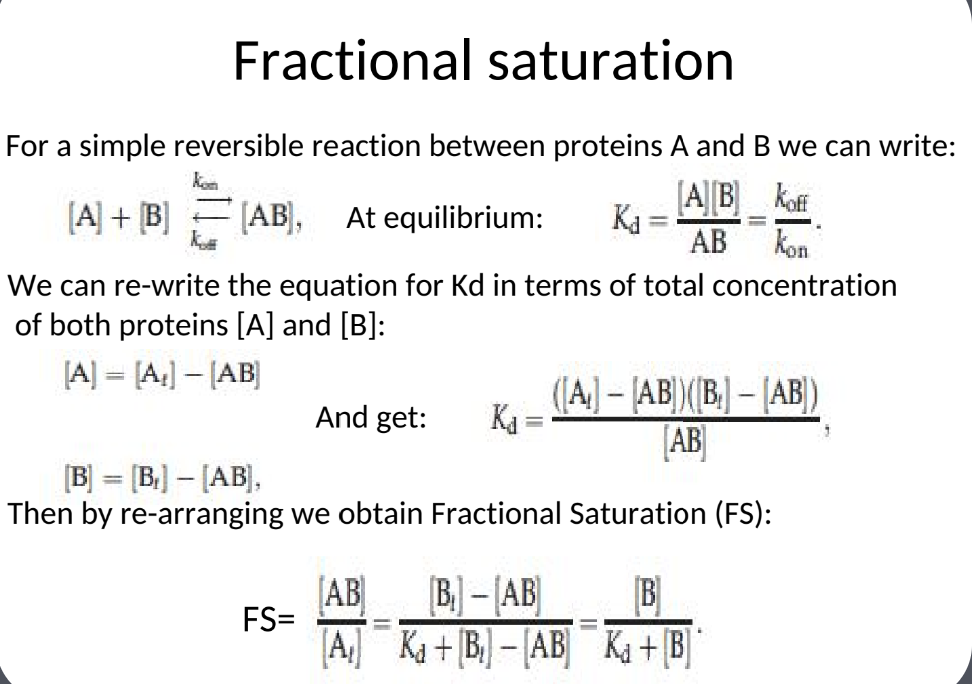
Defined by reversible reactions and governed by the law of mass action.
Velocity of chemical reaction is proportional to the product of concentrations of reactants.
Binding affinity measured by strength of the REVERSIBLE interaction
Expressed as dissociation constant .
Fractional Saturation
Defined for reversible reactions to help derive the relationship with total concentrations of proteins involved.
Rearranging results in equations relating and fractional saturation (FS).
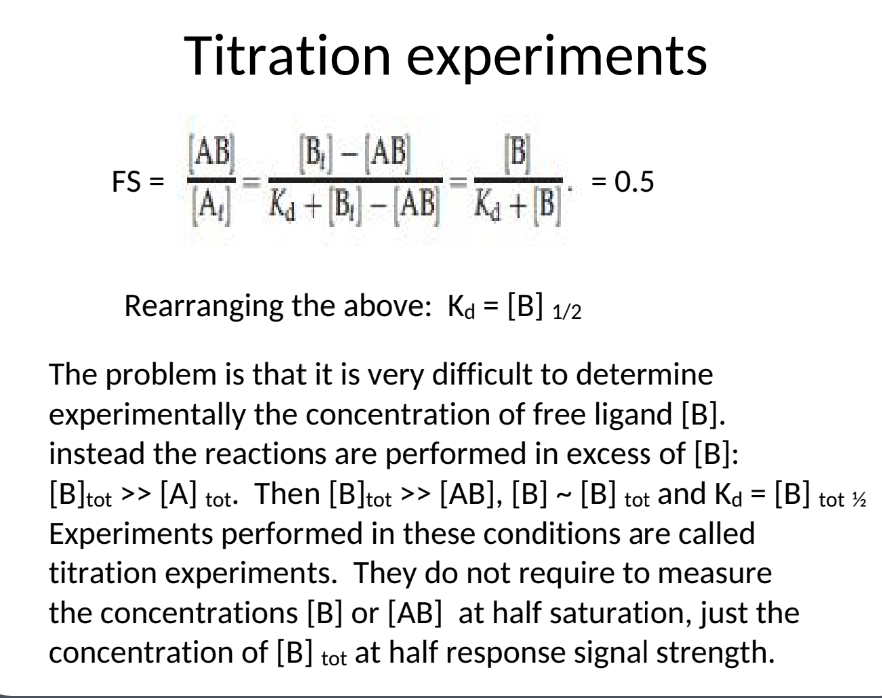
Outcomes of Titration Experiments
If [B]tot « = almost no [AB] complexes
If [B]tot = = 50% of [A] will be in complex [AB]
If [B]tot » = most of A will be in complex
[B] ~[B}tot
Very difficult to measure concentration of free protein so you use in excess. Btot = whatever we add
Strength of interactions
= nM to pM (10^-9 to 10^-12 M) = high affinity interactions
=uM (10^-6 M) = moderate affinity interactions
= mM (10^-3 M) = weak affinity interactions