Persuasion
Is Persuasion an Outcome or a Process that is engaged in whether successful or not?
A working definition of Persuasion:
Persuasion involves one or more persons who are engaged in the activity of creating, reinforcing, modifying, or extinguishing beliefs, attitudes, intentions, motivations, and/or behaviors within the constraints of a given communication context.
How do we change behavior?
get someone to do what you want them to do? or not do what you don’t want them to do?
to change Behavior, you Must change attitudes towards a behavior.
Attitude:
Learned predisposition to respond favorably or unfavorably toward some attitude object.
Psychological CONSISTENCY
People like to appear as if they’re making the same choices again and again.
People like to appear to be reliable.
Humans like consistency
Humans demonstrate consistency by making stable reliable choices over and over again.
Cognitive DISSONANCE
Consonant Beliefs: Consistent with one another I prioritize my health and I eat healthy foods!
Cognitive dissonance: When beliefs and behaviors don’t line up!
Dissonant Beliefs: Inconsistent and at odds
I prioritize my health, but I eat unhealthy junk food… Now what?
talking our way into different behaviors.
COMPLIANCE-GAINING STRATEGIES
RECIPROCITY: When given a gift, people feel obliged to return the favor.
ex: giving tickets to a friend prior for a fun basketball game, then asking someone later for help studying for an exam
THE CONSISTENCY PRINCIPLE: You always do this, so you should do it now, or you never do it, so you should NOT do it now. e
Implying that someone will be perceived as an inconsistent person if they make a different decision.
THE FOOT-IN-THE-DOOR PRINCIPLE
Get you on my side in a small request… then once they’ve committed, coming back with a larger request because they’re someone that has done a favor for you before.

THE DOOR-IN-THE-FACE Technique
Ask someone for something Large that is so unreasonable they decline, then asking for a smaller request so they no longer feel bad. “can you at least help us with this little thing…” ( 50 pg paper suggested that then is reduced to 10 pages… that’s more reasonable.")

LOWBALLING

Getting someone to agree to a deal/some terms, and then once someone commits, the deal gets changed.
Person affected will act shocked… but many people don’t walk away.
Most people with the pressure and peer pressure begin agreeing to something
When Someone’s trying to change your mind, are you:
Person A: Show me facts, statistics, and well-reasoned arguments that show why I should agree with you.
Person B:
depends on the scenario
ELABORATION LIKELIHOOD MODEL
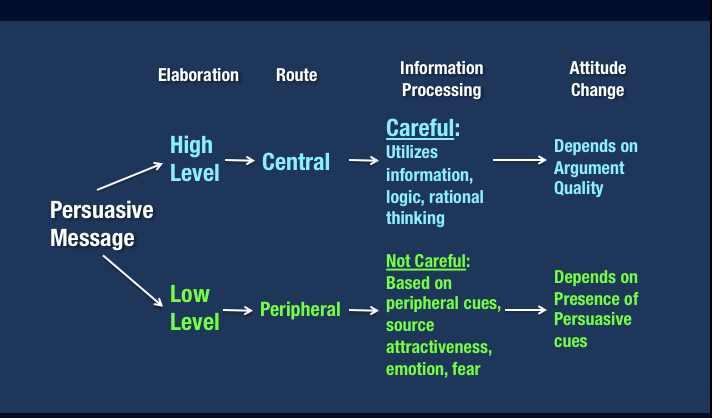
CENTRAL ROUTE:
A MORE CAREFULLY planned track that utilizes info processing
PERIPHERAL ROUTE
Persuasive cues where not as careful info processing is required
Persuasion in Context
Marketing Communication
Where do we position our product and company
How do we get customers to identify with us and go… “I identify with them and I want to purchase from that company”
Value of a company and objectives of a company all part of marketing
How do we communicate about our company to other people
Advertising
When a company pays for access to a space or time thats given to promote a company
Advertising is one way… we are telling you to by our stuff and we spend money doing so.
Public Relations
a strategic communications process that allows companies to communicate with relationships that are needed for the company to do well.
The ways in which we interact with other people
how we build relationships between an org/company and a community.
All rooted in getting others to think favorably of a company or get the company to perform or do well.
Credibility
In order to be persuasive... you have to be credible
Credibility or lack thereof can cost you the ability to persuade.
Has 3 key pieces
Trustworthiness: is what is happening with you believable
Expertise: does this person know what they are talking about.
Goodwill: does this person care about me?
How do you IMPROVE your own CREDIBILITY
Adapt your style to your audience. (apply the needs of the people)
Emphasize similarity. CREATE EMPATHY. (make people go, I get them and they get me)
If you have low credibility, emphasize receiver involvement.
it’s important for you to listen to me because you need it.
Have a credible source introduce/endorse you.
Someone credible making a connection for you. “Hey this is Joe their a student at the University of Connecticut…”