PSYCHOLOGICAL SCIENCE AND SOCIETY
evidence can make a claim - anecdotal but it does not account for all experiences
After you finish this module, you will be able to:
Explain how science is relevant to everyday life.
Identify the major elements of a scientific study from its abstract.
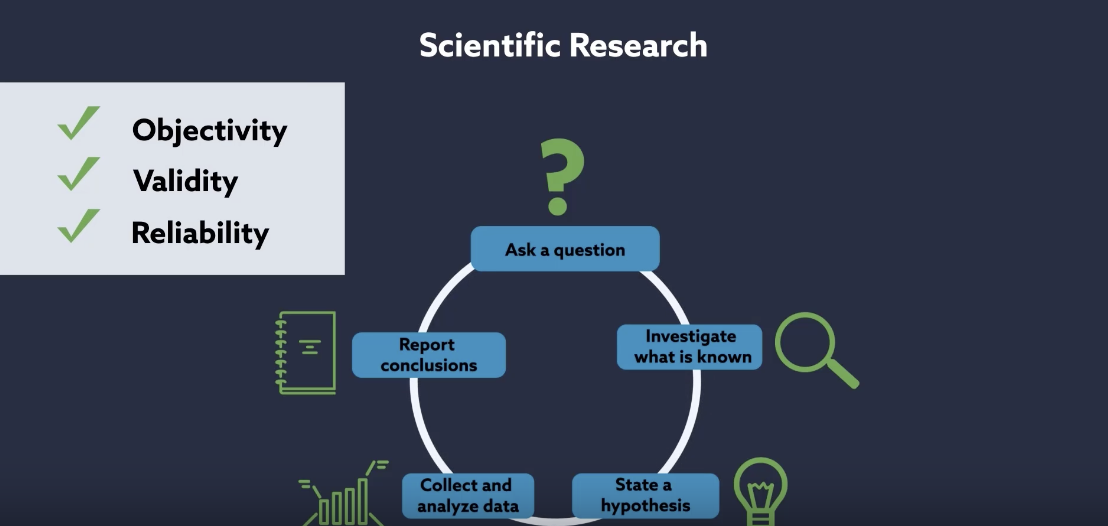
Apply the steps of the scientific method.
Distinguish between basic and applied research.
Explain how scientific knowledge progresses.
Identify the characteristics of scientific practices.
Distinguish pseudoscientific claims from scientific findings.
How science is relevant to everyday life + Major elements of scientific study
Science relevance- impacts personal decisions or schools, employers, and communities decisions (along with education, healthcare, commerce, studies)
Science impacts not only personal decisions, but also decisions made by the healthcare, educational, and trading systems that people interact with in day to day life.
Abstract - nearly every scientific research article contains it
Sections of abstracts:
Background - authors describe why the conducted the study (goal, objective, justification)
Methods - how the study was conducted (pop studied, sample method, stats)
review art - how articles were selected
Results - what was found from study (description not a interpretation)
Conclusion - describe results and how findings would be relevant to society or the theory they tested
Research Skills for Scientific Method
Research - process of collecting info to answer a question
Critical thinking - heart of all skills listed below, identifies good questions, examines info from question, design a study for hypothesis. EXAMINES weaknesses and strengths of your study
consider whether there are alternate explanations that explain the study
Data tracking - develop a systematic way to store, organize, and retrieve data
Preparation and delivery of presentations - tailor presentation to needs of audience
Problem solving - account for problems that arise during research
Data analysis -stats based on data (mean, median, mode) t-test for more complex
Application of ethics - no harm, consult others to make sure of
Location, organizing, evaluating, info from various sources
Report writing - intro, methods, results, conclusion - clearly and succinctly communicate
Teamwork
Everyday ex. of research methods knowledge and skills
assessment of situations -objectively observe and record situations events, document reasonable causes and decisions to address situations
complaints sent to transportation dept, head of dept
evidence-based decision making -locating, critically, reviewing, and synthesizing evidence in scholarly journals - knowledge study designs (descriptive, correlational, experimental) and the claims for results of each
A toy manufacturer wants to apply concepts related to physical, cognitive, and psychosocial development to determine the age ranges appropriate for new games it is developing.
Evaluation of outcomes -how to get permission to conduct a study, recruit participants, what and how to measure.
hospital admin asks if family of patients are less anxious with a sort of invention
Scientific Method
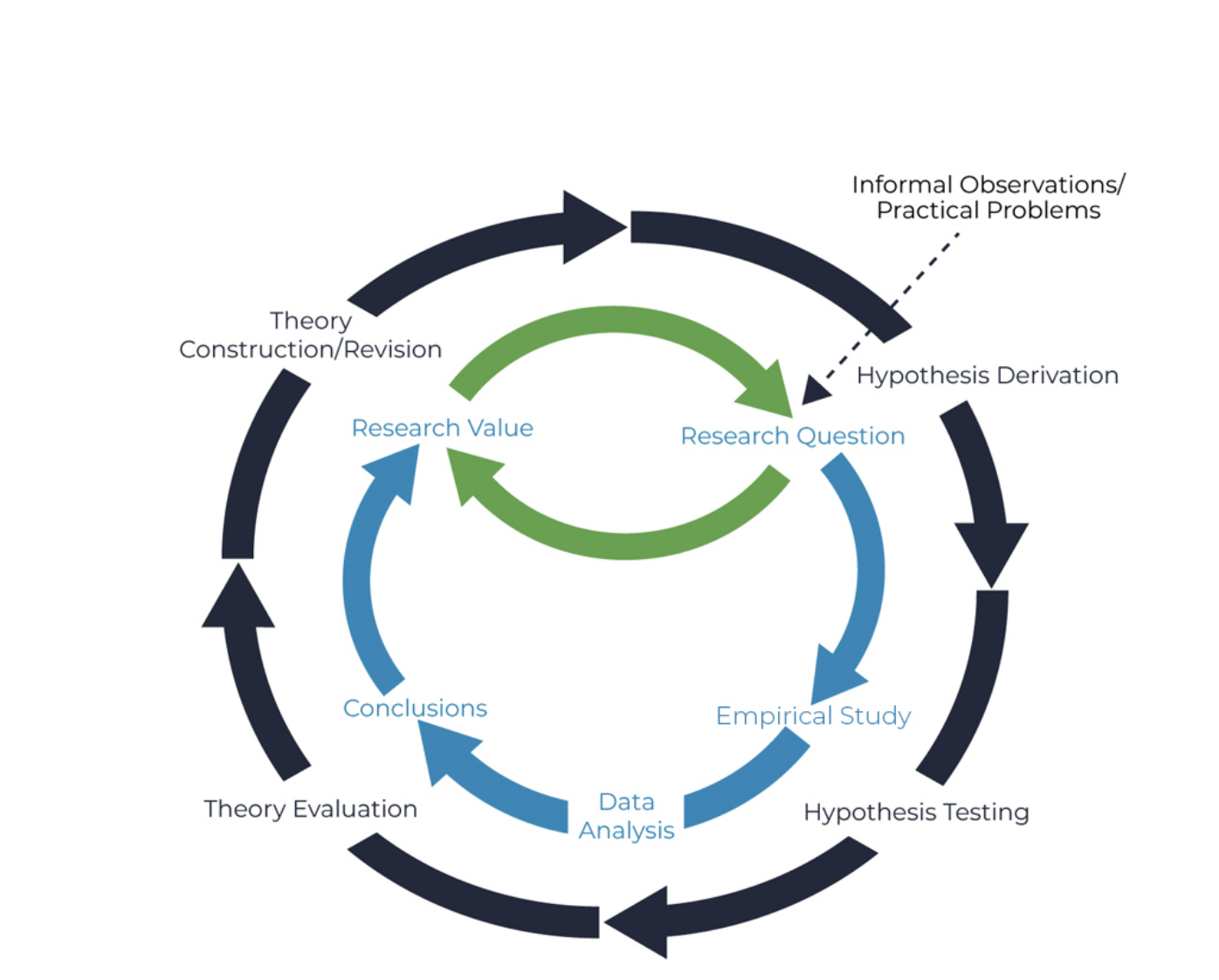
Observe a Phenomenon
Ask a question - what is causing it’s occurrence
Review the Literature - what is already know about the study
Form a hypothesis - testable prediction
test hypothesis - what research design best fits the study
analyze the data - what does the data show
draw conclusion - what’s concluded and how should the finding’s be shared - researcher propose a revision to an established theory
revise theory
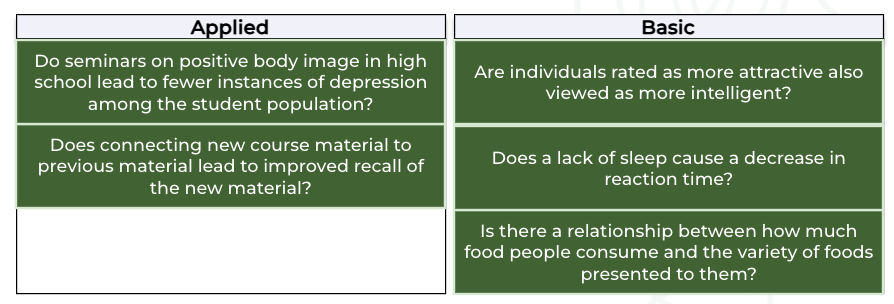
Applied research - designed to address problems “how can we use this knowledge to help solve problems
built on finding from basic research
uses that knowledge to develop and asses treatment plans for the disease.
partial problem - generate a solution for society to use
Basic research - is designed to gain to a better understanding with “why or how does this work“
how cells respond to diet, exercise. Certain rewards increase behaviors
Basic Research | Applied Research |
|---|---|
Aims to expand knowledge | Aims to solve real-world problems |
Driven by curiosity and theory | Driven by practical needs |
Not immediately useful for application | Directly useful for application |
Example: Understanding how stress affects the brain | Example: Creating stress-management programs for workplaces |
Characteristics of Science
deterministic - phenomena are caused by natural cause, can be discovered and explain. Believed information that is from the natural world
empirical - science is measurable, objective, reproducible evidence and not pure reason, emotion, or subjective experiences
testable and falsifiable - theory or hypothesis is not scientific unless it can be tested and shown to be false
provisional - a scientific theory is always open for revision based on new evidence. current theories are not always correct, good to know how much evidence there is for a theory
public -public good that benefits societies
value claims - describe the value from a variable (freq or amount)
association claims (correlations)
identify relationships from measured variable
make predicitons from one vari to another
strength of relationships lead to degree of confidence in prediction
causal claims - isolate the effect of one variable
manipulated
Characteristics of Pseudoscience
claims based on consensus often guided by the collective “full moon - strange behavior = opinion not research”
anecdotal evidence - astrology is based off personal anecdotes not scientific data
claims not open to falsification - claim cannot be proven wrong = cannot be tested - freud’s claim about the unconscious cannot be proven right or wrong as unconscious beings are unaware
attempts to prove something to be true -conversion thearpy
lacks openness - if past studies, evidence, or methods are not public’
Summary
Abstract: Short summary of a research study typically found at the beginning of a journal article.
Applied research: Research designed to solve a practical problem.
Basic research: Research designed to expand the body of knowledge on a topic.
Deterministic: All natural, social, and psychological phenomena are causally determined by preceding events or natural laws.
Empirical: Science is based on objective, reproducible evidence and not on pure reason, emotion, or subjective experiences.
Falsifiable: A theory or hypothesis is not scientific unless it can be proven false.
Hypothesis: A specific, testable prediction.
Literature review: The process of investigating existing research related to a topic of interest.
Provisional: All scientific knowledge is open to further testing and revision.
Pseudoscience: Non-scientific claims that may sound scientific, but fail to meet key criteria of scientific research.
Research: The process of collecting information to answer a specific question using the scientific method.
Scientific method: The process of observing a phenomenon, asking a question, determining what is already known about that question, constructing a hypothesis, collecting data, analyzing data, interpreting data and reporting results, then revising a theory and circling back to ask a new question or create a new hypothesis.
Theory: A related group of empirical findings that help explain a specific phenomenon.