Nursing Foundations
Development of the Nursing Profession:
Nursing is defined by the ANA as follows.
Protecting, promoting, and advancing clients’ health
Averting illness and injuries through health promotion
Using the nursing process to facilitate clients’ recovery from illness or injury
Minimizing or eliminating clients’ suffering
Advocating for the care and health of the client, family, or community
Nurse practice Act → rules, definitions, and regulations that guide how a licensed nurse SHOULD act
ANA’s Scope of Nursing Practice → provides the different roles of a nurse & the expectations for that role
ANA’s Standard of Nursing practice → Describes what level of competent care 7 professionalism all nurses should have
Code of Ethics → helps nurses with decision making
outlines rules for nurses about:
how to act
client privacy
behaviors that protect the client
nursing is all about patient centered care & what is best for the patient
Evidence Based-Practice → using evidence from research to guide nursing interventions & clinical judgement
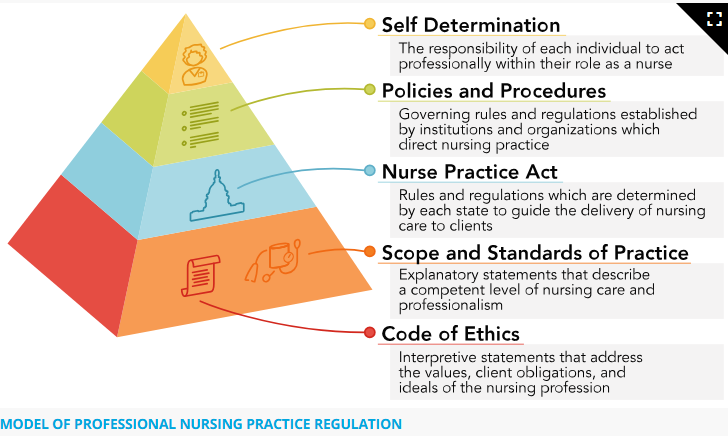
Code of Ethics: Values and ideals of the nursing profession
Scope and standards of practice: Nursing care and professionalism competency statements
Policies and procedures: Health care organization rules and regulations that direct nursing practice
Nurse Practice Act: State rules and regulations to guide nursing care delivery
Self-determination: The responsibility of the nurse to act professionally
Nurses & their contribution:
Florence Nightingale
Started nursing schools
Data collection (Evidence based practice)
Clara Barton
Founded the American Red Cross
Formalized nursing education
Dorothea Dix
Indigenous rights
Mental health awareness
Eddie Bernice Johnson
Created opportunities for minorities
U.S. Congressional representative
Ildaura Murillo-Rohde
Founded the National Association of Hispanic Nurses
Nursing Education:
Prelicensure Nursing program:
LPN → licensed practice nurse
degree obtained in 1 year
LVN → licensed vocational nurse
degree obtained in 1 year
RN → registered nurse
degree obtained in 2-4 years (dependent on the program)
Diploma nurse: hospital based, non-degree
ADN: associate degree in nursing
BSN: bachelor’s degree in nursing
Graduate Nursing programs:
MSN → masters of science in nursing
Doctoral
DNP → Doctor of Nursing practice
clinical practice degree
PhD → Doctor of Philosophy in nursing
research based degree
Nursing Delegation & Roles:
LPN & LVN work under supervision of RNs
Designed to meet the demands for care under a nursing shortage by allowing candidates to earn an RN degree in only 2 years → ADN
Prepares the advanced practice nurse for leadership roles and clinical practice when caring for clients with complex needs → DNP
These individuals must practice under the supervision of another nurse. Degree obtained within 1 year. → LPN
Nurses who earn this degree have a wider range of competencies related to research, leadership, community health care, developing health policy, and quality improvement processes. → BSN
A terminal degree that is research- and science-focused, with an emphasis on evidence-based analysis of statistics and research → PhD
Nurses who choose to further their education, work in advanced practice, or pursue higher education will pursue this graduate degree. → MSN
Transitioning from Novice to Expert nurse:
Stage 1: Novice
This initial stage covers nursing students and new nurses who have no previous experience. Novices cannot yet draw on their own judgment. The novice struggles to decide which tasks are most relevant in real-life situations.
Stage 2: Advanced Beginner
The advanced beginner has been involved in enough real-world situations to be able to recognize patterns and recurrent situations. A problem at this stage is that the focus is on remembering and following the rules and guidelines that have been taught. The advanced beginner needs clinical support to set priorities so that clients receive the care they need.
Stage 3: Competent
The competent nurse is able to prioritize tasks by drawing on past experiences. These nurses may not function with the same speed or ease of change as proficient nurses, but they have mastery in multiple areas. Competent nurses recognize patterns in clinical situations more quickly and accurately than advanced beginners can.
Stage 4: Proficient
The proficient nurse is able to understand the bigger picture or the desired outcome of situations, which facilitates improved decision making. Proficient nurses are able to respond to changing situations and modify plans in the face of different events.
Stage 5: Expert
The expert nurse has extensive experience and knowledge to draw from when responding to complex client conditions. At this stage, nurses have self-confidence and trust their intuitive sense of a situation. Expert nurses know what needs to be done and are able to perform it well.
