Lesson 8: Saline soils
Saline soils: high concentrations of ions (soluble salts) in the soil solution that affect plant growth.
Sodic soils (alkaline soils with sodium carbonate): with elevated concentrations of Na adsorbed on the exchange positions of clays that can disrupt the soil structure. This increases the pH above 9, breaking the soil structure.
Salinization: accumulation of salts more soluble than gypsum (2.6 g/l at 20 ºC)
The most representive soils are solonchaks. The have Az and salic horizons.
Origins:
Natural: marshlands, coastal plains, internal zones. High environmental interest due to the soil characteristics and the halophytic vegetation.
Poor irrigation water management: most of the irrigation agrosystems show salinization problems worlwide
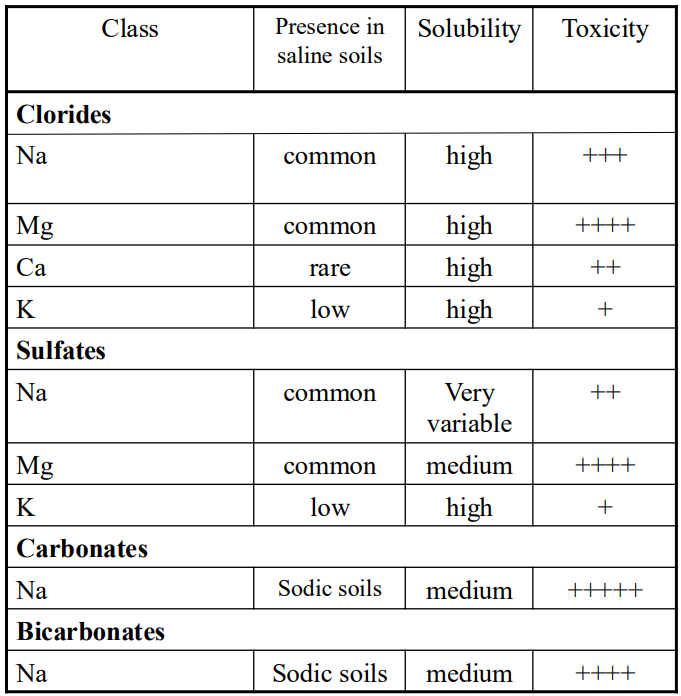
Origin of salts in soils
Parent material: sedimentary rocks, evaporites, halides. Coastal areas.
Relief: accumulation of salts due to runoff waters (hollows, dells, etc.). Water fronts close to the surface that rise by capillarity.
Wind: contamination in dry areas (carbn, sulf., clorides)
Unsuitable irrigation, fertilizers, industrial activities (aquifers´overuse: marine intrusion).
Salt accumulation needs:
Slow or impeded drainage: Fine texture or surface impermeable layer.
Dry climate: risk if Pp/ PET < 0.75 (FAO)
Ions
Principal cations: Na+ , Mg2+ y Ca2+ .
Principal anions: Cl- , SO4 2- , HCO3 -
Salts more soluble than gypsum
Gypsum (CaSO4 . 2H2O), 2.6 g l-1
Most frequent:
Clorides: NaCl, CaCl2 , MgCl2 , KCl
Sulfates: MgSO4 , Na2SO4
Nitrates: NaNO3 , KNO3
Carbonates: Na2CO3
Bicarbonates: NaCO3H
All the compounds that have Na are toxic, because Na doesn´t form structure, it breakes it due to it´s volume and charge. This occurs speceally with Na carbonate. This toxicity is related to plants.
The soil solution rises to the surface by capillarity, evaporates and salts accumulate (saline efflorescences). This inhibits the normal growth of plants, so we are only going to find halophytic vegetation.
By osmosis, the water moves in order to make both mediums equally concentrated. So when the concentration of salts is very high, the water form the plants exits the cells, making them die from dehydration.

Saline soil classification:
0 → no problems
2 → slighly saline (affects sensitive crops)
4 → saline (affects most crops)
8 → strongly saline (affects tolerant crops)
16 → extremely saline (affects almost all of them )
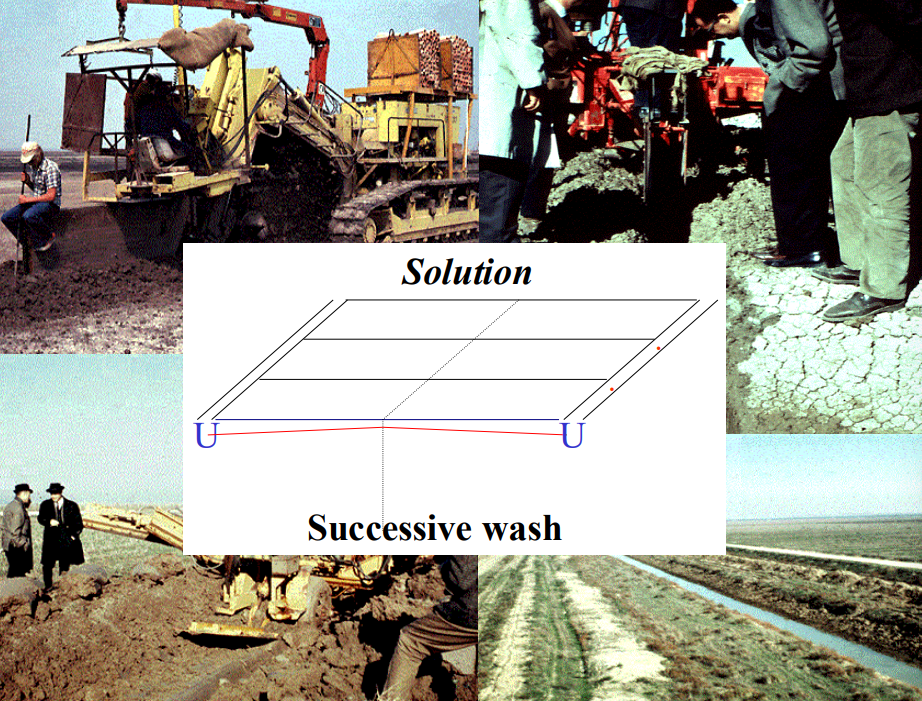
The salts are slowly removed from the soil thanks to the washing with water.
Specific effects os salinity:
Delay or inhibition of plant germination
Smaller plant size
Necrosis in leaves
Yield decrease
Plants and saline soils
They can have salt glands, which allows them to expell the excess salt from their body.
We can highlight various examples:
Permanent flooding: Juncus maritimus, Phragmites australis
Seasonal flooding: Arthrocnemum, Halocnemum, Salicornia, Sarcocornia
Without flooding: Limonium, Lygeum spartum
Sodic soils
With a subsurface horizon rich in clay and unstable structure, compacted or columnar structure. The Exchangeable Sodium Percentage (ESP → Na/CEC * 100) is equal or higher than 15%. Soil pH < 8.5
This destroys the horizons that have a lot of clay that is saturated with Na. This generates a lot of OH- ions, raising the pH.
Alcaline soils: with the same characteristics attributed to sodic soils but also high sodic carbonate contents, thus increasing their pH: 9-12. These high pH values condition adverse physical properties.
Sodicity
Na+ saturates the exchange complex
Giving its low charge density, Na+ promotes clay dispersion and organic matter solubilization
In the presence of water, clay minerals saturated with Na+ solubilize:
Clay-Na + H2O + CO2 Clay-H + Na2CO3
Na2CO3 2Na+ + 2OH- + H2CO3
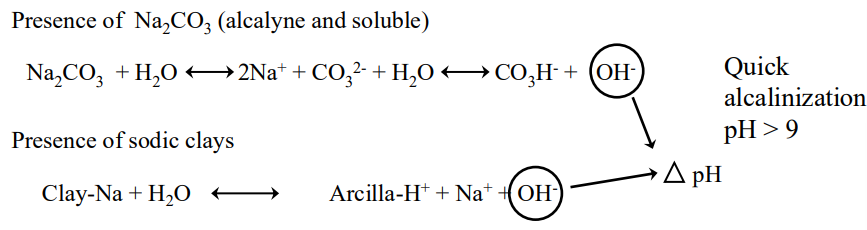
Alcaline hydrolisis (pH > 9)
Silica gets more soluble, part of the clay minerals are destroyed in the E horizon, at the contact with the Btn (natric horizon). The edges of the prisms get rounded and cracks appear.
This natric horizona has a very specific column structure

Acid hydrolisis
If the soil progreses and it´s liberated from the previous process, Na washes aout and decreases de pH, making the craks become deeper.
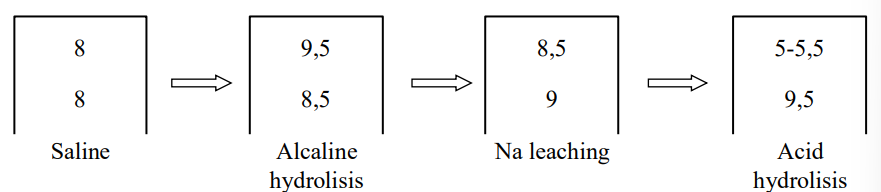
This soils cannot be washed because this lowers the pH. To remediate it, we add gypsum. Ca is exchanged for Na in the exchange complex and Na is released into the soil solution. Then remove the Na with a good drainage.
Consequences:
Alkalinization changes the soil´s physical properties.
Soil aggregates are destroyed.
Clay and organic matter illuviation that accumulate in the B horizon.
Shrinking and swelling give rise to a prismatic structure.
Strong hydrolysis of the clays in alkaline medium that originates a column structure.
Harmful effect of sodium for plant metabolism and nutrition.
Toxicity due to sodium carbonate content.
pH increase due to the accumulation of sodium carbonate and bicarbonate.
Sodium sulphate is less toxic.
Clorides are highly toxic.
Measurement of sodicity
Na concentration can be measured:
In the soil solution (SAR → sodium absortion ratio)
In the exchange complex (ESP)
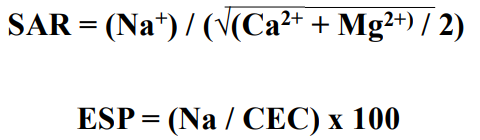
ESP = (100 x (0,01.475 x SAR) – 0.0126)) / (1+(0.01475 x SAR) - 0.0126))
Soil differenciation

Parameters to mesure when sampling irration water:
Dry residue (g/l)
Dissolved solids (g/l)
Suspension particles (g/l)
Electric conductivity (dS/m)
Clorides (Cl- ) (mg/l or meq/l)
Sulfates (SO4 2- ) (mg/l or meq/l)
Carbonates (CO3 2- ) (mg/l or meq/l)
Bicarbonates (CO3H- ) (mg/l or meq/l)
Sodium (Na+ ) (mg/l or meq/l)
Calcium (Ca2+) (mg/l or meq/l)
Magnesium (Mg2+) (mg/l or meq/l)
Boron (B3+) (mg/l or meq/l)
Special cases: NH4 + , NO3 - , Cu, Zn, Pb….
Determine the soluble salts more likely to be present in an irrigation water with the following analysis:

The aim is to see if this molecules are present:
NaCl
MgCl2
Na2SO4
Mg(HCO3)2
Ca(HCO3)2
We need to obtain the DS and SP in g/l
We need to take into the account the the number of equivalets = g / Weigh equivalent
Weq = molecular or atomic mass/ valencia