Nicotine Dependence
Assessment Strategies for Nicotine Dependence
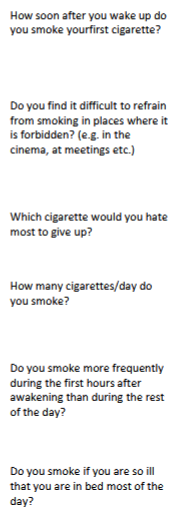
The Fagerstrom Test for Nicotine Dependence:
This is a specialized quantitative tool used to determine the level of a patient's nicotine dependence.
Structure: It consists of six specific questions concerning patient behavior and smoking habits.
Scoring Mechanism: Each answer is assigned a point value. A higher cumulative score indicates a higher level of nicotine dependence.
Interpretation: There is no specific numerical threshold to distinguish between dependence and non-dependence. Instead, the scale is used relatively to measure the intensity of the addiction.
Question Types:
Binary: Some questions are simple "yes/no" responses.
Quantitative: Other questions are more granular, such as asking specifically how long after waking up a patient smokes their first cigarette.
Focus: The test evaluates physical and behavioral needs, prioritizing how urgently the patient feels the necessity to smoke.
American Psychiatric Association (APA) Criteria:
The APA publishes the Diagnostic and Statistical Manual (DSM), which contains standardized criteria for diagnosing mental syndromes and disorders.
Diagnostic Shift: The manual recently transitioned from using the term "Nicotine Dependence" to "Tobacco Use Disorder."
Conceptual Change: This shift moved away from measuring simple physical reliance on nicotine toward evaluating how the reliance affects the patient's daily life and social functioning.
Diagnosis Threshold: A patient is diagnosed with Tobacco Use Disorder if they meet at least two specific criteria within a 12-month period.
Key Indicators: The criteria focus on whether smoking interferes with normal activities or causes the individual to behave in ways that are uncharacteristic of their normal identity.
Neurobiological Mechanisms of Addiction
The Dopamine Reward Response:
All addictive substances share the commonality of triggering the brain's reward system.
Mechanism: Nicotine causes an increase in dopamine secretion, which subsequently stimulates the increased release of glutamate.
The Transition from Liking to Craving:
Initial Phase (Liking): Early tobacco use creates a pleasurable, rewarding feeling that is qualitatively "better" than the baseline state.
Later Phase (Craving): Over time, the experience shifts. Rather than feeling good while smoking, the patient feels "awful" when they are not smoking. The behavior becomes driven by the need to avoid the negative state of withdrawal rather than seeking a positive reward.
Neural Pathways: This addictive process occurs through the same neural pathways utilized by highly addictive stimulants such as amphetamines and cocaine.
Serotonin Receptor Expression and Anxiety:
Nicotine affects the serotonergic system through a complex imbalance of ligands and receptors.
Mechanism: Nicotine decreases the production of serotonin (the ligand) while simultaneously increasing the expression (upregulation) of serotonin receptors.
Psychological Impact: High levels of vacant receptors combined with low levels of the necessary ligand signal the brain that something is missing, resulting in high levels of anxiety.
Anxiolytic Effect: When a dependent individual smokes, the nicotine acts as an anxiolytic (anxiety-reducing agent) to temporarily block the anxiety caused by this biological imbalance.
Opioid Receptor Interaction:
There is significant crosstalk between nicotine and the opioid receptor signaling pathway.
This interaction serves as an additional, distinct mechanism reinforcing nicotine dependence.
Determinants of Addiction: Nature vs. Nurture
Environmental Factors (Nurture):
Current research suggests that environmental factors (nurture) are more influential in the development of smoking habits than genetic predisposition (nature).
Exposure: Individuals exposed to tobacco at a young age or in continuous proximity are significantly more likely to become smokers regardless of their genetics.
Socioeconomics: Lower levels of formal education are statistically correlated with higher rates of tobacco usage.
Social Acceptance: Acceptance levels vary by time and geography. Tobacco use in the United States is currently less socially accepted than it was 10–20 years ago. However, the same individual might develop a stronger addiction if living in a region where tobacco use is more culturally integrated.
Marketing: Exposure to nicotine and tobacco advertising is a proven driver of addiction.
Biological and Genetic Factors (Nature):
Neurotransmitter Synthesis: Some individuals are more prone to addiction due to variations in the and genes. These genes are responsible for the synthesis of serotonin and dopamine.
Dopamine Reuptake: Genetic variations in the proteins responsible for the reuptake of dopamine can increase addiction risk. If an individual fails to reuptake dopamine efficiently, the dopamine released by nicotine has a longer, more intense effect on the brain, making the substance more rewarding and addictive.
Metabolism and the Gene:
The gene is responsible for the metabolism of nicotine into its byproduct, cotinine.
Polymorphisms: Genetic variations (polymorphisms) in can cause individuals to metabolize nicotine more slowly.
Impact on Dependence: Slower metabolism is associated with a reduced overall dependence. This may be because slower metabolism results in a "flatter" nicotine concentration curve in the blood rather than sharp peaks.
Treatment Difficulty: Although these individuals may be less likely to become addicted, they generally show a poor response to nicotine replacement therapy (NRT) and find it harder to break established addictions through that method.
Nicotine Withdrawal and Cessation
Prevalence: Withdrawal symptoms are most prominent in patients with heavy nicotine dependence. Those with mild dependence may experience them, but they are often not severe enough to derail cessation efforts.
Common Withdrawal Symptoms:
Agitation and Restlessness: General irritability and inability to remain calm.
Cognitive Impairment: Difficulty concentrating. This is exacerbated because nicotine naturally increases concentration; losing the drug results in a drop below the patient's normal baseline.
Anxiety: Often cited as the most distressing symptom reported by those attempting to quit.
Appetite and Weight Gain: Weight gain occurs because nicotine normally suppresses appetite. Dependent individuals are often underweight; withdrawal can cause a reversal of this effect, resulting in increased food intake.
Sleep Disturbances: This includes insomnia (being awake when wanting to sleep) or excessive drowsiness occurring at inappropriate times.
Cravings: Intense, overwhelming urges to smoke cigarettes to alleviate the physical and psychological distress of withdrawal.