Ch. 6 Membrane Potential
Neurons Functions
Excitability
Conductivity
Exclusive to neurons
Secretion
Neurons
Review Neuron Anatomy & Synapse
Axon Hillock — trigger sone, lowest threshold because it has great density of voltage-gated Na+ channels
Can be excitable faster in that region
Axon Terminal — output zone to synaptic knob

Electrochemical Gradients
Talks about ions (they have charges)
Combination of electrical and chemical concen gradients
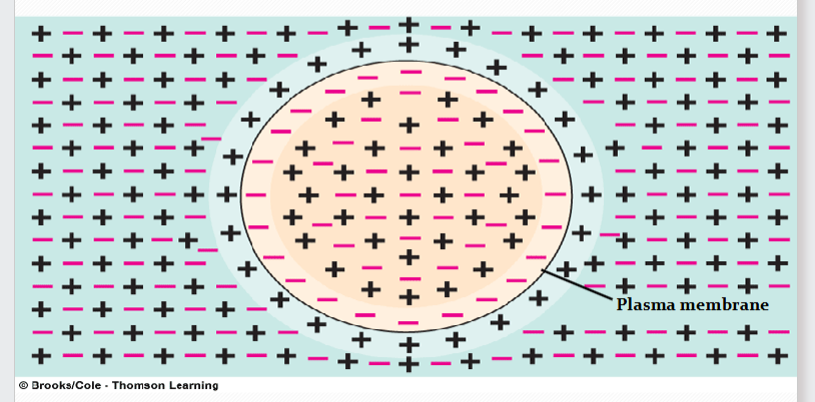
Membrane potential — difference in charge
Outer charge - inner charge = charge for that membrane
Unequal distribution of positive and negative electrical charges across the membrane surface represents potential energy
Once the gates are open, potential → kinetic
Membrane Potential (mp)
All cells have membrane potentials
Not all cells can change that potential (only neural and muscle cells can do it)
Nerve/muscle cells (excitable cells) are specialized and can use mp to undergo rapid potential changes that serve as electrical signals
Neural cells transmit messages (conduction)
Muscle cells initiate contraction (contraction)
Electrical signals are produced by changes in ion movement across the plasma membrane

Resting Membrane Potential
Constant membrane potential is non-excitable and excitable cells at rest
Equals -70mv typically
Ions responsible: Na+, K+, A- (large negatively charged intracellular protein)
Others: Ca2+, Cl-, HCO3- don’t directly contribute to resting properties of membrane
Determining Potential
When oppositely charged particles have been separated, the electrical force of attraction can be harnessed to do work when they are permitted to come together
Membrane Potential — ‘Potential’ to do work; measured in millivolts (mv)
Because Na & K wants to go out, but can’t, we’ve made a lot of potential energy which causes us to move
When + and - charges are equal across a membrane, no mp exists
When + and - charges are unequal, the attraction forces cause them to accumulate along the membrane, creating mp
The greater the number of opposite charges, the larger the potential and vice versa


Active Transport of Na+ & K+
Na+ is greater concen in the ECF, slowly diffuses into cell, fewer leak channels
K+ is greater concen in ICF, membrane more permeable, diffuses out of cell, has more leak channels
Concen maintained by Na+/K+ pump
For every 3 Na+ ions pumped out there are 2 K+ ions in
Generates mp
Membrane impermeable to A- (large proteins) found inside cell

Role of:
K+
Important factor in establishing RMP
Moves out of cell via concen gradient, but opposed by electrical gradient
The pull to keep K+ in the cell is greater
If only K+ leak channels present, the RMP would be -90 mv
Na+
The RMP of -70 mv is due to mvmt of Na+ into cell
Na+ moves along concen gradient and electrical gradient pulls Na+ in as well
Na+/K+
Establishes the mp
Pump more Na+ out than K+ pumped in
Theoretically, -90 mv is achieved when K+ equilibrium potential is reached
+60 mv is achieved when Na+ equilibrium potential is reached
Reality, because of diffusion of Na+ and K+, the typical nerve cell has a -70 mv resting potential