Chapter_7
Chapter 7: Health Care as an Economic Commodity
Introduction to Health Care as an Economic Commodity
Explored within the context of effective resource allocation and analytical models for the health care sector.
Importance emphasizes efficient and equitable use of health care resources.
Defining Health Care
Health care encompasses three categories of goods:
Goods aimed at health improvement available through personal exchange (e.g., over-the-counter medications).
Services intended for health improvement delivered by health professionals (e.g., surgical procedures).
Services provided by professionals that may not necessarily improve health but utilize specialized skills (e.g., cosmetic surgeries).
Relevance for Health Policy
Distinctions among health care types impact:
Insurance decision-making concerning coverage of effective health services.
Regulatory categorizations that differentiate between drugs and food products.
Calculation of health care expenditures to enable international health system comparisons.
Characteristics of Health Care as an Economic Commodity
Five key characteristics central to economic analysis:
Derived Demand: Demand driven by health improvement needs rather than direct enjoyment of services.
Externalities: Influence of individual health decisions on others.
Informational Asymmetry: Disparity in information between providers and patients.
Uncertainty: Unpredictability regarding health needs and effectiveness of care.
Vulnerability: Individuals' susceptibility at the point of health care consumption.
Demand for Health Care as a Derived Demand
Demand arises from the pursuit of better health rather than utility from health services.
Treatment experiences may differ in utility outcomes, especially in cases like cosmetic procedures.
An example utility function: U = f(H(Z, HC), HC, X) where:
H = health status influenced by health care (HC) and other goods (Z) affecting health.
Assessing Efficiency of Health Care Consumption
Allocative efficiency cannot be assessed solely from observable data in health care due to derived demand connection.
Health care consumption must provide observable improvements in health for it to be considered efficient.
Allocative Efficiency
Some judgments on health care efficiency can be made without knowing patient preferences.
Key research areas impacted include:
Small Area Variations: Compare health service usage across geographic locations to identify potential inefficiencies.
Appropriateness: Evaluate clinical guidelines for service utilization to assess when care is provided inappropriately.
Need vs. Want in Health Care
The distinction affects publicly financed health care systems like Canada's.
Need indicates a moral obligation to respond; a want does not carry such imperative.
Economists view needs cautiously due to the ambiguity in differentiating between needs and wants in practice.
Meaningful Interpretation of Need for Health Care
Need defined by two criteria:
Effectiveness in achieving a health objective.
The objective's legitimacy for resource allocation.
Health care is unique due to limited service substitutability and often unpleasant experiences associated with it.
Types of Externalities
Physical (Selfish) Externalities: Health status impacts of others (e.g., vaccinations).
Caring (Altruistic) Externalities: Emotional impacts due to others' health status (e.g., concern for a loved one receiving treatment).
Seeking Physician Care
Patients generally seek:
Diagnoses: Clarification on health issues.
Guidance: Recommendations following diagnosis.
Informational asymmetries can lead to inefficiencies in health markets, where providers often hold more relevant data than patients.
Addressing Informational Asymmetry
Regulation in Canada includes licensing, certification, and controlled acts for service provision.
Physicians must balance self-interest with patient needs, challenging the ideal of perfect agency.
Positive vs. Normative Analysis of Health Care
Traditional positive analysis disregards the influence of physician actions on market dynamics.
Debate exists regarding physician market power's impact on standard economic models and normative interpretations.
Uncertainty in Health Care Demand
Health outcomes are often random; this uncertainty creates demand for health care insurance.
Insurance reduces financial risks and improves access to care but complicates market functioning.
Unique Aspects of Health Care Markets
Health care markets experience multiple sources of market failure due to its unique characteristics.
No other good exhibits all of the features present in health care; this uniqueness presents profound challenges for economic analysis and policymaking.
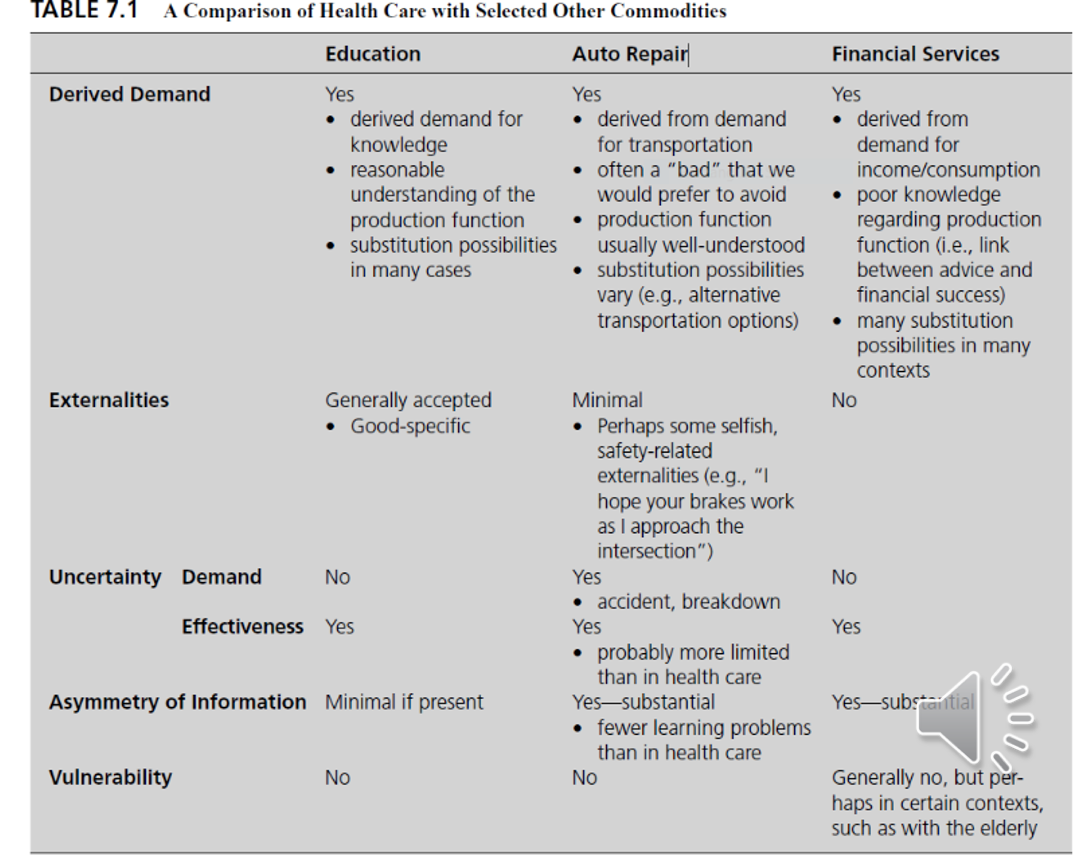
Comparison of Health Care with Other Commodities
Aspect | Health Care | Education | Auto Repair | Financial Services |
Derived Demand | Yes | Yes | Yes | Yes |
Externalities | Generally accepted | Minimal | Good-specific | Some |
Uncertainty Demand | Yes | No | No | Yes |
Effectiveness | Yes | Yes | Yes | Yes |
Asymmetry of Information | Yes | Substantial | Substantial | Yes |
Vulnerability | Yes | No | No | No |
Derived Demand And Effectiveness are all Yes’s
Externalities (Greatest to Least): Health Care, Financial Services, Auto- Repair (Good-Specific), Education
Uncertainty Demand: yes for healthcare and financial services. No for Education and Auto Repair
Effectiveness: All yeses
Asymmetry of Information: Yes for Health Care and Financial Services. Substantial For Auto Repair and Financial Services.
Vulnerability: All No’s except Health Care
Second-Best Analysis
Involves recognizing market situations where not all failures can be corrected without causing more issues.
For example, implementing cost-sharing may limit access while failing to efficiently reduce frivolous care utilization.
Conclusion
Health care is multifaceted and not a homogeneous commodity; various services exhibit differing levels of presented economic features.
Specific attributes dictate the analytic approach for addressing health care issues effectively.