P1
Energy stores and systems (P1)
Energy stores:
Thermal energy stores
Kinetic energy
Gravitational potential energy stores
Elastic potential energy stores
Chemical energy stores
Magnetic energy stores
Electrostatic energy stores
Nuclear energy stores
W
Energy can neither be created nor destroyed, only transferred
Speaking of transfers:
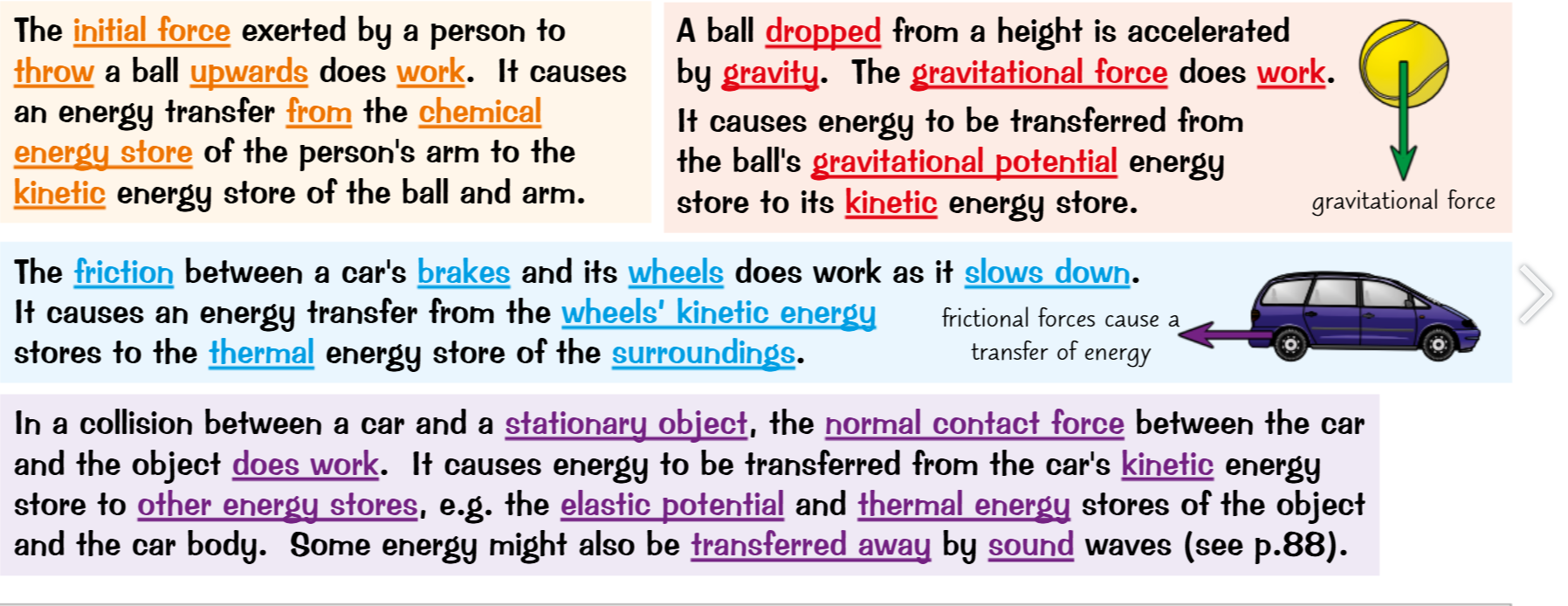
Work done- Forces (Mechanically)
Electrically- Work done by moving charges
By heating- Kettle, friction, vibrations
By radiation- E.g. Lights or Sound
What about systems?
There are 3 types of systems:
Open systems- Where energy and matter can exchange with the environment freely
Closed systems- Where energy can exchange with the surroundings but not matter
Isolated systems- Neither energy nor matter can pass its boundaries
A system is an object or group of objects observed purely in disregard of the surroundings (Apart from when you need to talk about energy dissipating)
All changes in a system is caused by energy transfer, between objects and the surroundings
Heating e.g.: A Kettle
The kettle and the water is the system
Water the water gain thermal energy via heating
This heating comes from the heating element of the kettle
Energy is transferred electrically to thermal energy of the heating element
By doing work:
Work done is just another way of saying energy transferred, Its even measured in joules just like energy. This work done is either against resistance or as a force. e.g.:
Recall questions:
What are all the energy stores
What are all the forms of energy transfer
What are the 3 types of systems
ayyy its short this time come on don’t forget to do further questions whilst the exam technique is still loading
Energy and Efficiency (P1)
Kinetic energy
Kinetic energy is just the energy of moving objects.
This is important as that means that this applies to particles.
Because of this, kinetic energy is also the internal energy of particles and their collisions
This’ll be important later

GPE
This is the energy that is used up by falling objects, and the potential energy available to be transferred in the event that the object falls
The energy of a raised object
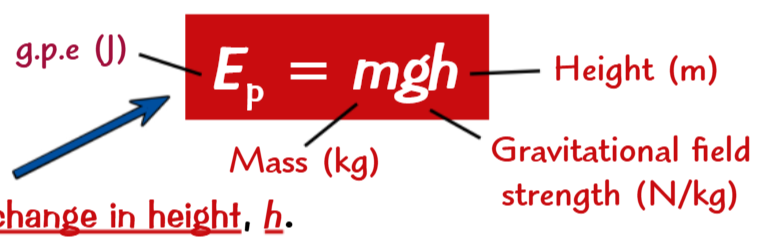
When objects fall, energy is being transferred from gravitational potential energy to downwards kinetic energy
Of course some of the energy is wasted through air resistance and friction
However ideally in the absence of air resistance GPE = Kinetic energy
Annd allllooonng cayme ilasticcc

Oh yeah and thermal energy

Conservation of energy and power:
Ok this is important kids:
The law f the conservation of energy is that-
Energy can’t be created or destroyed, only transferred usefully or dissipated Energy transfers are never 100% efficient and energy is always wasted due to counteracting forces such as air resistance. This governs all energy exchanges.
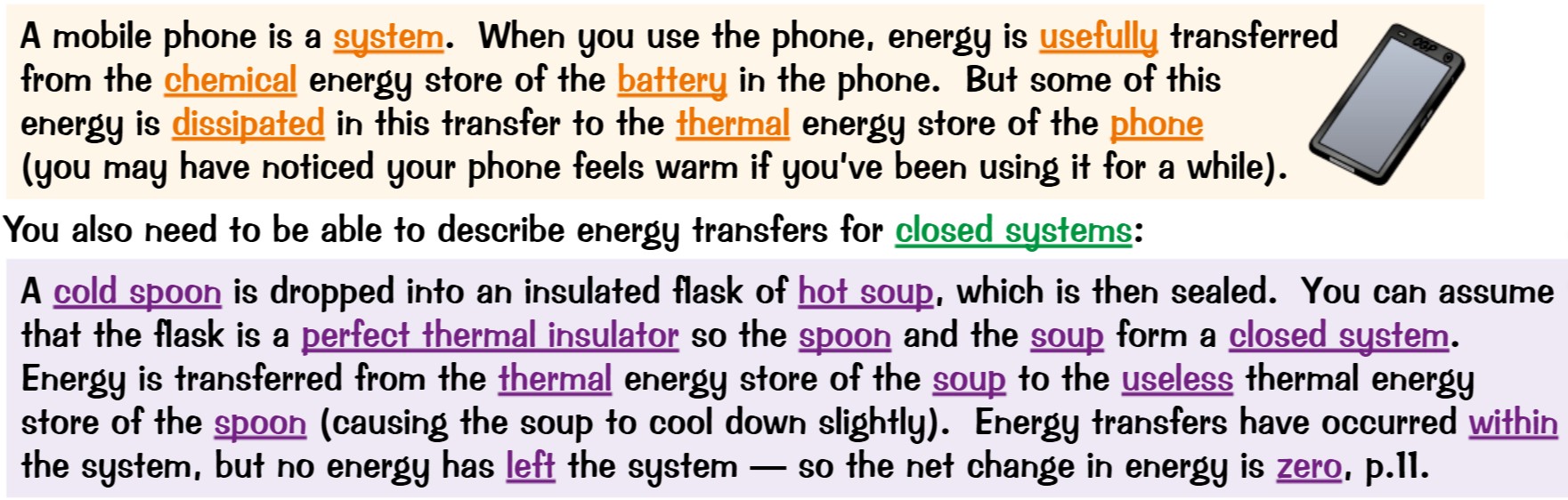
This directly coincides with efficiency:
Mainly in energy transfer, energy is transferred usefully, but never all of it. This energy is wasted energy which usually gets dissipated to the surrounding. This is why it is important to talk about wasted energy when talking about energy transfer into useless stores such as thermal energy.
However there is one key exception to this being electrical heaters as all energy dissipated as heat is useful as that is the desired effect
Recall questions:
What is the formulae for kinetic energy?
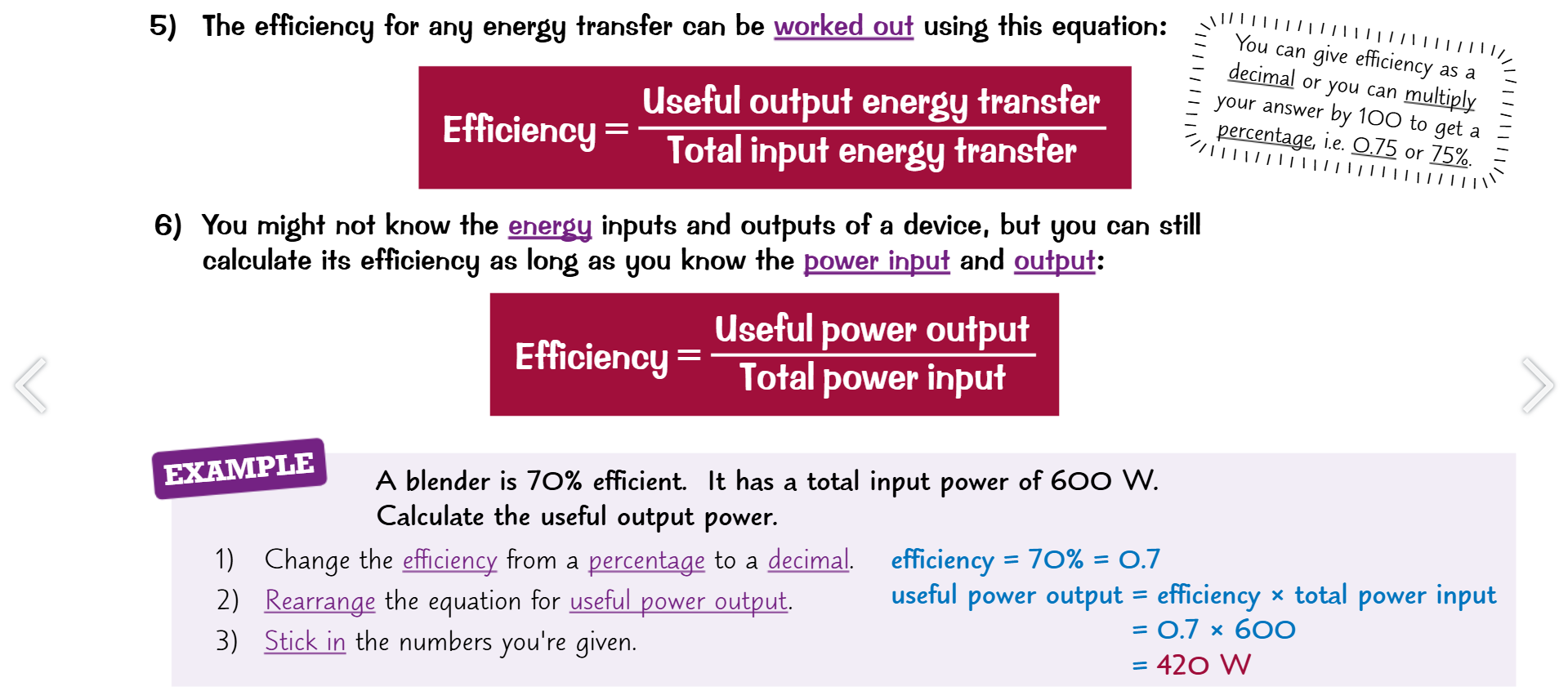
What is the formulae for Gravitational potential energy?
What is the formulae for elastic potential energy?
What is the formulae for Thermal energy?
What is the formulae for Efficiency?
What is the Law of the conservation of mass?
What is the energy transfer when an object is thrown up and falls down?
What is the energy transfer when someone is running
What is the point when a ball thrown in the air will have the most:
Kinetic energy?
Gravitational potential energy?
Conduction, convection and waste
The thermal energy of an object is shared across the kinetic energy of its individual particles.
Conduction:
This is the process of vibrating particles transferring energy to neighbouring particles
This is energy transferred by heating to the thermal store of the entire object.
The individual particles of the object this comes through as kinetic energy
As the object is heated on the particle level think of it as an infection
The more particles get infected with the vibration through to the other side
More thermal energy is transferred to the object as a whole
Thermal conductivity is the measure of how quickly energy is transferred throughout the material
The higher it is the faster its conducting
Convection (only in liquids and gasses):
Convection is the process of energetic particles moving away from the hotter regions to cooler regions.
unlike solids liquids and gasses can move somewhat freely
So when you heat the particles and their speed increases (due to kinetic energy)
They lose density
This means that the warmer less dense region will rise above the colder dense region
Causing a convection current
An example of this is a radiator in a room.
Apply it your damn self I’m tired
Reducing unwanted energy transfer
Lubrication: (no diddy)
Whenever something moves there’s always one force of friction acting on it
This causes energy to be dissipated/ wasted
Lubricants are things that coat objects and can flow easily
This helps reduce friction
Insulation
This is to stop energy loss of heat from houses via:
Thicker walls: Further distance energy has to travel and vibrate through
Insulating material: This lowers the rate of energy transferring between particles
Cavity insulation: Foam filling between inner and outer walls - reduces convection
Loft insulation: Reduces convection in the lofts
Double glazed windows- 2 layers if window to lower the energy conduction
Draught excluders- Blocks air currents under doors which may cause convection
Insulator chain check:
Boil water and pour into a sealable container
Use a thermometer to record the initial temp
Seal it and record 5 mins with a stop watch
Record final temp and pour away water
Allow container to come to room temperature
Repeat this experiment with the container wrapped in an insulating material
The lower the temperature diff the better the insulator
Ofc you can change what you are measuring
e.g. temp after different materials,
Temp after different layers. etc.
Energy resources
In order to generate electricity, you need to make certain turbine connected coils in a magnetic field. This turbine mechanism Is called a generator. All power stations must find a consentient and efficient way of spinning these generators in order to generate electricity This transferers kinetic energy to electric energy mechanically.
There are two types of resources:
Non -renewable resources:
Resources that are used at a quicker rate than they are replenished e.g. Fossil fuels and nuclear fuels:
Coal
Oil
Natural gas
These will all run out one day, damage the environment, provide most of our energy
Non -renewable resources:
Resources that are replenished at a rate faster than their use e.g.:
Solar energy
Wind
Waves
Hydroelectric
Hydro-electricity
Bio-fuel
Tidal fuel
Geothermal fuel
These will never run out, most of them do less damage to the environment that non-renewable energy, unreliable due to weather
Non-Renewable energy can be used in e.g.:
Petrol and diesel- For cars
Coal- For boats and steam trains
Natural gas- As house heating
Coal- In fireplaces
Electricity- Made from non-renewable
Renewable energy can be used in e.g.:
Biofuel- Vehicles and electricity
Geothermal- Heating buildings
Solar heaters
Wind energy
In order to get energy from the wind you need to set up wind turbines in exposed places like mores or coasts, with good air flow. Each turbine has a generator inside it rotated by the wind.
They have no running pollution
Running costs are low
No permanent damage to the environment
They cover lots of ground
1500 replace 1 coal powered energy station
Loud
“Ruin view”
Have to be stopped if the wind is too strong
Initial costs are high
Solar energy
solar cells generate electric currents directly from sunlight
They are often used in remote places e.g. Australian outback
There’s no running pollution
Only work small scale
Only work during daytime
Initial costs are high
Production emissions
Can’t increase power output
Geothermal energy
Comes from slow radioactive decay of elements deep within the earth
Very little damage to the environment
Not many suitable locations
Powerplant costs for it are high
This is only available in volcanic areas or near hot rocks
Hydroelectricity
This generates electricity by flooding a valley to build a huge damn that controls the rate of water flow in order to spin turbines and create electricity.
This method can immediately respond to demand changes
This doesn’t cause much pollution
Minimal running costs
No fuel costs
Requires flooding a whole valley- damaging the environment
Dead trees in environment decay producing CO2
Initial costs are high
It usually only works in remote areas
Doesn’t work during a drought
Wave power
Uses lots of wave powered turbines located around the coast.
This has no pollution
Disturbs wildlife
Hazardous to boats
Unreliable- rely of fairly strong winds
Initial running costs are high
Tidal barrages
These are damns built across river estuaries with turbines in them that allow water through at variable rates
This causes 0 pollution
No fuel costs
Can produce lots of energy
However it alters the natural habitat and blocks access from boats
High initial costs
Reliant on a high tide
Bio-fuels
This is a fuel created from animal dung or plants. They can be in any state and get burnt in the same way fossil fuels are. It is debated weather they are carbon neutral
Crops take a relatively short time to grow
They can be produced and stored for when they are needed
The cost to refine the is very high
There isn’t enough space or water to meet the demands for food
Requires large areas of deforestation to grow causing methane and CO2 emissions
Non-Renewable
Fossil and nuclear fuel meet demands easily with enough being the earth to supply us for a while. These produce lots of energy, but are slowly running out.
And they also produce environmental problems in the form of:
Co2 and Sulphur dioxide emissions
Oil spillages
Nuclear meltdowns
Trends in energy usage
We are mainly dependant on fossil fuels e.g.:
petrol and diesel for our cars
Coal for energy stations
Gas for house heating
Coal for boats
However pressure is being put on companies to create more renewable products e.g.:
Hybrid cars
Electric cars
etc
However, this change to renewable energy is being hindered/ stopped due to:
Limited reliability~ Wind energy requires windy conditions to use, solar energy only works at day time, geothermal energy only works in certain remote places like Greenland etc.
Cost~ It costs money to research into making these renewable methods more efficient, money for land for solar panels, Money for turbines, Money for new power stations, money to switch what fuels you use, money to create non emitting cars/ products, money to replace fuels etc
Politics~ People complain about wind turbines “ruining a view”, people complain about the sound wind turbines make, people complain about the space wind turbines take, people complain about the space solar panels take, etc
Specific heat capacity
What is this tho????
This is the amount of energy needed to heat a certain substance up by 1oc
Now this has a practical soooo:
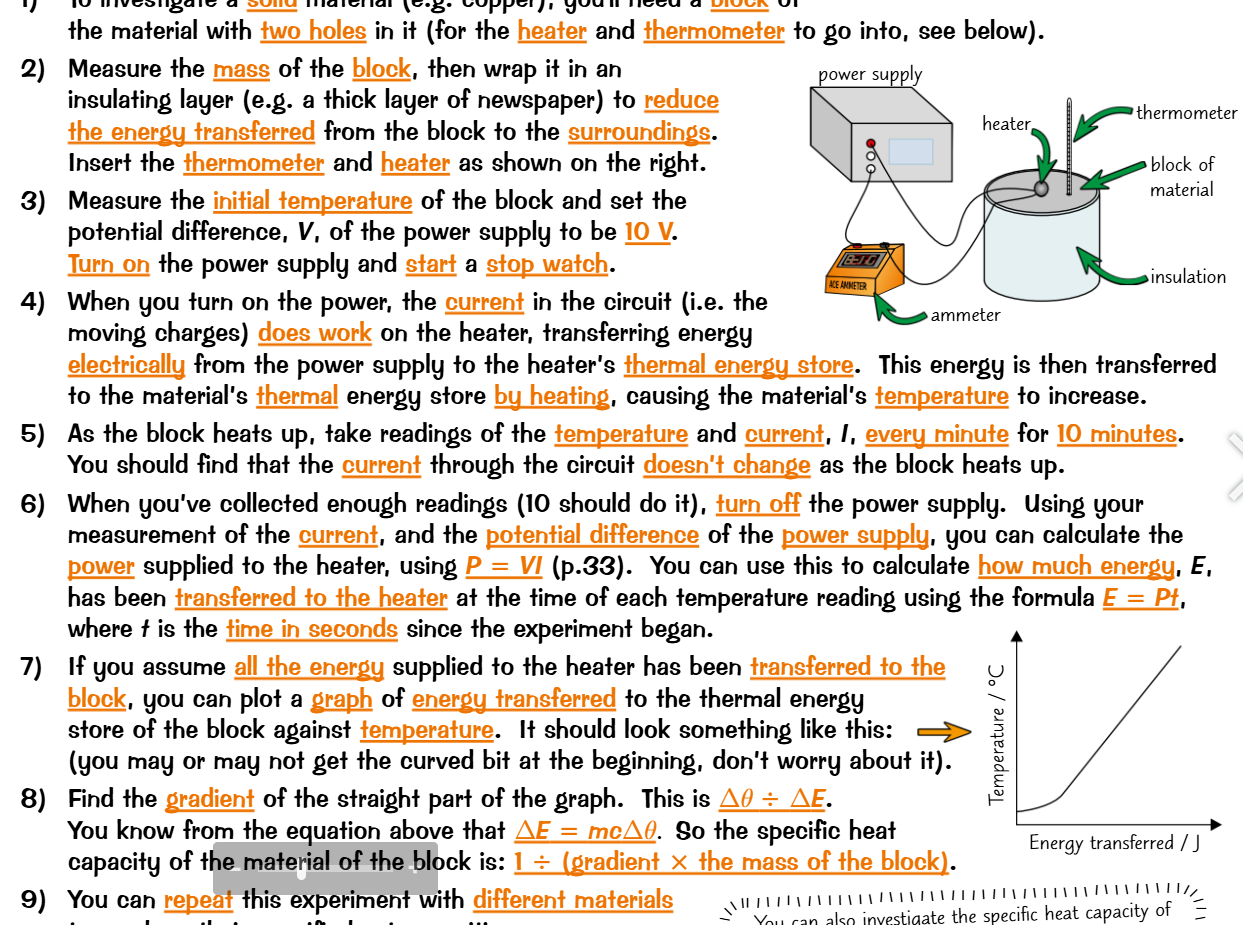
Get a block of whatever material you need with 2 holes in it (one for heater and thermometer)
Measure the mass of the block and then wrap it in insulating material to reduce energy dissipation
Wait some time or the thermometer the become the same temperature as the block
Then take an initial temperature and start the heater.
As the block heats up take recordings of the temperature at regular intervals i.e. 1 min for 10 mins
once you’ve collected enough readings turn of the heater calculate the power and energy transferred
This experiment is important as the charges does work on the heater to heat up the heater and subsequently the block. The change in thermal energy = the work done.
The work done:
Power = current * voltage
Energy transferred = power * time
GOWN!