S18 - Lego
Summary
TIMELINE
1916
1932: Becomes Lego
1947: First company in Denmark to purchase plastic injection-molding machine.
1949: Introduces automatic binding brick (precursor to modern LEGO brick).
1958: LEGO brick patented.
1960: Fire!!!!! No more wooden toys
80s: 70% of western europe families w/ kids <14 had a lego.
Quality ++
Manage demand! (demand > company’s capacity to produce)
Ideal situation - you can increase price and promote sense of scarcity.
Consequences…
Cannot meet needs, bad customer service.
False sense of security - believe the demand will always be there, and may pay less attention to innovation!!
Many activities which may not be profitable for the company
Costs decrease (?)
You have to fix the roof before it starts to rain
Situation:
A | B | |
Sales | 100 | 100 |
COG | 30 | 50 |
GM | 70 | 50 |
FC | 40 | 20 |
pi | 30 | 30 |
Which company is performing better??? What is this table missing?
The balance sheet!
Tells you how many assets you’re utilizing (less is better).
More importantly, it gives you the cash position.
The problem is the following:
Price of sale 10) payable within 30 days by me.
Technically, I made a profit!!! But I haven’t been paid yet lol...
So this is the problem - cash flow kills more companies than anything else.
Cash flow doesn’t let the company upgrade!!
Even if the profitability is good, you must look at the cash flow.
Destroying goods cost more than giving away, as the recycling cost is very high.
Questions
1. What drove Lego to the edge of bankruptcy?
External causes:
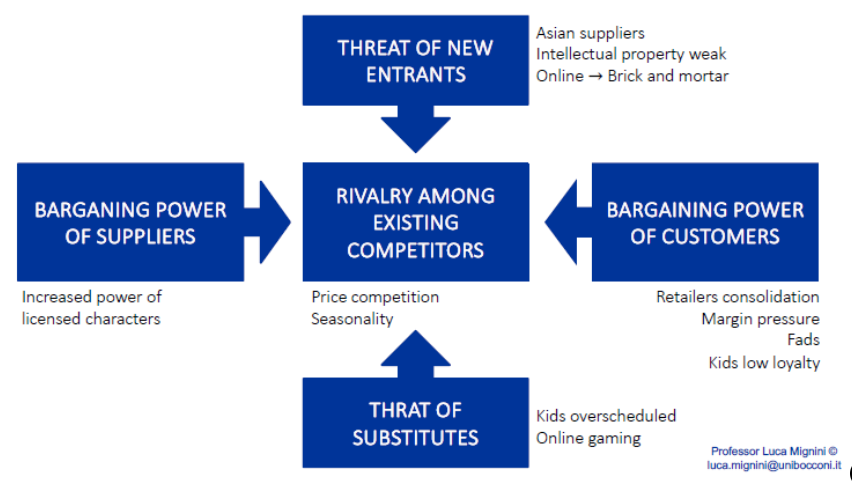
Internal causes: too complicated everything
2. Assessment of management moves during the “growth period that wasn’t” (1993-1998) and “the fix that wasn’t” (1999-2004).
Growth period that wasn’t (1993-1998)
Expanded product portfolio
Explored opportunities without thinking of margin
Theme parks
Website
Merchandising
Expansion in-house;
They were convinced this would preserve the brand identity.
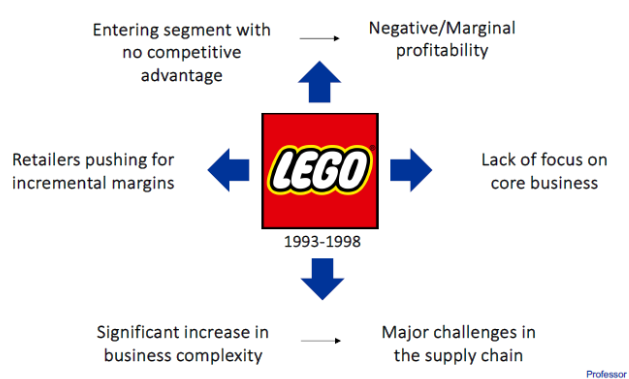
Instead, it originated the rising complexity!
Imagine one firm – that is not a conglomerate – doing material production, software development, park management, apparel and all without its main supervisor (Kristiansen)
Increased complexity in existing business (4k → 8k SKUs!)
++ indirect cost to supply chain
++ inventory
++ OOS
-- customer service
Consequences
Lose focus
Get opportunities
Capabilities
Resources
More complexity!!!
CORE BUSINESS --
Perfect Storm
The fix that wasn’t (1999-2004)
Organization restructure
Top mngt 100→40
Fire 1k employees
Extreme job rotation
Lack of accountability
Farther changes in product portfolio
+++ increase of weight of licensed characters
Key problem - you depend on someone else's success. The movie could be a flop. The movie could go well, but it's a wave (ups and downs, not good in terms of stock)
Important change in internal processes
Product innovation decentralized
Contractors
Introduced new distribution channels
Own brick and mortar shops
On-line flagship store
More increase complexity + explosion of costs
Thousands of shapes
Unable to meet demand
LEGO main challenge…
Activity based plan
Internally focused to cope with external challenges (consumers, competitors, trade, substitutes)
VS
Clear focus plan
Has consistency between internal and external actions, will evolve over time
Turnaround plan
Manage for cash
When operating on a patient, you need to make sure they're alive first. Same thing - before finding a solution for their strategy, they needed CASH to survive first.
How??
Expand payment terms for suppliers (think back on situation beginning page)
Minimize investment: make sure its absolutely vital before buying it.
Divest non-core assets: sell anything which is not core IMMEDIATELY, because you are in a crisis
Right-sizing organization (no hiring, raises)
Focus remaining $$ on core business.
(In general, 20% of SKUs bring 80% of the profits.)
Now that you've saved the patient, they have to go into rehab (stage two):
Manage for value
Establish strong SOP process: establish proper procedures in the compnay. Establish certain rules, very important for everyone to respect.
Define right org design
Set base for proper R&D innovation process
Short focused set of priorities
You don't have time in a crisis - so you need someone in charge, no time to discuss.
Manage for growth
Switch leadership (MOST IMPORTANT STEP!!)
Once the situation changes, and ur in a position where you can actually look for growth and expand, it's ciritcal that leaders become servants ot the organization, and not just a pain in the neck.
If you're in a constant state of crisis, people will give up.