Chapter 7 and Sperm Competition
Primate Sociality, Social Behavior, and Culture
Primate residence patterns
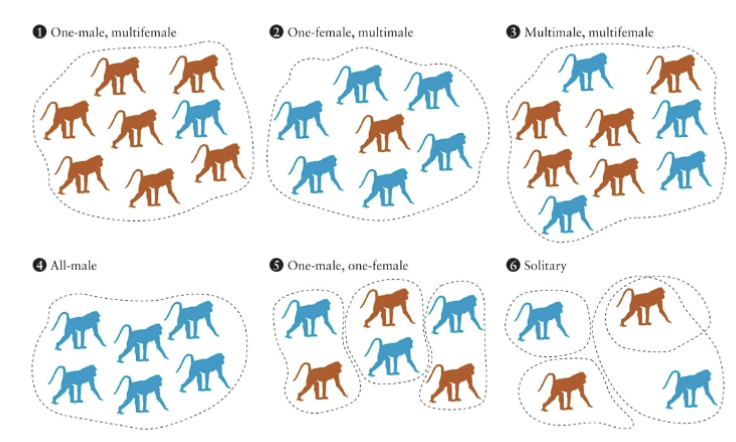
females need the highest quality food they can find so they can sustain pregnancy and lactation
females space themselves out over the landscape to get the best food
males are anxious to impregnate females
males space themselves out over the landscape to get best access to the fertile females
females spend far more energy in the creation of and caring for offspring than males do
rule: those member of the sex that expends less energy in this way (the males) compete more aggressively among themselves for sexual access to members of the sex that expends more energy (the females)
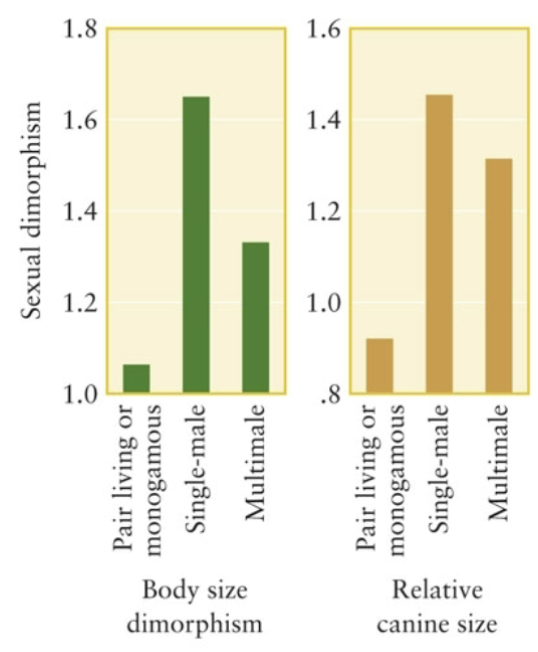
Primate Diets
the Jarman/Bell Principle: A general rule that the nutritional requirements of large-bodied animals are absolutely higher than those of smaller animals, but lower relative to their body size. Therefore, larger animals tend to feed on more abundant, but lower-quality foods than smaller animals
smaller animals need to eat really frequently or they will starve to death
larger animals can go longer without a meal
Optimal foraging strategy
works with many kinds of animals
they will get the food that has the most calories while expending the least amount of energy
find, capture, and consume
involves many important concept in ecology:
adaptation
competition
energy flows in ecosystems
Strict categories are somewhat misleading
most primates will eat some fruit, high in energy: easy-to-digest carbs or in an oily fat-rich form
many primates get essential fats and starches from seeds
flowers and nectar are also good sources of carbs
Smaller bodied (<10kg) primates often eat insects and fruit: frugivore-insectivores
larger bodied (>10kg) primates often eat fruit and leaves: frugivore-folivores
Dominance hierarchy- a ranking system among individuals usually established by the outcome of aggressive and submissive interactions
competition for resources happens within stable dominance hierarchies
the dominant one is the individual who doesn’t back down in a confrontation
Communication & Cognition
Olfactory Communication
important in strepsirrhines, who have special scent-making glands in different areas of their bodies (head, throat, wrists)
will scent mark their territories, also engage in stink fights
In may primates, scents can indicate when a female is in estrus (receptive to mating)
it’s important for a male to know when a female is ovulating
other indicators are sex swellings (the females anogenital region) and ‘proceptive’ behavior
Important note: Except for humans and bonobos, most primate sex takes place right around the time of ovulation. Humans & bonobos are unique in that females will permit copulations at any time of their ovarian cycle.
Tactile Communication
touching is very important in primates
feeling of well-being, reassurance, reconciliation
grooming as a ‘social' cement’
males holding each others testicles if they are coalition partners (baboons, muriquis)
touching to indicate which copulatory position is desired (baboons)
Visual communication
occurs when one animal gains information from another by looking at it
not only facial signals but how an individual spaces itself, and its body postures
anthropoids have better innervation to their muscles of facial expressions than strepsirrhines
strepsirrhines have a ‘tethered lip’ and often a long snout
nonhuman primates regularly maintain and manipulate social relations through the judicious use of visual communication
threats can be used to coerce another individual into performing a particular activity
male baboons use threats and neck bites to encourage females to follow them closely
attempts to gain support and cooperation of another may also involve gestures of reassurance and conciliation, such as friendly approaches
How to get an ally to help when another animal is antagonizing you: make a threat gesture to your antagonist & simultaneously retreat toward the source of support
deceptions: De Waals’s chimps trying to hide their facial expressions so rival animals would not infer their emotional state
hands pushing lips together to hide fear grimace
low-ranking male making approaches to estrous female and turning his back and hiding his erection when alpha appeared
Vocal Communication
Species recognition
each species has a unique repertoire
in animals that are territorial, they use long-distance vocalizations to communicate their whereabouts and this allows members of different groups to avoid or approach each other
when pygmy marmosets are spread out over a big tree, eating gum, they do a special trill in sequence, waiting for all members to indicate their presence before any one member trills a second time
mothers know the sound of their own babies
other mothers know, if they hear a baby cry, whose baby it is
Intentional or involuntary information sharing
non-human primates only have some voluntary control over their vocalizations
chimps make a call when they find food, and they try to silence it to avoid having to share
Cognition
little evidence of active teaching among nonhuman primates
apes understand the ‘object-task’ relationship, where they realize that it is necessary to bring the tool to a certain place, where it will be used for getting food
apes, not monkeys, will imitate
imitation requires a level of representational thought that is ‘beyond’ monkeys
monkey sees itself in a mirror, doesn’t realize it is self
ape does
Ecological models for the evolution of primate intelligence:
species differences in cognition are attributed to the relative strength of selection pressures for abilities such as remembering where food can be found or following birds to sources
Spatial memory
ability to remember where important food resources = good advantage and can help save time and energy from other activities
primates that rely on foods with a patchy distribution, like ripe fruit, benefit most from good spatial memory
Spider monkeys are fruit specialists, break into groups when feeding (Fission-Fusion) and can go straight to remembered tree
lively, intelligent, bigger brain per body weight
VS
howlers eat fruit, but also A LOT of leaves
slow, supposedly less intelligent, smaller brain per body weight

not all ‘smart’ animals use tools
bonobos rarely seen using them in the wild
gorillas have elaborate ways of harvesting the vegetables they eat without tools
among all primates, it is almost always the immatures or adult females that develop tool-related innovations first
Social Intelligence
Alliances
benefits of having a good memory may be even of even greater importance (than spatial memory) when it comes to keeping track of social relationships
De Waal was one of the first to realize that studying how animals ‘fix' things’ after a conflict is extremely important
he also notes that primates form stable relationships and that members of a group can be simultaneously friends AND rivals
humans and other primates are ‘aggressive’ by nature but they are also good at making peace
Tactical Deception
acts from the normal repertoire of the agent, deployed such that another individual is likely to misinterpret what the acts signify
Theory of mind - an individual can perceive the mental perspective of another rather than responding solely to its overt behavior
apes have it, monkeys dont
Sperm Competition
the physical competition between the sperm of two separate males to fertilize the eggs of a lone female
high in multi-male groups
a male’s fitness is usually measured as a function of the number of females inseminated, however in many animal species fertile females mate with many male partners
-Large sperm volume/larger ejaculates
-Penile spines (keratinized projections on penis)
-Vaginal plugs/Sperm plug/Mating plug/Copulatory Plug
-Mate guarding behavior
-Seminal enzymes to destroy previous males’ sperm
-Female reproductive tract proteins that “select” sperm
-Prolonged (humans) or repeated copulation (apes)
most primates have a penis bones (baculum) and achieve erections through muscle contractions (humans don’t)
