Comprehensive Study Notes on Classical, Early Christian, Early Medieval, and Carolingian Art and Architecture
Early Christian Art in Africa
Coin of King Joel (Early Christian Africa Period, Ethiopia):
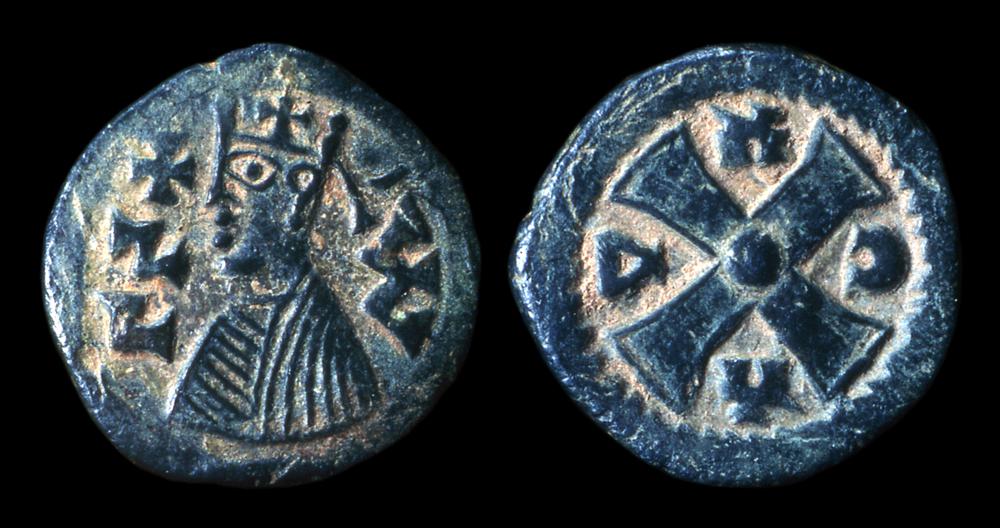
Obverse displays an official profile portrait of King Joel, identifying him as a Christian ruler by the cross decorating his royal crown.
Documents a major regional religious shift, replacing earlier pagan astral symbols (suns and moons) with a prominent Christian cross on the reverse.
Serves as early physical evidence of the political and cultural adoption of Christianity in the Kingdom of Aksum (Ethiopia).
Wall Painting with Martyrdom of Saints (Early Christian Africa Period, Egypt):

Depicts the biological brothers Cosmas and Damian, both of whom served as physicians.
Visually records their severe martyrdom, illustrating them being stoned, hung on a cross, shot with arrows, and finally beheaded.
Represents the enduring tradition of early Christian narrative wall painting within Christian Egypt.
Silk Coptic Panel (Early Christian Africa Period, Egypt):

Represents a rare surviving example of luxury decorative textiles from Christian Egypt.
Skillfully woven using imported silk, demonstrating high social status and commercial wealth.
Reflects the distinctive artistic style and technical expertise of Coptic textile weavers.
Early Christian Art and Architecture in Italy
Good Shepherd, Orants, and Story of Jonah (Early Christian, Italy):

Landmark catacomb ceiling painting program utilizing symbolic Biblical narrative imagery.
Built on typology, a theological system matching Old Testament events to New Testament counterparts that they were understood to prefigure.
Combines central imagery of the Good Shepherd with figures in prayer (orants) and narrative scenes of Jonah's deliverance.
Old Saint Peter’s Basilica (Early Christian, Italy):

Monumental longitudinal basilican church erected directly over the traditional burial site of Saint Peter.
Commissioned during the reign of Constantine to accommodate large congregational assemblies and pilgrimage veneration.
Established the standard architectural blueprint for Western Christian longitudinal church design.
Mausoleum of Galla Placidia: The Good Shepard (Early Christian, Italy):

Designed as a centrally planned cruciform architectural structure.
Crowned by a prominent central dome at its crossing, echoing the layout of Roman administrative buildings.
Features elaborate interior mosaics depicting Christ as the Good Shepherd dressed in imperial purple and gold.
Munich Ascension Plaque (Early Christian, Italy):

Narrative relief plaque delicately sculpted out of precious ivory.
Depicts the historical and theological scene of Jesus' ascension.
Integrates classical architectural motifs, including the depiction of a Roman-style mausoleum.
Sarcophagus of Junis Bassus (Early Christian, Italy):

Elaborately carved marble burial sar
cophagus made for a high-ranking government official baptized on his deathbed.
Divided into two horizontal registers featuring carved architectural niches framing Old and New Testament scenes.
Displays strong classical stylistic affinities with the imperial sculptural traditions of Emperor Marcus Aurelius.
Early Medieval Art Across Europe
Eagle Brooch (Spain, Early Medieval Art):

High-status cloisonné metalwork constructed from gold, garnet, and crystalline inlay.
Exemplifies art mobilier (portable art made to be transported by migratory peoples), worn to display personal wealth and rank.
Combines imperial Roman authority (symbolized by the eagle) with Christian meaning (indicated by its cruciform silhouette).
Brescia Cross (Early Medieval Period, Italy):

Associated with Lombard culture, an Italian migratory group whose name translates etymologically to "long beard".
Features a cruciform structure crafted from gold and encrusted with an extensive collection of gemstones.
Embeds an antique painted medallion glass cameo depicting a Roman-Egyptian family.
Burial Assemblage of Queen Arnegunde (Early Medieval Period, France):

Royal Merovingian grave containing the remains of Queen Arnegunde, who died at approximately years of age and stood tall.
Identified by elite silk garments, including a short purple tunic, denoting her high regal status.
Yielded prestigious gold and garnet personal accessories, including an inscribed signet ring, ornate brooches, and a heavy ornamental belt buckle.
The Sutton Hoo Burial and Insular Art
Sutton Hoo Ship Burial (Early Medieval Period, England):

Elite pagan Anglo-Saxon royal ship burial that has undergone modern archaeological reconstruction.
Highlights Germanic grooming and cultural customs, where kings wore mustaches rather than full beards and dyed their hair blonde.
Excavations recovered a rich assemblage of weapons, regalia, and specialized personal clothing fasteners.

Purse Cover, Sutton Hoo Ship Burial (Early Medieval Period, England):
High-status cloisonné plaque created using gold, s
liced garnets, and millefiori glass.
Crafted specifically to mount directly onto the exterior flap of a leather pouch or purse.
Features complex Insular animal-style decoration, including birds of prey and heraldic human figures flanking beasts.
"Matthew" Gospel Book of Durrow (Early Medieval Period, Schotland):

Represents the rigid, highly abstracted, and static aesthetic distinctive of Insular manuscript illumination.
Matthew's tunic is styled in flat geometric patterns mimicking gold and garnet cloisonné metalwork to denote spiritual authority.
Produced within a monastic scriptorium (a designated room for copying and illuminating manuscripts) in contrast to classical Roman naturalism.
Carolingian Art and Architecture
Equestrian Portrait of Charles the Bald (Carolingian Art, France):

Small-scale cast bronze sculpture historically misidentified as the Roman emperor Marcus Aurelius.
Represents a deliberate ideological synthesis of imperial Roman equestrian portraiture and traditional Frankish royal costume.
Depicts the ruler bearing an imperial orb and wearing specialized personal regalia and garment clips.
Palace Chapel of Charlemagne (Carolingian Art, Germany):

Royal central-plan palace chapel erected as part of Charlemagne's primary residence to unite religious devotion with imperial governance.
Dedicated specifically to the Virgin Mary, honoring Charlemagne's prized Marian relic.
Served as Charlemagne's imperial mausoleum following his death.
Vienna Coronation Gospel: St. John (Carolingian Art, Germany):

Rendered using the classical imperial Roman colors of purple-dyed vellum and gold pigment.
Portrays St. John seated in a naturalistic pose wearing a traditional Roman toga, demonstrating direct revival of classical prototypes.
Contrasts sharply with the flat, geometric, and abstracted figure of Matthew found in the Gospel Book of Durrow.
Lindow Gospel Cover: Front Cover (Carolingian Period, Switzerland):
Monumental Carolingian treasure binding executed in repoussé gold and encrusted with gems and pearls.
Portrays Christ alive, open-eyed, and triumphant on the cross, symbolizing victory over death rather than physical suffering.
Provided physical protection and sacred visual honor for the liturgical manuscript within.
Plan of St. Gall (Carolingian Period, Switzerland):

Master architectural drawing preserved on large pieces of animal parchment stitched together.
Outlines a comprehensive, self-contained monastic complex featuring an expansive basilica with integrated western towers.
Conceived purely as an idealized conceptual blueprint for monastic life and architecture rather than an actual construction plan.