Classifying Avalanches
Avalanche Observations and Recording
Traveling in the field and gathering observations about recent avalanche activity is one of the most exciting parts of being an avalanche professional. Witnessing firsthand the raw destruction of an avalanche is not something the everyday backcountry user aspires towards. Being able to appropriately classify and document past and present occurrences is central to any forecasting operation that wishes to understand the avalanche phenomena.
When recording an avalanche occurrence, there is a multitude of characteristics that can be documented. Date, Time, Age, and Location are the most obvious. Additional descriptions commonly recorded and some standardized codes are located in the drop-downs below. More detailed info can be found in SWAG, chapter 3- Avalanche Observations.
Type
Avalanche type in this instance is different than avalanche problem type (storm slab, wind slab, persistent slab, etc). Although there is some overlap in terminology, there is an important distinction, particularly when discussing soft and hard slabs. For example, a persistent slab avalanche could be hard or soft. There are nine potential codes that can be used to classify the avalanche occurrence by avalanche type.
L-Loose snow avalanche
WL- Wet loose snow avalanche
SS- Soft slab avalanche (usually <1F slab harness, smaller chunks of debris)
HS- Hard slab avalanche (usually 1F or greater, larger, more angular chunks of debris)
WS- Wet slab avalanche
I- Ice fall avalanche
SF- Slush flow
C- Cornice fall
R- Roof Avalanche
U- Unknown
Trigger
Trigger is used to describe the mechanism by which the avalanche was released. There are multiple codes for primary, secondary, and modifiers to drill down into specifics. Here are some examples to get you started or refresh your memory.
Primary: Secondary: Modifier:
N- Natural or spontaneous
NC-Cornice fall
c- An intentional release by the indicated trigger
A- Artificial
NR- Rockfall
u- An unintentional release
U- Unknown
NI- Ice fall
r- A remote avalanche released by the trigger
AS- Skier y- an avalanche released in sympathy with another avalanche
AM- Snowmobile
AE- Explosive thrown or placed under the snow
AH- Explosives placed via helicopter
Size
There are two widely used classification systems for avalanche size. Relative to Path (R) and Destructive Force (D). Each is a five point scale and can be used depending on the needs of an operation. While each system contains somewhat different info, the numerical categories of the scales are not comparable.
Relative Scale- a general measure that accounts for factors such as horizontal extent, depth of fracture, volume and mass of debris, and the runout distance:
R1- Very small, relative to path ~ 20% of the path released.
R2- Small, relative to path ~ 40% of the path released.
R3- Medium, relative to path ~60% of the path released.
R4- Large, relative to path ~80% of the path released
R5- Major or maximum, relative to path~100% of path released
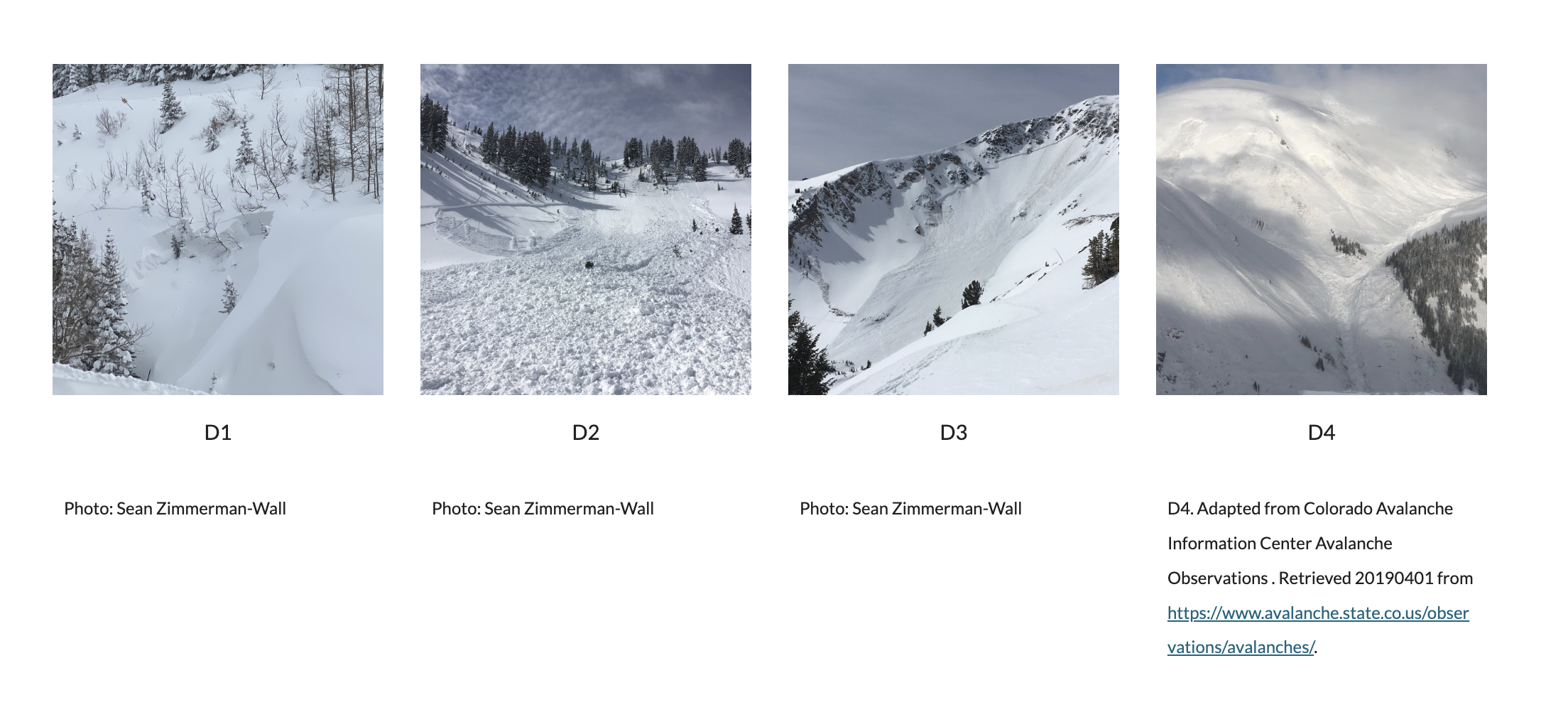
Destructive Scale- an estimate of the destructive potential from the mass of deposited snow. Imagine that the objects were located in the track or beginning of the runout zone:
D1- Relatively harmless to people
D2- Could bury, injure, or kill a person
D3- Could bury and destroy a car, damage a truck, destroy a wood frame house, or break a few trees
D4- Could destroy a railway car, large truck, several buildings, or a substantial amount of forest
D5- Could gouge the landscape or destroy a small village.
Bed Surface
The level of the bed surface is recorded to indicate where within the snowpack the slab released. Note that in the event of an avalanche that steps down through layers, all applicable codes should be noted.
S- The avalanche released within a layer of recent storm snow
I- The avalanche released at the new snow/old snow interface
O- The avalanche released within the old snow
G- The avalanche released at the ground, glacial ice or firn.
U- Unknown
Weak Layer
Record the weak layer by grain type and hand hardness.
Slab Dimensions
When it is safe and practical to access the site, you can document the following dimensions of the avalanche:
Slab Thickness
Slab Width
Vertical Fall
Length of Path Run
Location of Avalanche Start
Describe the location of the fracture with one of the following codes
T (L,R,C)-At the top of the starting zone (left, right, center)
M (L,R,C)-In the middle of the starting zone (left, right, center)
B (L,R,C)-At the bottom of the starting zone (left, right, center)
U- Unknown
Avalanche Terminus
Describe the location of the tip of the avalanche deposit with one of the following data codes.
SZ- The avalanche stopped in the starting zone
TK- The avalanche stopped in the track
TR- The avalanche stopped at the top part of the runout
MR- The avalanche stopped in the middle part of the runout
BR- The avalanche stopped in the bottom part of the runout
U- Unknown
Recording Formats
You will find different operations may use different templates to record an avalanche, but the coding structure is generally the same. In the template on the left, you can see all of the basic info gathered to record an avalanche occurrence.
In this example, the avalanche was a soft slab triggered by an intentional ski cut. It produced an avalanche large enough to bury, injure, or kill a skier/rider and it ran within the old snow. Specifically on a layer of buried facets buried in January.
Download a copy of this fieldbook template used on AIARE PRO Courses for use in your precourse preparation