Human+Impacts+review+sheet_ANSWERKEY.docx
Human Impacts Review Sheet ANSWER KEY
Vocabulary:
Habitat Destruction: The most obvious human impact, humans destroy natural habitats for our own purposes
Land Pollution: Mining, Agriculture and Industry can contaminate soils making the land unusable
Water Pollution: any macro or micro contaminant in freshwater and in our oceans.
Air Pollution: a mixture of solid particles and gases mainly produced from burning wood/fuel
Biomagnification: The idea that pollutants get more concentrated as we go “up” a food chain.
Climate Change: the change in global mean temperatures and precipitation patterns, felt most greatly at the poles.
Greenhouse effect: Certain gases naturally trap heat from the sun
Biodiversity: Diversity of living things in an ecosystem
- Why do we believe that we are in the middle of a “sixth mass extinction?”
The amount of organisms that have gone extinct since humans evolved rivals any mass extinction in the fossil record.
- What makes this extinction unique?
It is the first one NOT caused by naturally occurring geologic processes (like asteroids, volcanic eruptions, and climate change). This one is caused by humans.
- What was the impact of Rachel Carson’s silent spring?
It is the beginning of the modern environmental movement. People started to second guess widespread use of insecticides and herbicides.
- What are the Pro’s and Cons of GMO’s?
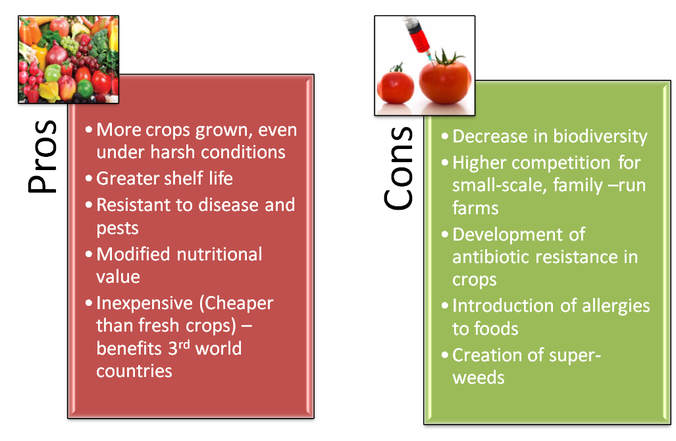
- What impacts do humans have on Biodiversity?
Humans have been shown to have a negative impact on Biodiversity
- What are two different sets of arguments for maintaining biodiversity?
Utilitarian value: many of the species that have not gone extinct may still hold unknown benefits (i.e. medicines) so we need to preserve them so we can benefit economically
Non-Utilitarian: every living thing has a role in the biosphere, and it deserves to be preserved
- What are the side effects of a warming planet?
Increased heat, drought and insect outbreaks, all linked to climate change, have increased wildfires. Declining water supplies, reduced agricultural yields, health impacts in cities due to heat, and flooding and erosion in coastal areas are additional concerns.
- Why is poaching difficult to stop?
Simply put: Economics. The price for artifacts from trophy species is many times what annual incomes are in regions where these species are naturally found.
- What role do nature preserves and zoos play in species preservation?
Preserving the organisms while protecting them from poachers in hopes of reestablishing these species.
However, genetic diversity can be an issue.
- Why are plastics in our oceans a huge issue? (at least 3 consequences)
- Physical impact on marine life: entanglement, ingestion, starvation.
- Chemical impact: the buildup of persistent organic pollutants like PCBs and DDT.
- Transport of invasive species and pollutants from polluted rivers to remote areas in the ocean.
- Economic impact: damage to fisheries, shipping, and tourism.
- Why are “invisible pollutants” in our water supply an issue? (Think about Dupont and the Ohio river.)
Many of the chemicals that can contaminate our freshwater are forever chemicals, meaning that they do not naturally break down in the environment. Removing them from our freshwater is not only difficult, but extremely costly.
- Why is human population growth a key issue for our planet?
All of the aforementioned issues are compounded by a rapidly growing human population. The closer we get to carrying capacity, means that the death rate is inching upward.