Microscopy Exam 2 Review
Crystal Systems
Crystals can be classified into isotropic (cubic) and anisotropic systems (uniaxial and biaxial).
Understanding these systems is essential for identifying minerals and predicting their behavior under polarized light.
Isotropic (Cubic)
Isotropism refers to materials exhibiting the same optical properties in all directions, appearing dark under crossed polars in PLM.
Uniaxial Anisotropic (Tetragonal, Hexagonal, Rhombohedral)
Uniaxial crystals include tetragonal, hexagonal, and rhombohedral systems, which exhibit unique interference figures.
Biaxial Anisotropic (Orthorhombic, Monoclinic, Triclinic)
Biaxial crystals consist of orthorhombic, monoclinic, and triclinic systems, each with distinct optical properties.
Crystal Morphology (Equant, Columnar, Tabular, Constant Face Angles)
Crystal morphology can be categorized into equant, columnar, tabular shapes, and those with constant face angles.
Pleochroism
Pleochroism refers to the phenomenon where a substance displays different colors when viewed from different angles under polarized light.
This effect is due to the absorption of specific wavelengths of light depending on the orientation of the crystal structure.
Anisotropic materials exhibit pleochroism, which is a key characteristic in mineral identification.
Retardation
Retardation is calculated using the formula: Retardation = birefringence x thickness x 1000 (to convert from nanometers to microns).
Birefringence
Birefringence is defined as the difference between two principal refractive indices, which is crucial for understanding optical properties of materials.
Isotropism & Anisotropism
Isotropism refers to materials exhibiting the same optical properties in all directions, appearing dark under crossed polars in PLM.
Anisotropism indicates materials with varying properties in different directions, which do not go to extinction under crossed polars, remaining visible as the stage rotates.
Orthoscopic and Conoscopic
Orthoscopic: distortion free view parallel rays (front focal plane)
Conoscopic: Cone of converging ray of light (back focal plane)
Double Refraction
occurs when light splits into two rays traveling at different speeds through certain materials, such as calcite (Icelandic spar).
Erasmus Bartholinus first reported this phenomenon in 1669, highlighting its significance in optical mineralogy.
Calcite Rhomb (Icelandic Spar)
two dots, one moves around the other and they appear to be on different levels. When using polaroid, one dot disappears. When two are moved together, film turns entirely dark when positioned in a certain way different heights because different values of refractive indices.
Starch Grains ID
Maltese Cross pattern
Cellulose down in particular order
Parallel, Oblique, Symmetrical Extinction
Parallel: 0 degrees (“goes extinct”)
Oblique: 45 degrees
Those that don’t go extinct a little off 0 degrees
Symmetrical: other angles
Goes extinct when symmetrical
Isotropic Indicatrix
For isotropic minerals the indicatrix is a sphere as can be seen here. The indicatrix can be placed anywhere within or on a crystal so long as the crystallographic directions in the indicatrix are moved parallel to themselves.
Three dimensional plot of refractive index vs vibrational direction
Sphere
Uniaxial Indicatrix Figures
(Oblate or Prolate Ellipsoids of Revolution)
3 central sections: principal, circular, and random
Positive (prolate; vertical oval) and negative (oblate; horizontal oval)
Biaxial Indicatrix Figures
(Triaxial Ellipsoids)
Three axes: x,y,z
Three dimensional plot of refractive index vs vibrational direction
Lesson 6, slide 26
Uniaxial and Biaxial Interference Figures
Uniaxial: cross with yellow and blue quadrants, cross doesn't disappear when moved.
Positive if E >O-> Blue in quadrants 1 and 3=additive
Negative if E<O-> Yellow is in 1&3
Color temperature
2000k-8000k candlelight to snow, water, and blue sky
“w” or “o” ray, “E” or “e” ray
calcite rhomb rays, ordinary ray (predictable path) and extraordinary ray (obvious contradiction of snell's law).
O and E ray vibrate perpendicular to each other
“a” -alpha, “B” -beta, “Y” -gamma rays
Beta: slow rays parallel, additive compensator
Gamma: subtractive compensator
Optic Sign (Determining Optic Sign)
E-W= Optic Sign
positive and negative, blue in quadrant 1 and 3 is positive, yellow in 1 and 3 is negative.
most fibers are positive except some acrylics and triacetate
Sign of Elongation
when crystal length is also the high index direction, the sign of elongation is positive.
low index = negative (often applied to fibers)
-Pos optic sign
Optic Angle (2V, 2H, 2E)
Tobi's method-relationship between angular aperture; axial angles 2E, 2H, and 2V; and linear diameters of the back focal plane of the objective.
Tobi’s Method (d/D)
Optic angle
Measure between hyperbole 45 degrees off extinction (d) total (D)
Spindle Stage or Goniometer
A spindle stage is a rotation device with a needle/thin object on a stage that holds a crystal for rotation.
identifies crystal
EXCALIBR
Excalibur is used to upload the points of extinction seen from rotating a crystal on a stage which can later be used for reference when identifying other materials.
Monochromatic Interference Filter
polarized monochromatic light may be extinguished by the analyzer after passing through an anisotropic mineral
Phase Contrast Microscopy (PCM)
A contrast technique in which the phase position of the non-diffracted light is shifted in relation to the diffracted wave fronts, thereby improving the constructive and destructive interference conditions.
typically used for glass chips and semen
phase plate -> objective -> Condenser-> light ring
(“Hoffman”) Modulation Contrast
Modulator->Objective->condenser->slit
A Slit allows light to come in at oblique angle so one side of image is bright and the other is dark.
Bright Field Microscopy
produces an image made from light that is transmitted through a specimen specimen against a light background
Dark Field Microscopy
shows the specimen against a dark background and provides good resolution
Dispersion Staining (D.S.)
The contrast technique that utilized a central stop and an annual stop to produce "colors", which can be used to help identify the sample
Crosses with oil
Central-Stop D.S. and Annual Stop D.S.
(Right) Annular and Central stop colors.(The two stops produce complimentary colors).
To produce dispersion staining colors, the particles and immersion liquids must have different dispersion curves which intersect sharply in the visible light region
Differential Interference Contrast (DIC)
microscope that uses a prism to split the incident beam into two mutually perpendicular components. analyzer makes the vibration directions parallel so light rays can interfere at the intermediate image plane.
Wayne Williams Case
tried for the murder of two individuals in the Atlanta, Georgia
An essential part of the government's case was the numerous fibers linking Williams to the murders
yellow-green fibers discovered on a number of the murder victims were linked to a carpet in the Williams home which helped proved his guilt
Put Fiber forensic evidence on the map
Behavioral analysts/profiling
Vegetable Fibers (Seed hairs-cotton, kapok)
seed hairs - cotton, kapok
-Bast or Stem Fiber- (ie; Linen, Manila, Hemp)
-Trichomes or Leaf hairs- (ie; Cannabis sativa)
unicellular and used as individual fibers rather than bundles.wool, silk, fur or domesticated
Animal Fibers (wool, silk domestic dog/cat, animals)
Wool-(Important textile)
Silk- (From Silkworm Bombyx mori)
Other Animal Fibers (Furs, Domesticated
Mineral fibers (asbestos)
Asbestos
Bast fibers (jute, ramie, sisal, hemp)
Jute, Ramie, Sisal, HempMarijuana ID by Leaf Fibers (Cystolith Hairs, Conical Trichomes, Glandular Hairs)
Marijuana ID by leaf fibers
(Crystalith hairs (bear claw), conical trichomes (long hair), glandular hairs (where THC is))
In the old days
3 botanical structures (see above)
Positive levine test (THC test)
Cotton characteristics
incomplete extinction: lack of an extinction position. As the stage is rotated between crossed linear polarizing filters the fiber's brightness doesn't significantly change.
Lumen: the hollow canal that runs the length of the fiber
Undulation
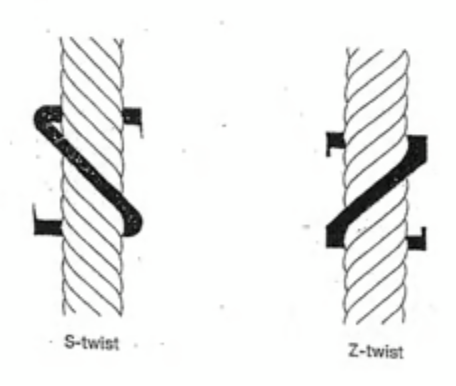
“S” or “Z” twist of natural fibers
Modified Herzog test
an empirical test for determining the fibrillar orientation using polarized light microscopy.
Old way of identifying natural fibers
Synthetic fibers
Nylons, polyesters, polyolefins, polyethylenes and polyproyplenes, acrylics, saran, vinyon, elastic, glass, metallic
Regenerated fibers (rayon, acetates)
Rayon, Acetates
Monomers (glucose)
building blocks of polymers glucose
Polymers (“poly-glucose”)
(cellulose, rayon)
Delustering agents
reduces the sheen of synthetic fibers.
Back in my day
a polyester suit got shiny looking after a few days and gross.
Let's try wool instead.
Pigment in the hair shaft.
Add pigment in synthetic Fiber.
Titanium dioxide (cheap) put into polymer makes it look better
Complete extinction (synthetic fibers)
man-made fibers and silk show complete extinction unless they have been deformed.
Low birefringence (acrylics, acetates)
modacrylic, acetate, acrylic, triacetate
Moderate birefringence (olefins, nylon)
(Olefins, Nylon)
(cellose)
High birefringence
(polyester)
Cross-striations (bast fibers-dislocated fibrils)
bast fibers- dislocated fibrils, shown between crosses polars, because of dislocation
of fibrils during bending.
Weaves, knits, felts
Fabric construction
Felt (non woven) - common in cars, tyvek suit
Weaving: plain, twill, satin
Warp and weft or fill
components used in weaving to turn thread into fabric.
Plain weave
The simplest weave in which the weft (crosswise) yarn is passed over then under each warp (lengthwise) yarn.
twill weave
a textile weave in which threads are crossed over one another to give an appearance of diagonal lines.
satin weave
A weave that produces a smooth, shiny-surfaced fabric resulting from passing the weft yarn over and under numerous warp yarns to create long floats.
Cordage terminology (plys, strands, yarns, fibers)
Look at twisting
Rope made up of plys (first division)
Then strands
Strands made up of yarns
Yarns made up of fibers
Sometimes core (helps it not fray as much)
“S” or “Z” twist of cordage
See above
Affects optical properties
Silk-bombyx mori (looks synthetic)
Silk from a moth
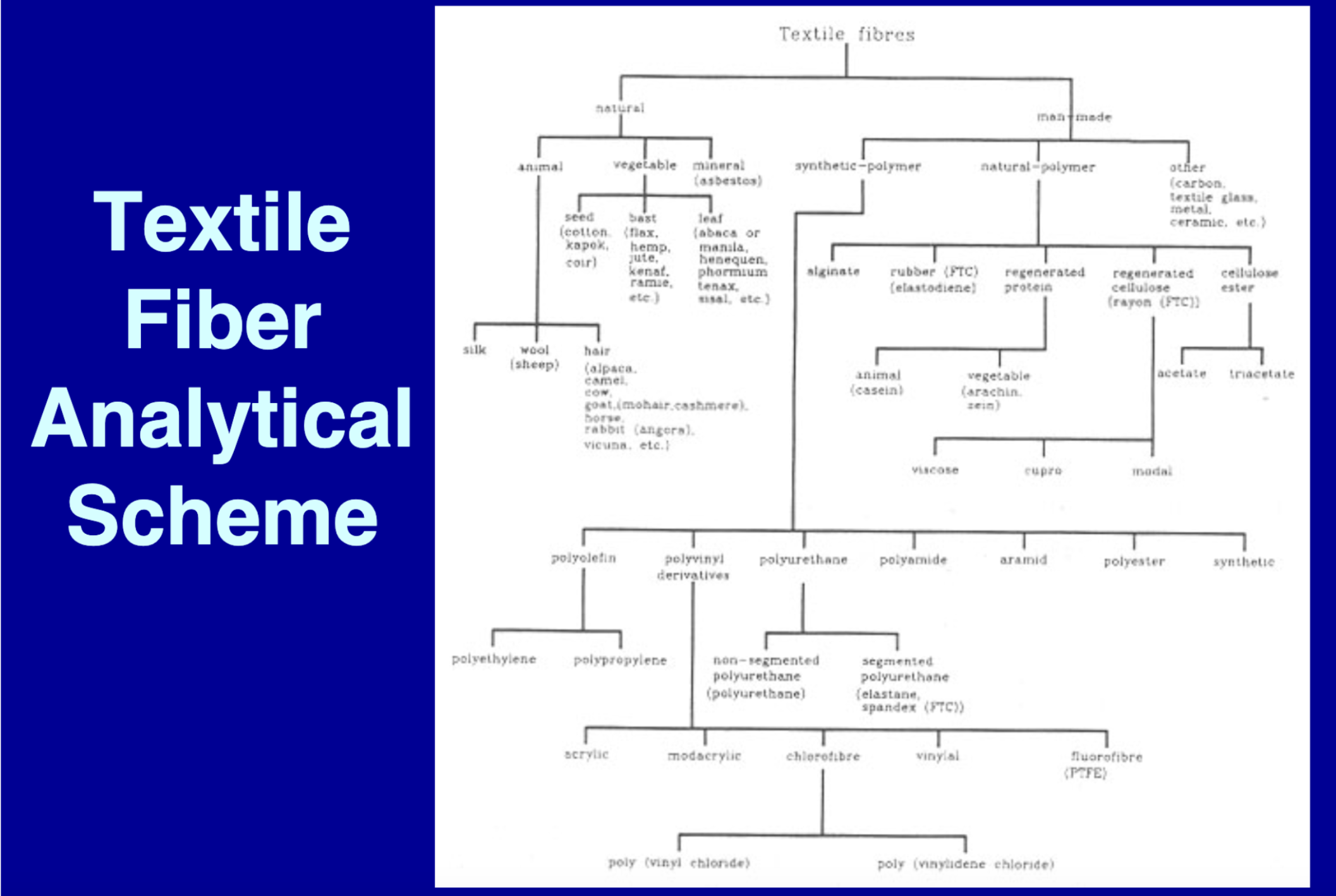
See Textile Analytical Scheme
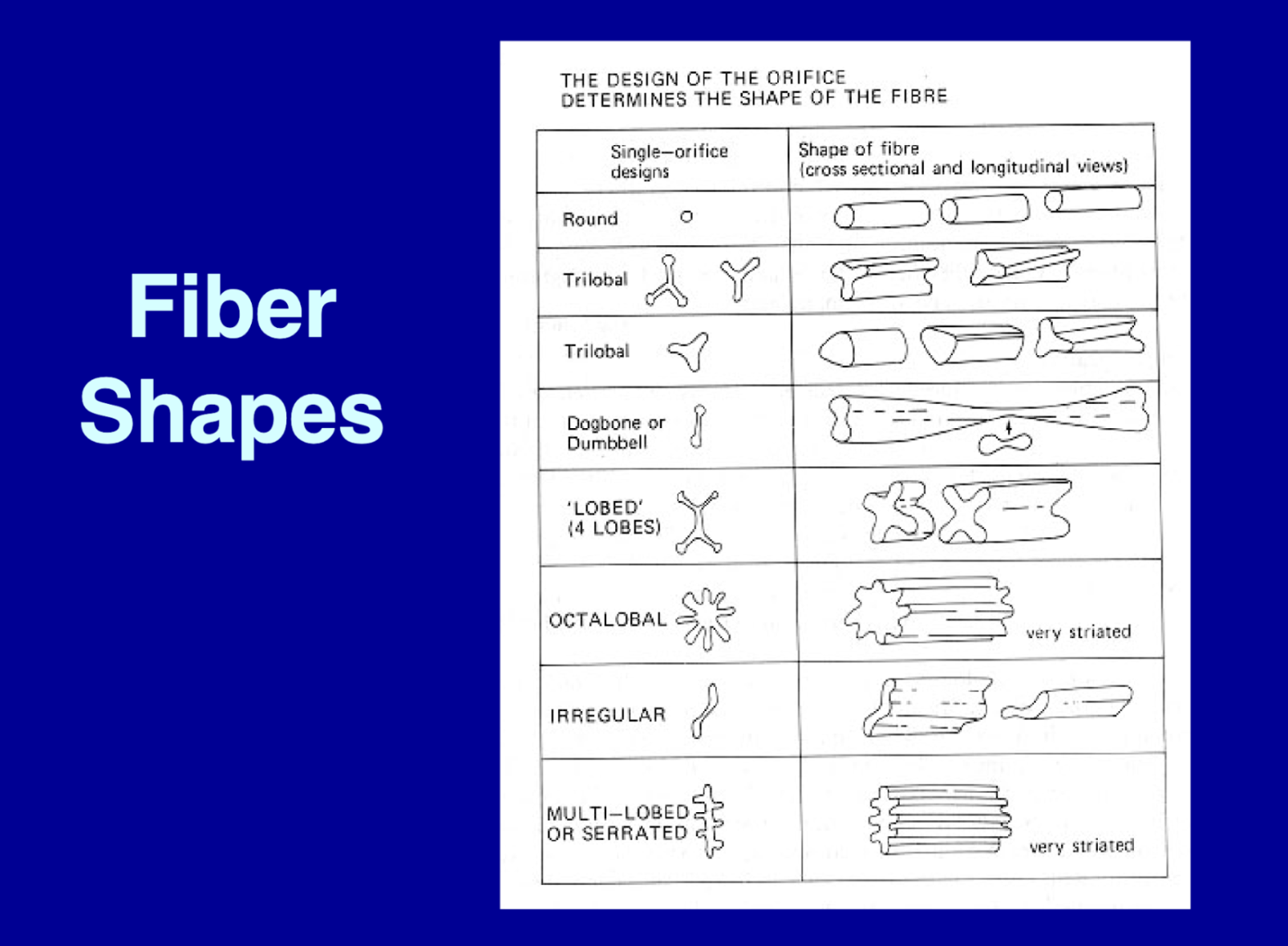
Fiber shapes (x-section vs longitudinal)
(Cylindrical, triloba (carpet fiber)l, dogbone or dumbbell, multiserrated)
Optic sign of elongation
(Most fibers are positive except for some acrylics and some acetates)
What’s a fiber that has a lot of fibrils or opemits and has a lot of dislocations?
Bast fiber
What is a fiber that is very luxurious that almost looks synthetic but is not?
Silk fiber
This fiber undulates, incomplete extinction, amber retardation color and lumen:
Cotton