Simple Harmonic Motion (SHM)
Definition
Simple harmonic motion (SHM) occurs when an object moves such that its acceleration is always directed toward a fixed point and is proportional to its distance from the fixed point.
Equation
a = - ω2 x
Alt. Definition
SHM is where the motion of a point whose displacement, x, changes with time, t,
Equation
x = A cos(ωt + ε)
v = -Aω sin(ωt+ε)
With ε being the phase constant.
It is normally 0 or 𝛑 / 2 depending on the displacement at time, t = 0.
If at t = 0 the displacement is at its maximum, then ε = 0 and if at t = 0, the displacement is 0, then ε = 𝛑 / 2.
SHM Graphs
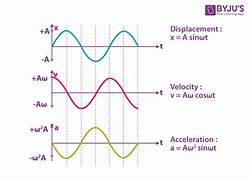
Video
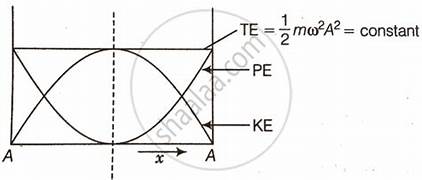
Energy
Grapical Representation of PE and KE
Pendulum
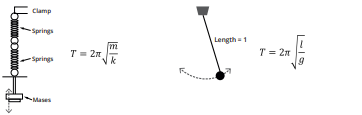
Total Energy Equation
(for undamped SHM):
Total Energy = Ep + Ek = 0 + ½ mω2A2
Total Energy = ½ mω2A2
Total energy ∝ A2
Derivation of K.E Equation
K.E = ½ mv2
since v2 = ω(A2x2)
K.E = ½ mω2 (A2 - x2)