Chapter 12: Smaller Ecdysozoans
<<Protostomes<<
Ecdysozoans
- Possess a cuticle
* Nonliving external layer secreted by epidermis
* If firm: restricts growth
* Ecdysis required to grow
* Molted
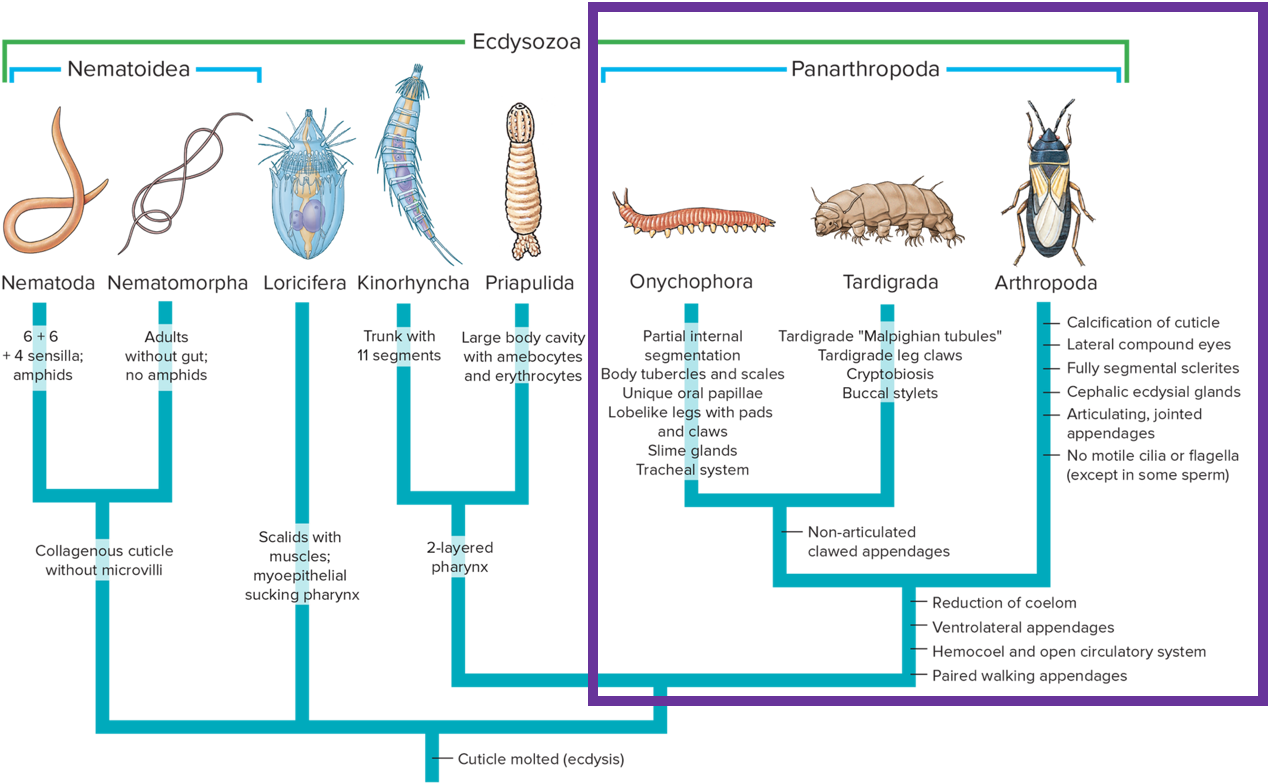
<<Clade Panarthropoda<<
- Phyla
* Onychophora
* Tardigrada
* Arthropoda
* All have a hemocoel
* Fusion of main coelomic cavity and blastocoel
* Blood from the open circulatory system enters
* Surrounds internal organs
* Blood + lymphatic fluid = hemolymph
<<Phylum Onychophora<<
- Velvet worms
* ~200 extant species
* Found in rainforests, other tropical and semitropical leafy habitats
* All terrestrial
* Nocturnal
* Require air saturated with moisture
* Most are predators
* Entangle and immobilize prey in slime
* Prey digested by salivary enzymes
* Velvet worms consume only liquid portion - Covered with soft cuticle
* Contains chitin and protein and is molted in patches - Head
* Pair of flexible antennae
* Pigment-cup ocelli at the base (nearly blind) - 14-43 pairs of legs
* Each ends with a flexible pad and two claws - Tracheal System
* Enables them to breathe air
* System of tubes that bring in air from pores scattered all over the body - Reproduction
* Nearly all species are dioecious
* In some species: viviparity
* Placental attachment between mother and offspring
* Live birth (offspring born as juveniles)
* Other species: ovoviviparity
* Young develop in eggs inside the mother
* Hatch from eggs while in the uterus
* Live birth
* 2 Australian genera: oviparity
* Females lay shell-covered eggs in moist places
<<Phylum Tardigrada<<
Video Notes
- Eights legs
- Not closely related to anything else on Earth
- Clade Tactopoda
- Found in three major aquatic environments: marine/brackish, freshwater, and films of water clinging to moss, etc.
- Each tardigrade eye is a single photoreceptive cell
- Covered in a cuticle (shed as tardigrade grows)
- Have digestive systems, salivary glands, and even tiny brains
- Life span from a few weeks to over 100 years
- Cryptobyosis - metabolism lowers when conditions are bad, then replenishes, and roll into a tun to avoid being dried up
- Anoxybiosis occurs when there is insufficient oxygen