Plant Speciation and Polyploidy
Biological Species Concept - a group of organisms that are reproductively isolated from other groups. Two types:
Pre-Zygotic Isolation
Definition: What prevents mating and fertilization b/w species BEFORE zygote forms.
Habitat Isolation: Different species live in different habitats, no encounters for mating.
Temporal Isolation: Species could breed at different times of the day/year.
Gametic Isolation: Chemically incompatible gametes preventing fertilization.
Mechanical Isolation: Structural differences prevent mating.
Post-Zygotic Isolation
Definition: What occurs AFTER fertilization, preventing development of viable offspring.
Hybrid Inviability: Produced offspring develop improperly → abortion/developmental issues.
Hybrid Sterility: If offspring is produced, they are sterile.
Hybrid Breakdown: Offspring may be viable + fertile, but future generations have reduced fitness.
Considerations: Intergression
occurs when gene flow takes place between distinct species, enabling certain alleles to cross into another species' genome without resulting in complete hybridization.
Speciation
One species splits into two.
Allopatric Speciation: A PHYSICAL barrier separates populations → genetic divergence due to isolation from gene flow.
Dispersal: Individuals migrate to different area causing physical separation.
Vicariance: Physical barrier arises splitting population → independent evolutionary pathways
Genetic Drift: Random fluctuation in alleles → Differentiation within separated populations
Sympatric Speciation: New species arise in same geographical region w/o physical barriers.
Resource Partitioning: Species using different resources in the same habitat → reduced interbreeding. Ex. apple maggot flies, which adapted to new food sources and underwent speciation due to mating preferences.
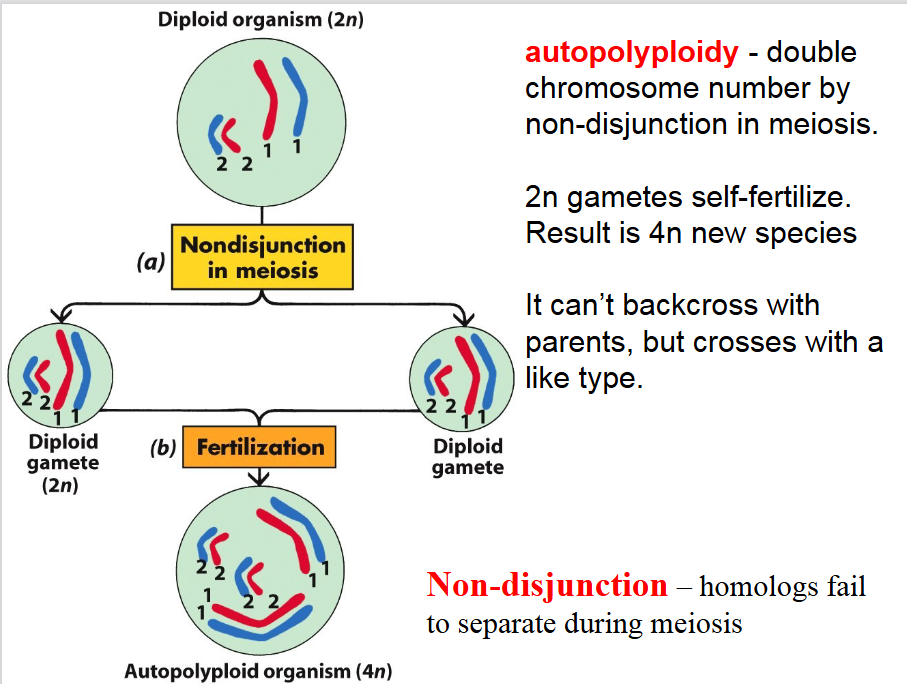
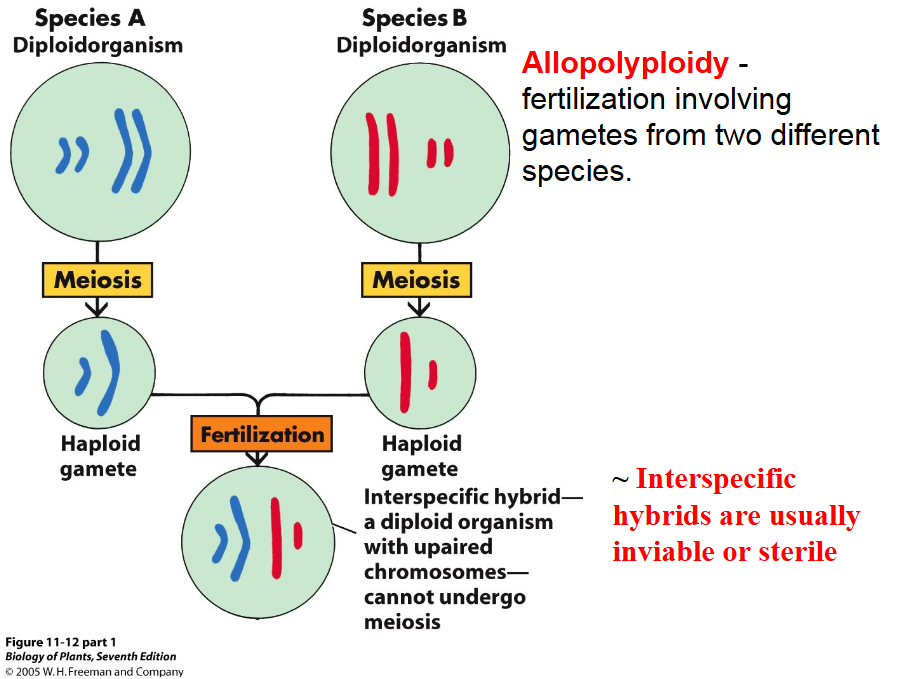
Polyploidy: When hybridization + chromosome doubling result in a new species.
Autopolyploidy: Organism doubling its chromosome number from a single species (individual created by nondisjunction within the same species).
Allopolyploidy: hybridization b/w 2 diff. species followed by chromosomal doubling → fertile new species that is reproductively isolated from its parents.
Importance of Polyploidy in Plant Evolution
Significant evolutionary mechanism. 80% of angiosperms are polyploid allowing greater genetic diversity and adaptations in varying environments. Presence of polyploidy helps mitigate issues related to inbreeding depression by introducing new genetic combinations, thus enhancing overall fitness.