Lipids
- Lipids are ==hydrophobic== (“water-fearing”), or insoluble in water, bc they are ==non-polar molecules==
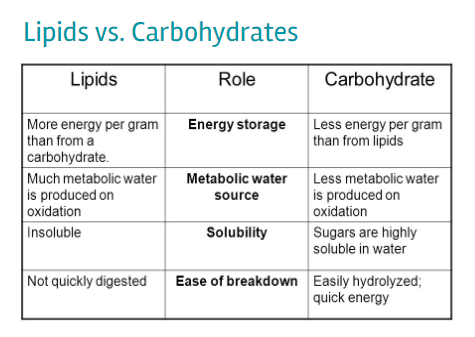
- Like carbohydrates, lipids contain carbon, hydrogen, and oxygen, but in lipids, the proportion of oxygen is much smaller
- They are the body’s main form of stored energy, plasma membranes, and hormones
- They also include fats, phospholipids, steroids, and waxes
Biological Roles of Lipids
Shock Absorbant
- Fat absorbs shocks
- Organs that are prone to bumps and shocks are ==cushioned== w a relatively ==thick layer== of fat
Metabolic Water
- Lipids are a source of ==metabolic water==
- During respiration, stored lipids are ==metabolized for energy==, producing water, and CO2
Insulation
- Stored lipids provide ==insulation== in extreme environment
- Increased body fat levels in winter ==reduce heat losses== to the environment
Most Common Fat
- Fat molecules are also called ==triacylgycerols or triglycerides==
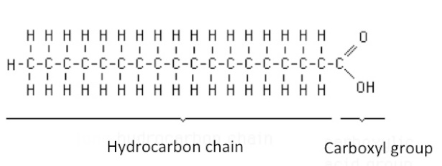
- They are made up of a ==glycerol backbone + three fatty acid tails==
- In the human body, triglycerides are primarily stored in ==specialized fat cells called adipocytes== (adipose tissue)
Glycerol
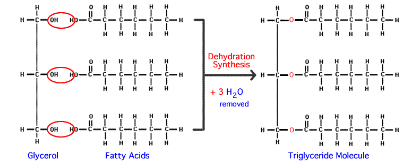
- An organic compound w three carbon atoms, five hydrogen atoms, and three hydroxyl (OH-) groups
Fatty Acids
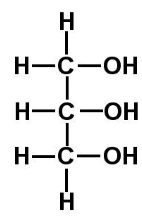
- Have a ==long chain of hydrocarbons== to which an ==acidic carboxyl group is attached==
Triglyceride Formation
- Glycerides are formed when the hydroxyl group on glycerol ==bonds== w the carboxyl group (COOH) on fatty acids (dehydration synthesis)
- Bond is called ==ester linkage==, and the process is known as ==esterification== (a C-O-C bond)
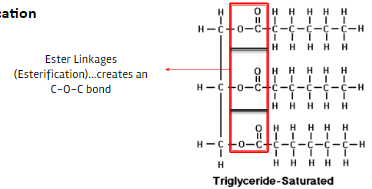
Saturated
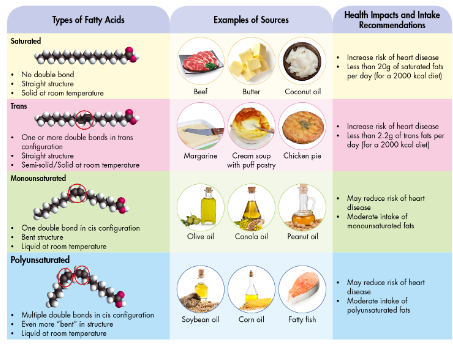
- Saturated fatty acids contain as much hydrogen as it possibly could, bc there is a ==single bond betwen all its carbon atom==s (therefore ==two hydrogens== can form in each)
- ==Solid at room temp==
Unsaturated - monounsaturated
- Fatty acids w ==one or more double bonds== are unsaturated since they contain ==less hydrogen== than before
- Monounsaturated fatty acids contain ==one double bond==, meaning a hydrogen was ==taken away== from it
- These double bonds result in kinks in the fatty acid chain affecting the ==melting point== of the fact
Unsaturated - polyunsaturated
- Contains ==more than one double bond==, further depriving it of hydrogens
- Tends to be ==liquid at room temp== as double bonds cause kinks in the structure and prevent molecules from packing together
- A type of dietary fat, and one of the healthy ones (w monounsaturated)
- Found in ==plant and animal foods==, like salmon, vegetable oils, and some nuts and seeds
Hydrogenation
- Hydrogen atoms are ==added to double bonds== in unsaturated triacylglycerols
- Forms trans form rather than the cis form
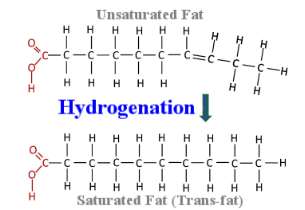
Trans Fat vs Cis Fat
- In cis, chains of carbon atoms are on the ==same side of the double bond==, resulting in a kink
- In trans, hydrogen atoms are on the ==opposite side of the double bonds== of the carbon chain, making the fat molecule straight
- Cis isomers cannot line up next to one another as the trans isomers due to the ==larger bend==
Phospholipids
- Make up the ==lipid bilayer== of cell membranes, and ==important structural feature== of cells
- Made up of a glycerol + two hydrophobic fatty acids + hydrophilic phosphate group
Phospholipids Bilayer
- Phosphate heads facing the water and their tails pointing towards the inside
- Bilayer prevents hydrophilic tails from coming into contact w water
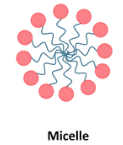
- If a drop of phospholipids is placed in water, it may spontaneously form a sphere-shaped structure known as a ==micelle==
- Hydrophilic phosphate heads ==face the outside== and the fatty acids tails ==face the interior== of this structure
- This formation is a response to the ==amphipathic nature== of fatty acids
Steroids
- A lipid composed of ==four carbon ring + OH functional group==
- Also called sterols due to ==hydroxyl group== on ==one or more rings==
- Do not contain any fatty acids
- Considered lipids bc they are ==hydrophobic and insoluble in water==
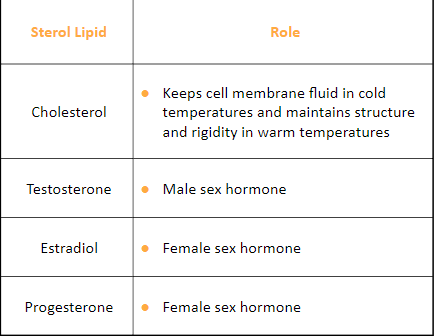
Cholestrol
- A steroid that is essential for animal cell membranes and converts into a number of compounds, like vitamin D
- High cholestrol levels contribute to ==atherosclerosis==, which can lead to heart attacks and strokes
Waxes
- Fatty acids linked to ==alcohols or carbon rings==
- Non-polar - hydrophobic
- Pliable consistency - ==forms waterproof coating==
- Barrier against ==water loss and infection==
- Keeps birds dry and bees busy (forms honeycombs/beeswax)
- Waxes cover the feathers of some aquatic birds and the leaf surfaces of some plants
- Hydrophobic properties prevent water from ==sticking to or soaking into the surface==