Module 8- Problem Solving Under Uncertainty
Examples:
How many boxes are behind a tree?(we do not know as we can not see because the tree is in the way?
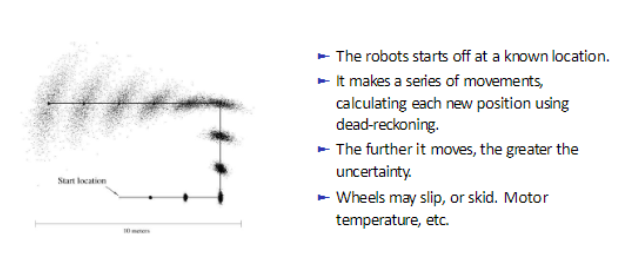
Where am I?
Your location is (x1,y1) and pose 01→After we move ,how can we determine the new location (x2,y2) and pose 02?
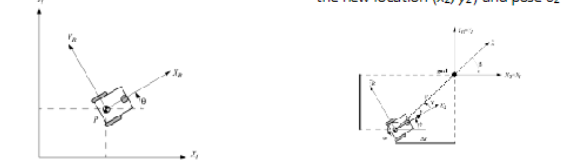
1.Dead-reckoning is the process of using information about direction, and elapsed time to calculate new location
2.Odometry refers to the use of motion sensors, such as measuring wheel rotation.
and etc.
Buying a car:
Key variables,,Assumptions, Conclusion
What do these exaples tell us?
Even though our understanding of the world will often be uncertain , we can nevertheless make informed inferences, or predictions.
Example:
Our visual system makes predictions all the time. We infer distance, colour, objects,etc.
Language tends to be highly ambigious, yet we can infer meaning from utterances.
We make desicions from limited information, sucj as which courses to follow, who to marry, which product to buy.
Intelligent systems also need to be able to make inferences under uncertainty. THis different way of thinking about problems.
Inductive inference vs deductive inferece
Dectictive inference is all about going from true statements to other true statments using rules of logic.
Example:
All dutch cities have a train station
Tilburg is a Dutch city
Therefore, Tilburg has a train station.
Here, we are certain about our knowledge . We infer facts about the world.
Inductive inference is all about going from specific observations to informed guesses or conjectures.
Examples:
You vist(observe )10 DUtch cities.
They all have a train station.
You conclude all Dutch cities have train stations.
Your friend concludes that all dutch cities, except those with “Z” in their name, have train stations.
Here, we are uncerain about our knowledge . We make conjectures about the world.
Thinking about inductive inference
Point: Faced with uncertainty, we need to make inductive inferences.
And if some inductive inferences are better that others, a number of questions emerge:
How should we choose between competing explanations? What does “good” mean?
What principles should we use in order to make good inductive inferences?
What is a rational solution to the problem of inductive inference?
These questions will repeatedly crop up in the coming lectures, and in other courses.
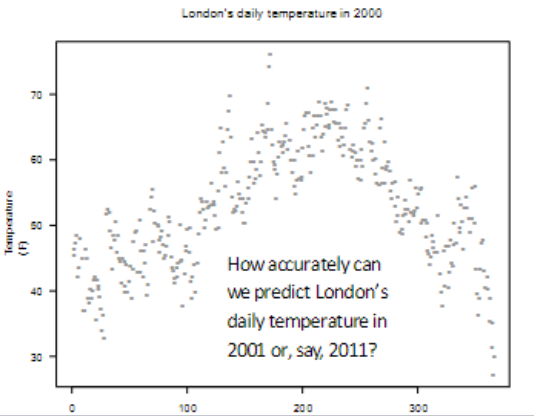
Example: Predicting the weather
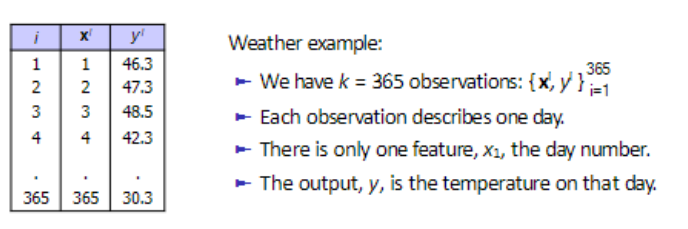
What is an observation?
► We have a series of k observations (examples/instances/cases).
► An observation describes a set of inputs x = (x1, . . . , xn) and an output y.
► Each xi is called a feature, attribute, or input variable.
► y is typically called the output variable.
Solution: For 2001,predict the year 2000 temp
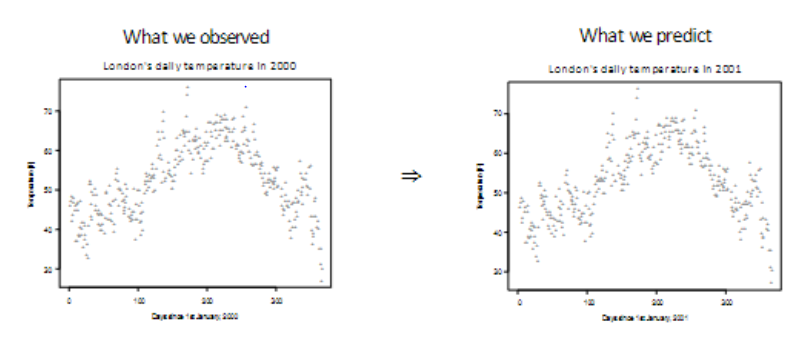
Making accurate predictions is hard
Prediction is very difficult, especially if it’s about the future.”
— Niels Bohr.
Why?
1. There is likely to be noise in the data.
2. There are yearly variations in temperature.
3. We want to capture what is systematic in London’s temperature.
4. We want to ignore what is accidental in London’s temperature.
Why?
► What is systematic is likely to be observed again.
► What is accidental is not likely to be observed again.
► Our goal is to make accurate predictions, not describe the data exactly.
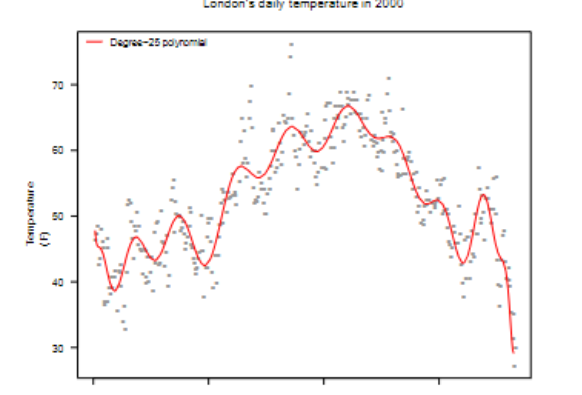
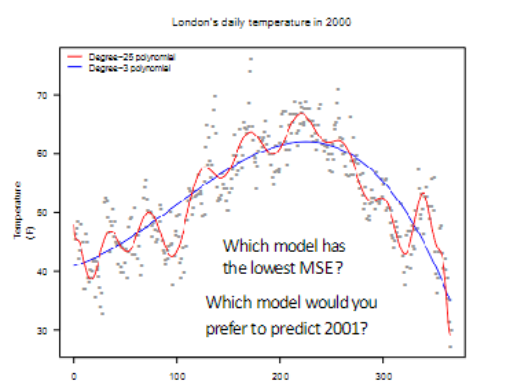
Solution: Use a model to capture the temperature trend
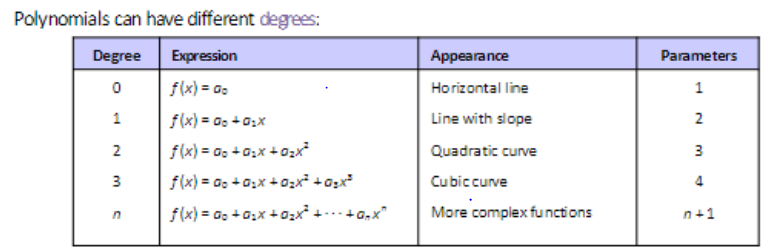
What is a plynomial model?

► x is the input of the model.
► Values a0, a1, ... , an are the model parameters.
► We change the value of the parameters, and the model changes.
► Learning refers to finding good parameter values.
Remember : Always an infinite number of potential models!
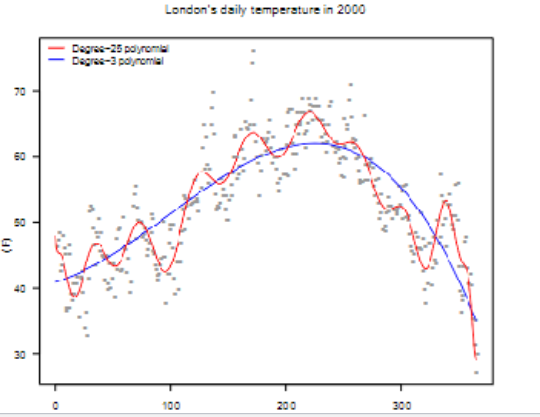
What makes a good model?
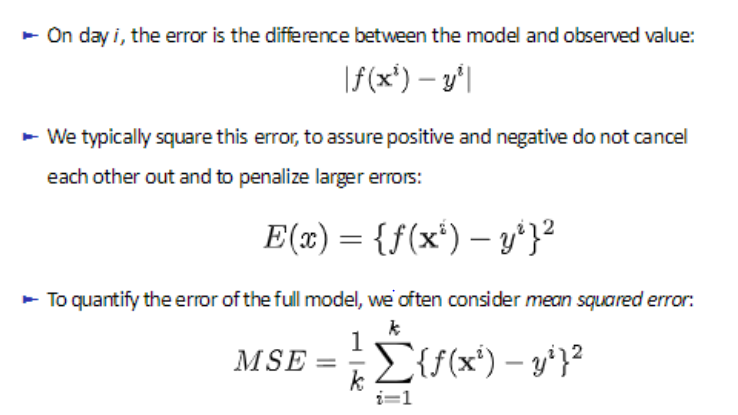
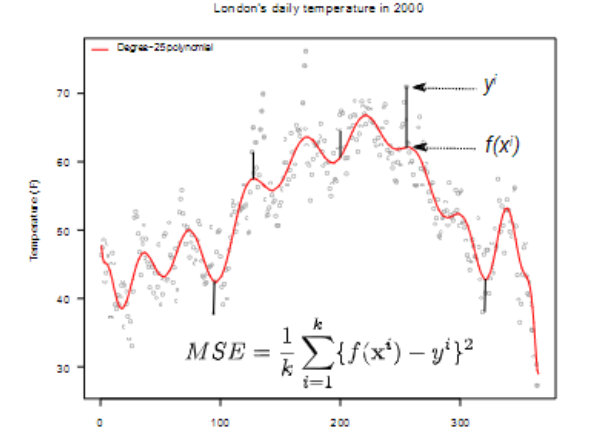
Good model makes errors
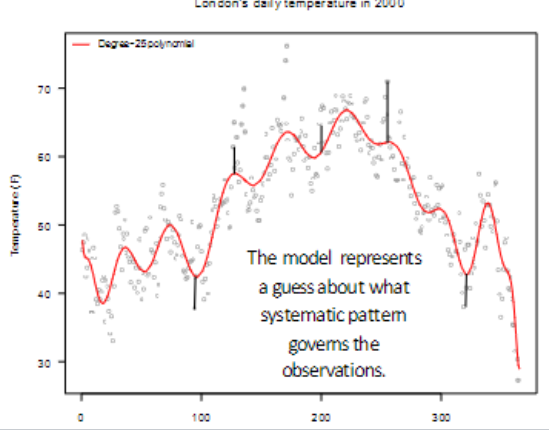
Measuring the error of a model
Training a model
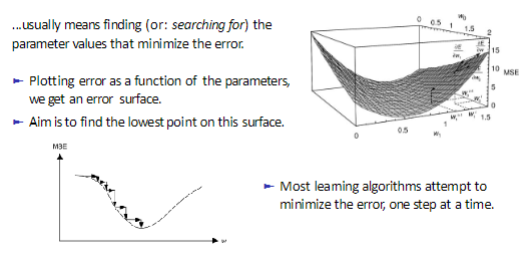
Both these models are trained to minimize MSE
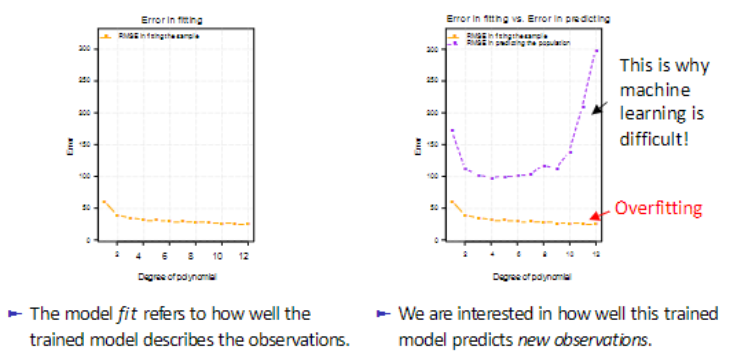
Fitting versus prediction
Predicting the weather: Summary
1. We know the daily temperature in London for the year 2000.
2. We want to predict the London’s temperature in the future, say 2001.
3. Simply predicting 2000 temperatures for 2001 is a bad idea.
4. We need a model to capture what is systematic, and ignore what is accidental.
5. We considered polynomial models of different degrees.
6. Models make errors, and we minimize these errors.
7. When fitting, the higher the degree of the polynomial, the lower the error.
8. When predicting, there is a U-shaped relationship, a trade-off.
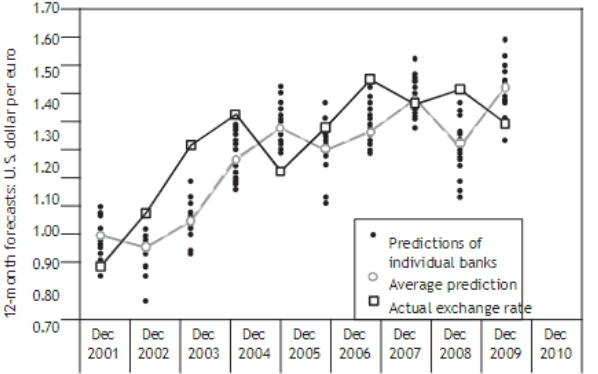
Example : Predicting the USD/Euro exchange rate
Summary
Key point: Reasoning about an uncertain world is difficult!
Four examples:
► Example 1: How many boxes were behind the tree?
► Example 2: Where am I?
► Example 3: How can we predict London’s temperature?
► Example 4: Can we predict the USD/Euro exchange rate?