Probability
Uncertainty:
observed variables (evidence)
unobserved variables
model
agent knows something about how the known variables relate to the unknown variables
Random variables:
some aspect of the world about which we (may) have uncertainty
R = is it raining?
T = is it hot or cold?
D = how long does it take to drive to work?
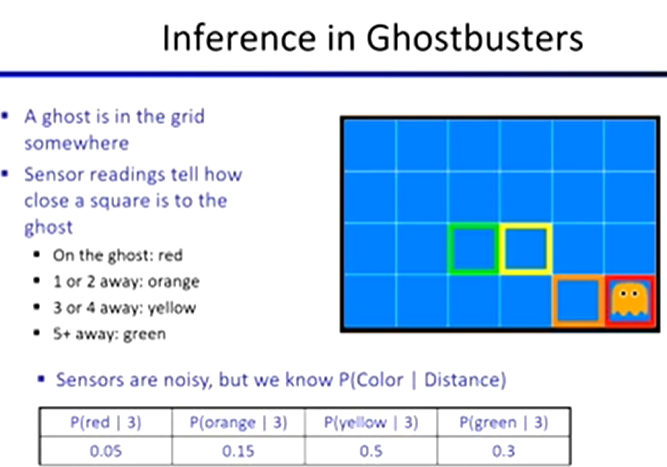
L = where is the ghost?
We denote with capital letters
Have domains
R = {true, false}
T = {hot, cold}
D = {0, infinity}
L = {(0,0), (2, 3)}
Probability Distributions
associate a probability with each value
unobserved random variables have distributions
ex. P(T): T P Where P(Hot) = 0.5
Hot 0.5
Cold 0.5
Joint Distributions
over a set of random variables: X1, X2, … Xn
specifies a real number for each assignment (or outcome)
P(X1 = x1, X2 = x2 … Xn = xn OR P(x1, x2 …, xn)
Size of distribution if n variables with domain size d?
dn
Probabilistic Models
a joint distribution over a set of random variables
(Random) variables with domains
assignments are called outcomes
say whether assignments are likely
normalized: sum to 1
Events:
a set of E outcomes
P(E) = ∑ P(x1, x2 …, xn)
from a joint distribution, we can calculate the probability of any event
Marginal Distributions
sub-tables which eliminate variables
Marginalization (summing out)
combining collapsed rows by adding
Conditional Probabilities
simple relation between joint and conditional probabilities
P(a | b) = P(a, b) / P(b)
Conditional Distributions
probability distributions over some variables given fixed values of others
ex. P(W | T = hot)
capital letter is an array of all the values
Normalization Trick
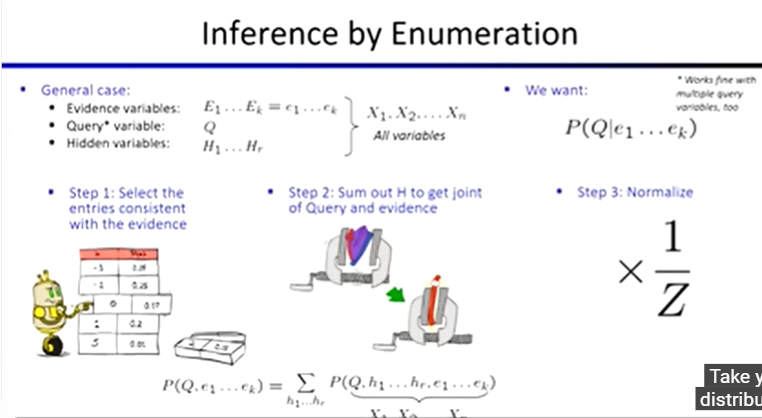
Step 1: select the joint probabilities matching the evidence
Step 2: normalize the selection (make it sum to 1) by dividing
Probabilistic Inference:
compute a desired probability from other known probabilities
generally compute conditional probabilities
probabilities change with new evidence
The Product Rule
P(y)P(x | y) = P(x, y)
The Chain Rule
P(x1, x2, x3) = P(x1)P(x2 | x1)P(x3 | x1 ⋅ x2)
Bayes Rule
P(x, y) = P(x | y)P(y) = P(y | x)P(x)
P(x | y) = [ P(y | x) / P(y) ] * P(x)