Anadromy and Diadromy in fish
Aquatic Productivity and the Evolution of Diadromous Fish Migration
Authors and Source
Authors: Mart R. Gross, Ronald M. Coleman, Robert M. McDowall
Source: Science, Mar. 11, 1988, New Series, Vol. 239, No. 4845, pp. 1291-1293.
Publisher: American Association for the Advancement of Science.
Stable URL: JSTOR link
Introduction to Diadromous Migration
Diadromous migration refers to the migratory behavior of certain fish species that travel between freshwater and marine environments. This includes two major groups:
Anadromous Species: Fish that are born in freshwater, migrate to the ocean to feed, and return to freshwater to spawn. Examples include salmon and lamprey (family Salmonidae and Petromyzontidae).
Catadromous Species: Fish that are born in the ocean, migrate to freshwater for feeding, and return to the ocean to spawn. Examples include some eels and mullets (families Anguillidae and Mugilidae).
The Paradox of Diadromous Migration
The existence of both anadromous and catadromous migrations presents a paradox in animal behavior. The authors propose that global patterns in aquatic productivity can explain this behavior.
Key Concept: The differences in the available food resources in oceanic versus freshwater habitats help explain why certain species evolve to migrate in differing directions.
Oceans vs. Freshwaters: Typically, oceans exhibit higher productivity than freshwater bodies in temperate latitudes, leading to a predominance of anadromous species. In contrast, tropical freshwater environments are often more productive than their adjacent oceans, leading to an increase in catadromous species.
Evolutionary Implications of Diadromous Migration
According to the authors, for diadromous lifestyles to evolve via natural selection, the benefits must exceed the costs associated with migration. The costs include:
Physiological adjustments for osmoregulation.
Energy expenditure during swimming.
Increased mortality risks associated with migration.
Factors Influencing Migration Decisions
Several hypotheses have been posited to explain why juvenile fishes may choose to leave their birthplace for different habitats. These include:
Reduced predation risks.
Decreased disease prevalence.
Reduced physiological stress.
Enhanced food availability.
Geographic Distribution of Diadromous Species
Data presented by McDowall indicate latitudinal trends:
Anadromous species are more common in temperate and arctic regions.
Catadromous species predominate in tropical areas.
The authors emphasize that a successful hypothesis for the evolution of diadromy must account for both the geographical distribution and the advantages of migration.
Food Availability Hypothesis
The authors propose that the differential availability of food resources in oceanic and freshwater habitats explains diadromous migration patterns. Key points include:
Primary Productivity as a Measure: Primary productivity is a good proxy for food availability in aquatic environments. It is measured in grams of carbon fixed per square meter per year.
Findings from Studies: Studies show that anadromous juvenile salmon can experience a growth rate increase of 10% to 50% when transitioning from freshwater to ocean habitats due to enhanced food availability.
Impact of Food Resources: Access to food is crucial for growth, leading to higher fecundity and improved reproductive success in diadromous species.
Testing the Food Availability Hypothesis
The authors test the food availability hypothesis by correlating diadromous species' migration patterns with productivity data. Key considerations include:
Where ocean productivity exceeds freshwater, anadromy is expected to dominate.
Conversely, where freshwater productivity is higher, catadromy is expected.
This hypothesis was supported by comparative data showing migration tendencies align with food availability metrics.
Graphical Representations and Data Analysis
Figure 1A
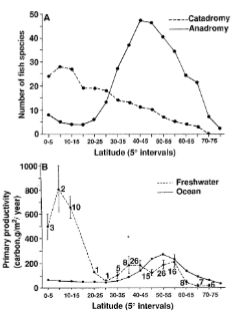
Illustrates the number of anadromous versus catadromous fish species relative to latitude.
Figure 1B
Compares annual primary productivity rates of freshwater and ocean habitats against latitude, showcasing a disparity between temperate and tropical regions.
Figure 2
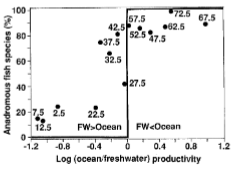
Plots the relationship between relative productivity (ocean vs. freshwater) and the proportion of diadromous fishes that are anadromous, demonstrating the predictive capacity of food resource availability on migration behavior.
Complications and Considerations
While the food availability hypothesis explains many observed patterns, several complicating factors remain:
Primary productivity's imperfect correlation with actual food availability.
Certain fish species may migrate north/south post-crossing the ocean-freshwater boundary.
Additional biological interactions, such as competition and predation, that may influence migratory decisions are not accounted for in the current analysis.
Conclusion
The authors conclude that food availability is a key factor in explaining the geographic distribution of diadromous fishes and the reasons for their migratory behavior. The findings suggest that understanding the dynamics of aquatic productivity can provide renewed insight into the evolutionary ecology of diadromous species.