Chapter 4
Light and Quantum Theory
To understand arrangement of electrons → study/analyze light emitted by energetic atoms
Properties of Waves
Wave lengths: distance between points in adjecent waves (NM) upside-down Y (λ)
Frequency (ν) “nu” how frequently a wave passes in a second (Hz = 1 cycle/s) how many cycles in a second
Speed (c) of wave: c = λ x ν
Maxwell 1873
Visible light → electromagnetic wave
Electromagnetic radiation: emission and transmission of energy in the form of electromagnetic waves
Speed of light (c) in vacuum = 3.00×10^8 m/s
All electromagnetic radiation: c = λ x ν
Quantum Theory
Max Planck: father of modern physics (MATTER IS NOT EMITTED NOR ABSORBED CONTINUOUSLY BUT IN CHUNKS CALLED QUANTUM)
#1 Mystery Heated solids problem (solved by Planck 1900)
Solids heated → emit electromagnetic radiation on range of wavelengths
Radiant energy emitted at certain temp → depends on wavelength (ends up glowing if very hot
Energy (light) emitted/absorbed in discrete packets (quantum/quantities)
Base amt really small
E = h x ν (energy is proportional to frequency)
Planck’s constant = h
Planck’s constant = 6.63e-34 J x s (juele times second) Derived unit
Black Body Radiation: soilds continuously giving off radiation temp above 0K
Below the frequency that our eyes can see (invisible) in the spectrum
Once heated ~700-750 degree celcius → solids will glow red
Metals → red hot in fire
As temp rises → more energy added (yellow → blue → white)
1200 degrees Celsius → white hot metal (ex old lightbulb)
As result of Radiation → found relationship between energy emitted and frequency of radiation emitted by heated obj (CONSTANT VALUE) or h = 6.63e-34 J x s
vibrating atoms in heated solid → absorb emit electromagnetic radiation only in certain descrete amts
Smallest amt of energy: Quantum
#2 Mystery Photolelectric Effect (solved by Einstein 1905)
Light itself is quantized maybe..
Part. of light energy = photon
Proof:
Take metal → shine red light metal and nothing happens to metal
if a higher wavelength of light (ex. blue light) → electrons can be ejected from the anode and go to cathode & create photons
Shorter wavelength → higher frequency and higher energy
Longer wavelength → lower frequency and lower energy
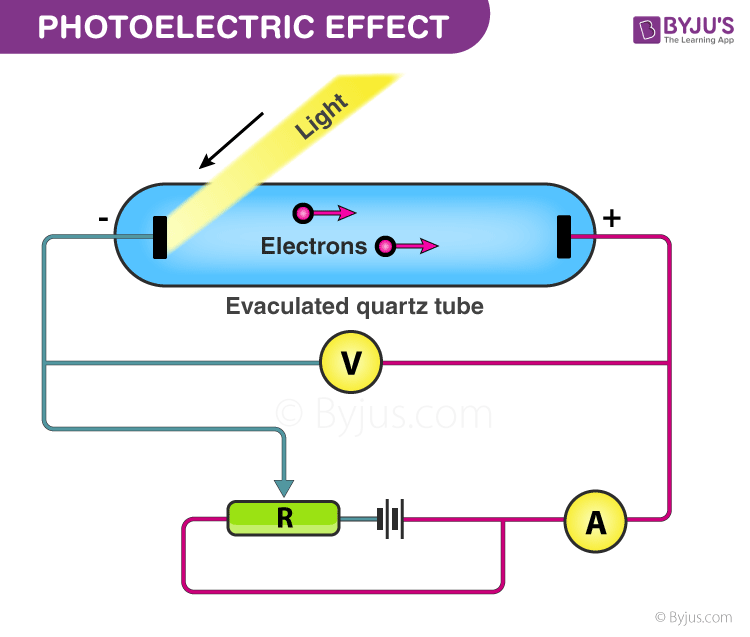
Light has both
wave nature
particle nature
hν = KE + W
KE = hν - W
W = work function and depends how strongly electrons and held in metal
Lamp containing hydrogen gas (hydrogen gas-discharging tube)
Electric current passes thru lamp → some hydrogen atoms energized as struck by electrons
Energized atoms → give off energy in form of light
Pass light thru prism → see different colors seperated by dark regions (breakdown light frequencies)
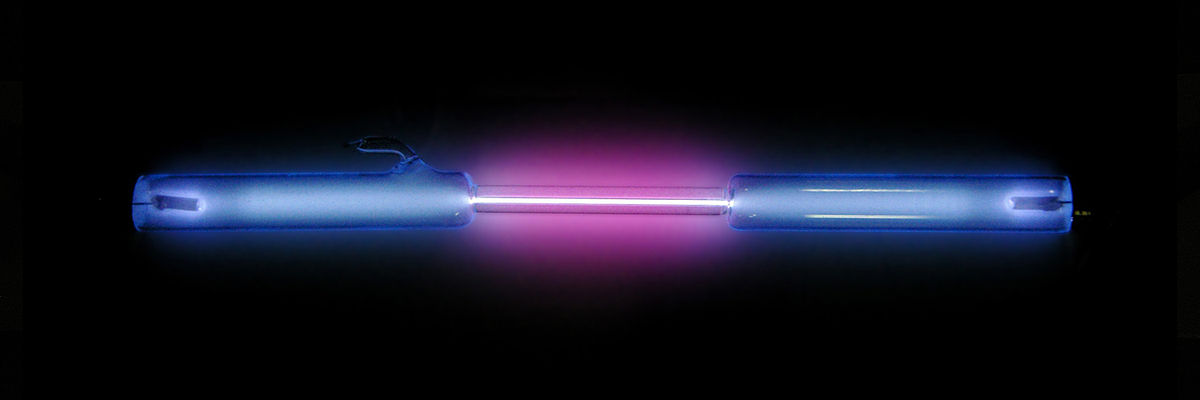

monochromatic radiation (only wavelength seen from hydrogen gas pink light)
light seen from hydrogen atoms → dispersed into different wavelengths (dispersed by prism) known as Emission spectroscopy
Emission spectroscopy: analysis of light emitted when element is heated or energized by electric current (EVERY ELEMENT HAS THEIR OWN TYPE OF EMISSION SPECTRUM)
ex. used to find stars in space
Can identify unknown substances
Neils Bohr: took several works of hydrogen gas experiment and explained its structure of hydrogen atom
Combined quantum theory with physics
Electron in hydrogen → can only exist in quantized energy levels (orbits theory)
Electron energy levels are fixed, when it falls to high to low → gives off the difference of energy thru photons
Bohr: took rutherford’s nuclear structure and came up for a reason for why they dont crash into the nucleus
Orbits → assuming electrons move in circular orbits around nucleus (little Solar Systems)
If electron can only give off certain amt radiation → has fixed value of where it could fall
Angular momentum is how part. travel in a circular path (Momentum = mass x velocity)
Can only have certain allowable values (can’t live between)
As long as electrons remains in energy lvl → does not emit or absorb energy
prevents electron from spiraling to nucleus (momentum)
When electron loses energy → gives off photon light energy
if absorbs more levels → it goes to another level (orbiting around the sun type poop)
known as Solar System Model of the Atom
Johan Balmer and Rydberg: studying hydrogen
studied the 4 wavelengths of hydrogen (relating to the integer 2) m²=2x
Helped Bohr describe the energy levels electrons can exist on
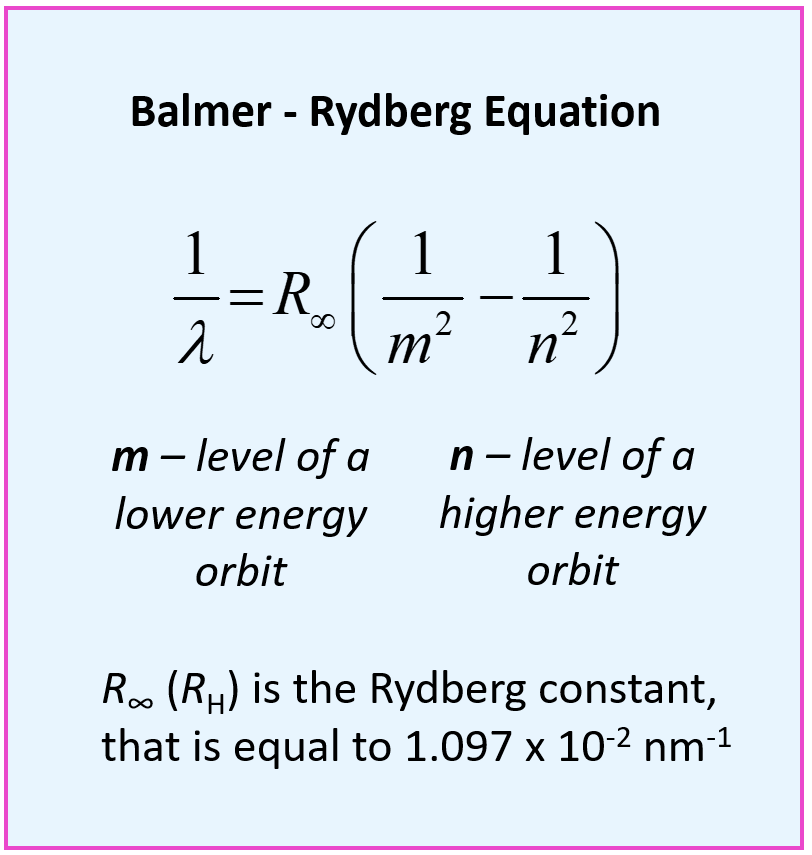
Rydberg’s constant: 1.09737e7/m
Nature of Energy
Bohr used Planck, Rydberg, and Einstien’s idea and explained the phenomena this way
Electrons in atom can only occupy certain orbits (corr. to certain energies/angular momentum)
Cannot be in the middle
Energy is only absorbed or emitted in such a way as to move electron from one “allowed” energy state to another; energy defined as E = hv
Energy absorbed or emitted from process of electron promotion or demotion using Rydberg’s Equation
Anytime an electron falls down to the specific levels, it emits a photon that we can see (the colors)
Energy an electron has to be in a specific level: E= -2.18e-18 J/n²
Bohr calculated the energy that an electron has on an each energy level
If find energy different btwn two energy levels → calc the wavelength of radiation emitted or absorbed when there is a transition
Energy values are negative for all values of n
lower (more negative) energy is → more stable atom will be
What happens to radius and energy as n becomes large?
Inc energy → orbit gets big and could become disconnected from the nucleus
Energy would = 0
Electrons could jump from 1 energy state to another by absorbing or emitting photons whose radiant energy corresponds exactly to the energy difference between the two states
However.. it doesn’t work for multi-electron atoms
electrons don’t orbit nucleus in fixed energy orbits (the fixed levels were true tho)
light could have particle-like prop. and wave-like prop.(duel nat. of light)
Bohr got the electron structure rolling