Inheritance, variation and evolution
DNA
Deoxyribonucleic acid (DNA) is a polymer and makes up all our genetic material
Double-helix shape - 2 strands wrapped around each other
There are 46 sections (chromosomes) in 23 pairs
The 23rd pair are the sex chromosomes - female is XX and male is XY
A gene is a small section of DNA that codes for a protein
It is a small segment of a chromosome
They code for amino acids - there are 20 different types to be combined
They determine the type of cell formed
A genome is the entire set of genetic material in an organism
For example, it is more similar to parents than strangers
Scientists now know the complete human genome
They can identify certain genes that may cause inherited diseases or increase the risk of others
The BRCA gene increases the risk of breast cancer, for example
They can also tell the migrations of ancestors through genomes, from when they separate and change
Genes we inherit determine our characteristics
For example, one gene can change fur colour or cause colour blindness
Several genes can interact, to change height for example
Genes code for particular types of proteins
The different versions of the same gene are called alleles (blue, brown or green for eye colour, etc.)
We get two copies of every gene from our parents
If they are the same alleles, they are homozygous
If the alleles are different, they are heterozygous
With heterozygous, one allele will be dominant and the other will be recessive
If purple is dominant:
P,P - purple (homozygous dominant)
P,p - purple (heterozygous)
p,P - purple (heterozygous)
p,p - other colour (homozygous recessive)
A genotype is the entire collection of alleles we have
P,P and p,P are both different, so different genotypes
A phenotype is the characteristic that is expressed, and is from the genotype
PP and p,P are both purple, so have the same phenotype, but different genotypes
DNA is a double helix structure
It has two strands that twist together
A monomer is a nucleotide - phosphate, sugar and base
A triplet (three nucleotides) codes for one amino acid
The entire strand is a polymer
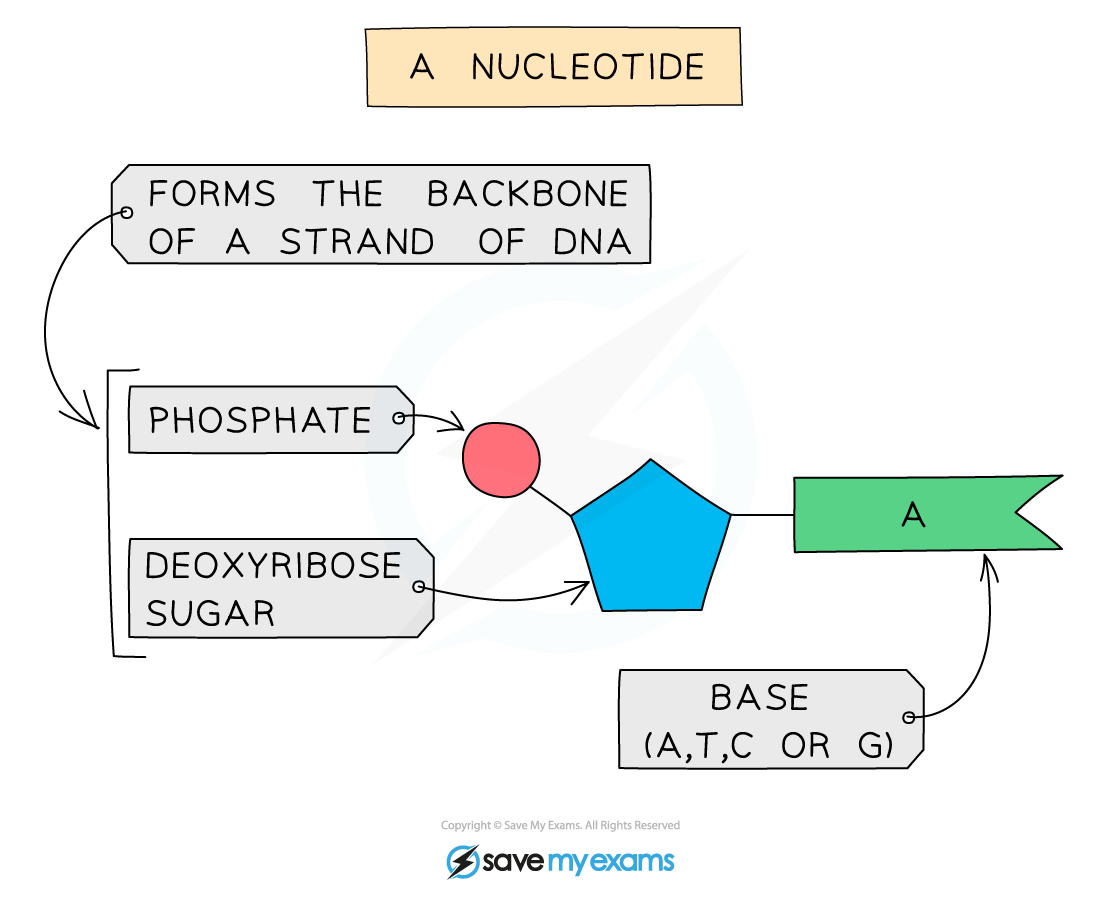
Phosphates and sugars are the same within a DNA strand
They form the backbone of DNA, and join in a long chain
Bases can change, as they code for the different amino acids
They can be A (adenine), C (cytosine), T (thymine) and G (guanine)
Between the two strands they join into base pairs
These must be complementary
A and T
G and C

A genetic code is a sequence of bases
A gene is a particular sequence of bases that code for a protein
Three bases code for an amino acid, and these amino acids code for a protein
Each three bases code for a specific amino acid, called a triplet
All proteins have a different sequence of amino acids
They all have unique shapes, that can carry out a particular function
Usually as enzymes, hormones or structural proteins
Protein synthesis
Protein synthesis is the process of making proteins
Transcription is the process of taking a single gene of DNA and copying it into a structure - mRNA
Translation is the process of taking the mRNA strand and using it to produce a protein
In a cell, the nucleus holds DNA, which contains genes with specific sequences of bases that code for specific sequences of amino acids, which form a protein
The specific sequence of bases has to be read by ribosomes, that then form amino acids in a sequence that code for proteins
The whole DNA strand is too large to leave the nucleus, so a copy of a gene (section) that is smaller is made, so it can leave and travel to a ribosome
The copy is called mRNA (messenger RNA), and is a copy of a single gene
This is similar to DNA but is much shorter and only a single strand (no double helix)
It doesn’t have the base thymine, instead it has uracil
Transcription
DNA is usually a double helix
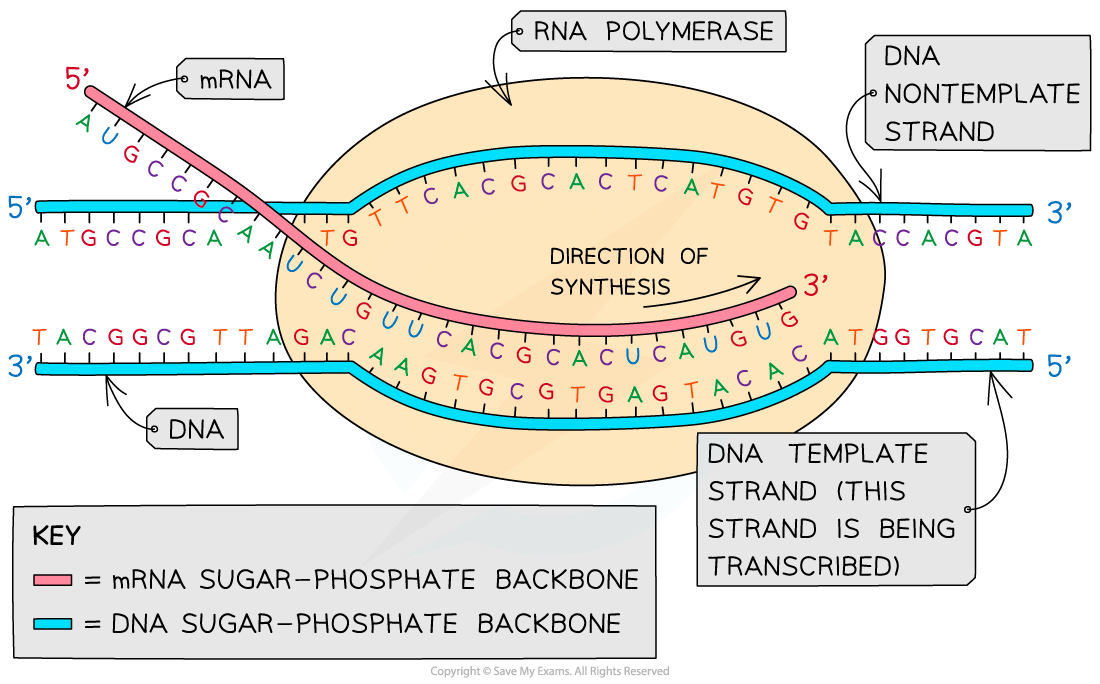
When in the RNA polymerase, the bases separate, which exposes DNA bases
The RNA polymerase reads the bases of the gene we are copying, and makes a copy (mRNA) with complementary bases
For example, if we are copying a sequence with AGACTGA, the RNA polymerase would make a mRNA copy of TCTGACT
After they have passed through the RNA polymerase, the DNA joins back up, so only a small section is ever exposed
As the RNA polymerase moves along the strand, the mRNA copy gets longer, until the entire gene wanted is copied
The gene wanted to be copied is called the template strand (is used to make mRNA strand)
The mRNA strand is now free to leave the nucleus and go to a ribosome for translation (makes amino acids that form proteins)
Translation
Each triplet/codon codes for one specific amino acid
20 amino acids then form a protein
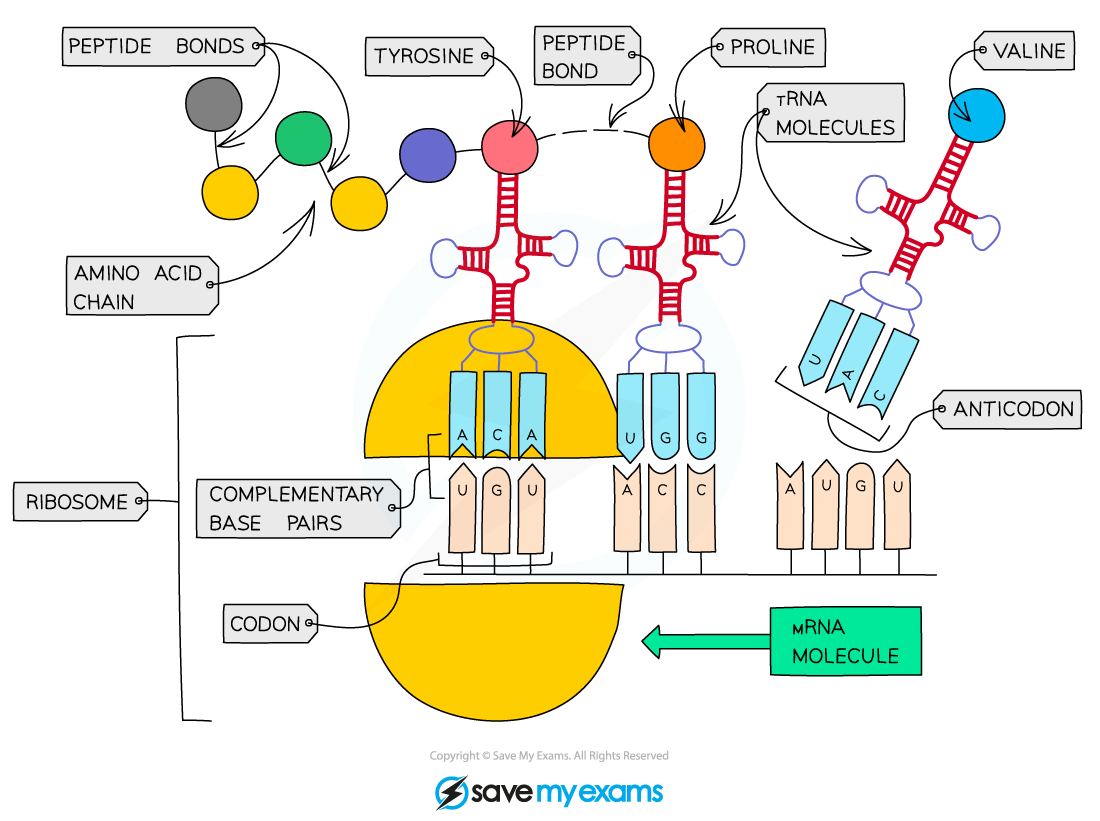
The mRNA strand (copy of gene with complementary bases) enters the ribosome
A tRNA (transfer RNA) molecule carries an amino acid that matches the codon with complementary bases
They are the same as the original gene
It has an anticodon, that matches with the codon on the mRNA strand
As the anticodons are specific to certain genes, they carry the right amino acid in the right order
The anticodon and codon join, matching the amino acid to the codon
This repeats, so another amino acid joins the chain
This allows the amino acids to join, forming a peptide bond
The tRNA molecule then leaves, forming the amino acid chain
The ribosome moves along the mRNA chain, repeating the process and allowing a complete chain of amino acids to be formed
The amino acid chain folds up on itself, and forms a protein
Sexual and asexual reproduction
Most animals reproduce sexually, where bacteria reproduces asexually and plants can do both
Sexual reproduction is the fusion of male and female gametes to cause fertilisation
There are two parents
They have genetically different offspring
There is lots of variation
Gametes are the sex cells, like sperm and eggs in animals or pollen and eggs in plants
They only have half the genetic material (23 chromosomes), and fusion between the two cells creates 46 chromosomes - a full set
This is carried out through meiosis
Asexual reproduction has only one parent
There are no gametes
No mixing of genetic material - no variation
Offspring are genetically identical clones
It occurs in eukaryotic organisms (plants, fungi and some animals) where they asexually reproduce through mitosis
It occurs in prokaryotic organisms, like bacteria, through binary fission
Pros and cons of types of reproduction
Asexual reproduction
Pros - only one parent is needed
The process is very quick - one organism can quickly colonise a new area (bacteria and plants)
Cons - no genetic variation
A new disease can wipe out an entire population
There is less chance of adaptation to new conditions - climate change or new competitors can destroy a population
Sexual reproduction
Pros - there is lots of genetic variation
They are less likely to die out from a single event (like disease)
Evolution can take place over time - adaptations occur
Cons - It takes more time and energy
They have to find and impress mates first
Meiosis
Sexual reproduction requires gametes
Gametes (sex cells) have half the genetic material (are haploids), so when they combine they can form a normal cell
This can grow into a new organism and has two different sets of genetic information - diploid
To make gametes, a cell has to undergo meiosis
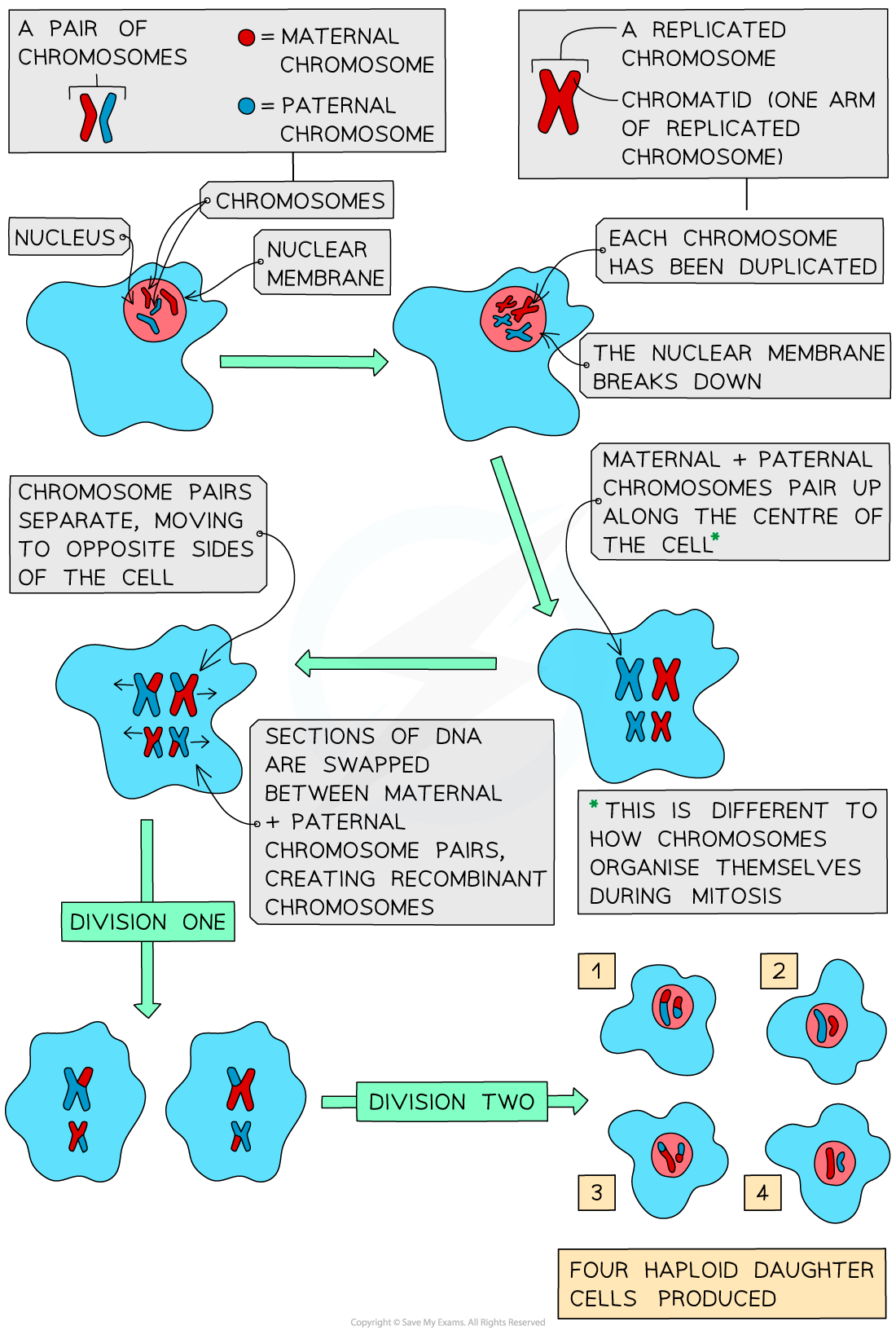
In a cell, there are 23 pairs of chromosomes
Mothers - maternal chromosomes
Fathers - paternal
In meiosis the DNA is replicated, so there are copies of the chromosomes (as X’s)
They line up along the centre of the cell
Maternal or paternal is completely random on either side
The first division is where the cell is pulled apart and splits
There is random distribution of DNA on either side - genetically different cells
The second division is where the chromosomes line up again, and the two arms are pulled apart
There are 4 genetically unique daughter cells - gametes (only 23 chromosomes)
These daughter cells would develop into egg/sperm cells, and if fused with another gamete, a diploid cell would form
Through mitosis, this diploid cell could become an embryo, then a foetus and finally an entire organism
Genetic diagrams and punnet squares
Genetic diagrams show the different combinations of alleles that we can get from two parents
Alleles are different versions of the same gene, and can be dominant or recessive
If dominant, they are shown as uppercase - A
If recessive, they are shown as lowercase - a

If two heterozygous tall plants bred, their offspring could either be tall or short
There is a 75% chance that the phenotype will be tall
There is a 50% chance that the genotype will be heterozygous tall, a 25% chance of homozygous tall and a 25% chance of the genotype being short (and phenotype)
This is a simplified diagram - normally multiple genes would affect one characteristic
It is also affect by the environment and conditions it is in
Family trees (family pedigrees)
Family trees show how characteristics or inherited diseases are passed down through families
Cystic fibrosis is a recessive inherited disorder
To have it, you need the alleles ff
FF - healthy
ff - disease
Ff or fF - heterozygous, so carrier but otherwise healthy

We can work out the probabilities of offspring having a disease, and work out the genotypes of family members
For example, anyone with children with cystic fibrosis must at least be carriers
Inherited disorders and embryo screening
Inherited disorders are conditions passed on in alleles (from parents)
Polydactyly is a condition that means you have extra fingers or toes
It causes no other problems and is caused by a dominant allele
This means heterozygous genotypes still have the disease
Cystic fibrosis is a disorder of cell membranes that causes a sticky mucus to be released into airways of the lungs and the pancreas
It is caused by a recessive allele (must be homozygous recessive - parents have to both be carriers or have the disease)
During IVF, an embryo can be removed from the uterus to have its genes looked at
This allows us to see if it is carrying any genetic disorders - embryo screening
Pros of embryo screening - it reduces the overall suffering (fewer people with health problems)
It can save money - treating disorders is expensive
Cons - It implies that genetic disorders and people with them are undesirable
It could lead to future screening for other traits - to make the ‘perfect’ person?
Mendel
Gregor Mendel was the ‘founding father’ of genetics
He was an Austrian monk and scientist in the 1800s
At this time, crossbreeding was already widely used by farmers, but it was unknown why it worked
While Greg was in his little monastery, he experimented with pretty little pea plants, and studied how certain traits (height, colour, size, etc.) were passed down

When white and purple plants were crossbred, all of the offspring were purple
We now know purple would have been the dominant allele, so the offspring would have been - pp, pw or wp - the original white plant must have been heterozygous and the purple would have been heterozygous
When these purple offspring were crossbred, they were only 75% purple
This showed Mendel how traits were passed down
He found that parents passed down ‘hereditary units’ to their offspring
He called them dominant or recessive, and said recessive was only expressed if it from both parents
He repeated his experiments many times, with colour and height, and always found the same pattern
However, at this time scientists didn’t know anything about DNA or genes
It was only decays after his death that the significance of his discoveries were realised
In the late 1800s, chromosomes and behaviours during cell division were discovered
In the early 1900s, similarities between Mendel’s work and others was noticed - hereditary units were found to be chromosomes
In the 1950s, the double helix structure was discovered
In 2003, the entire human genome was sequenced (all of the sequences of genetic bases that make up human DNA were found)
Variation and evolution
Variation is the differences in a population through their phenotypes (expressed characteristics)
Phenotypes can depend on genes, but also change depending on their environment
Everyone has a unique human genome (bar identical twins) which codes for an entire organism (from genes, which form amino acids, that form proteins when in different combinations)
The environment also affects many observable traits
It can link with genes to develop certain traits
For example, if you sleep and eat less, you won’t grow as much - will be shorter
If you spend more time in the sun, your skin will be darker
Mutations are changes in the DNA code so proteins it codes for may change and be different
Most have no effect to the phenotype, and just lead to variation
Some mutations can cause changes, mainly bad and unwanted, but occasionally they can be beneficial
Could cause you to run faster or be more resistant to disease
People with beneficial mutations are more likely to survive, so they are more likely to reproduce and pass on genes to the next generation
Charles Darwin’s theory - 1800s
‘Survival of the fittest’
He noticed that traits were passed on from parent to child, usually useful, which he called ‘natural selection’
The fittest individuals were selected to survive
He discovered evolution - inheritance of certain characteristics in a population, over multiple generations, could lead to a change in the whole species (or a development of a new species)
It shows that all current species must have evolved from different past species
All living species have evolved from a single life form
It has taken a long time for Darwin’s theory to be accepted
We can now see its proof through antibiotic resistance and fossils
Darwin, Wallace and Lamarck
Lamarck’s early theory of evolution suggested that organisms could acquire new traits over their lifetime, which could be passed onto offspring
For example, giraffes had short necks for lower vegetation, but they then stretched them to reach higher branches resulting in longer necks during one lifetime
They then passed these acquired traits onto offspring
This theory was proved wrong by modern genetics, which show that physical changes due to environments don’t change DNA
Charles Darwin found that individual organisms in a species show a wide range of variation for a specific trait
He observed variation between species in different environments
Older rock had less complex organisms as fossils, compared to new species
Natural selection is the main reason for gradual development in a species over time
Russel Wallace came to a similar conclusion independently, and later presented a joint paper with Darwin, supporting his theory
Some giraffes have a longer neck than others due to variation within a species, and they were better adapted to an environment
They had a higher chance of survival, as they could eat more, so reproduced more and passed on height as a desirable trait
This produced modern giraffes over many generations having small, gradual changes
It took time for the theory to be widely accepted
Religious reasons - the belief that god created all life
Lack of evidence
DNA hadn’t been discovered - why variation and inheritance happened was unknown
Selective breeding
Selective breeding is breeding the past plants or animals together to get better offspring with desirable traits
Used in agriculture for 1000’s of years
It can now be used for:
Cows with higher meat/milk
Plants resistant to disease
Pets that are desirable
First, the two best plants or animals with the trait want are bred together
From this next generation, two more organisms are selected and bred - this is repeated over many generations
This creates offspring with desirable traits
Drawbacks of selective breeding:
It reduces the gene pool (collection of different alleles in a population) of a population
Selecting certain alleles that code for wanted traits decreases the amount of alleles in total in a population
Best individuals are closely related, which can lead to inbreeding, increasing the chance of diseases
Less variation - one pathogen can affect all organisms, not just a few
Genetic modification
An organism with a desirable characteristic has a gene that that characteristic
The gene can be extracted, and transferred to another organism so it develops the same trait - modifying the organism’s genome
Genetic modification isn’t limited to the same species only
Bacteria has been genetically modified to produce insulin - can be harvested to treat diabetes
Sheep can produce drugs in their milk
Crops are larger and have higher quantities and can be resistant to disease, insects and herbicides
Gene therapy is treating inherited disorders by removing a faulty gene and replacing it with a healthy version
Its hard to transfer the new gene to every cell - we could transfer at the early stage of development (egg/embryo) so it develops with the organism
Issues with genetic modification:
We don’t know how GMOs might affect our health - little evidence
If plants end up in the wild, they may outcompete local plants so could change ecosystems - unlikely, but possible
Pros:
Crops with desirable characteristics produce more fruit and disease resistant
More food, for less money - good in developing countries
They can contain special nutrients - beta carotene (needed for sight) in golden rice can prevent blindness occurring
We take the gene we want, and by using enzymes we isolate from the DNA chain
We insert it into a vector - implant in a bacterial plasmid or a virus
The vector (and gene) are implanted in the plant/animal wanted to develop that trait, and the cells take up the vector so start producing the protein 🙂
Cloning animals
The first animal to be cloned was a sheep in 1996 called dolly 🐑
She had lots of health issues but survived and the process has since been repeated
Take an egg cell from a donor female, and remove its nucleus - ‘enucleated’ cell
Take an adult body cell (e.g. skin cell) from the organism wanted to clone and remove its nucleus (DNA)
Put the nucleus from the adult body cell into the enucleated egg cell
Stimulate the cell via electric shock - it will act as a zygote and divide by mitosis, forming an embryo
Implant the embryo in a surrogate mother’s uterus - it will develop into a fetus and be born
Cloning transgenic animals to make human protein