transpiration
Transpiration: Definition and Significance
Transpiration is the process by which plants lose water in the form of vapor from their aerial parts, such as leaves, stems, and flowers. This process is crucial for several reasons:
Cooling Effect: Transpiration helps to cool the plant, preventing it from overheating, especially in hot environments. The evaporation of water from the leaves has a cooling effect, similar to how sweating cools animals.
Water and Mineral Uptake: Transpiration creates a transpiration pull, which assists in the upward movement of water and dissolved minerals from the roots to the rest of the plant. This is essential for nutrient distribution.
Turgor Pressure: By maintaining a constant flow of water, transpiration helps maintain turgor pressure in cells, which is necessary for the plant's rigidity and proper functioning.
Types of Transpiration
There are three main types of transpiration:
Stomatal Transpiration: This is the most significant type, accounting for about 90-95% of the total transpiration. It occurs through the stomata, which are tiny pores on the surface of leaves.
Mechanism: Stomata open and close in response to various factors, such as light intensity, carbon dioxide concentration, and water availability. When stomata are open, water evaporates from the mesophyll cells into the air spaces and then diffuses out.
Cuticular Transpiration: This occurs through the cuticle, a waxy layer covering the epidermis of leaves and stems. Cuticular transpiration accounts for only about 5-10% of the total water loss because the cuticle is relatively impermeable to water.
Lenticular Transpiration: This happens through lenticels, which are small openings in the bark of woody stems and roots. Lenticular transpiration is minimal compared to stomatal and cuticular transpiration.
Factors Affecting Transpiration
Several environmental and physiological factors influence the rate of transpiration:
Light: Light stimulates the opening of stomata, increasing the rate of transpiration. In the dark, stomata usually close, reducing transpiration.
Temperature: Higher temperatures increase the rate of evaporation, thus increasing transpiration. However, extremely high temperatures can cause stomata to close to conserve water.
Humidity: High humidity reduces the rate of transpiration because the air is already saturated with water vapor, decreasing the concentration gradient between the leaf and the atmosphere.
Wind: Wind removes water vapor from the leaf surface, maintaining a steep concentration gradient and increasing transpiration.
Water Availability: When water is scarce, plants may close their stomata to conserve water, reducing transpiration.
Leaf Area: Larger leaf area provides more surface for transpiration, increasing the overall rate.
Mechanism of Stomatal Transpiration
The opening and closing of stomata are regulated by the turgor pressure of the guard cells, which surround each stoma.
Opening of Stomata:
Light: In the presence of light, guard cells perform photosynthesis, producing glucose.
Potassium Ions (): The glucose increases the osmotic pressure in the guard cells, causing them to draw in water from surrounding epidermal cells. Additionally, potassium ions () enter the guard cells.
Turgor Pressure: The influx of water increases the turgor pressure, causing the guard cells to swell. The inner walls of the guard cells are thicker than the outer walls, so they bulge outwards, opening the stoma.
Closing of Stomata:
Darkness: In the absence of light, photosynthesis stops, and the glucose concentration decreases.
Potassium Ions (): Potassium ions () exit the guard cells, followed by water.
Turgor Pressure: The turgor pressure decreases, causing the guard cells to shrink. The elastic outer walls of the guard cells cause them to close the stoma.
Adaptations to Reduce Transpiration
Plants in arid environments have developed several adaptations to minimize water loss through transpiration:
Thick Cuticle: A thick, waxy cuticle reduces cuticular transpiration.
Sunken Stomata: Stomata located in pits or depressions reduce air movement and water loss.
Reduced Leaf Area: Small leaves or spines reduce the surface area for transpiration.
Leaf Orientation: Some leaves orient themselves to minimize exposure to sunlight, reducing leaf temperature and transpiration.
CAM Photosynthesis: Crassulacean Acid Metabolism (CAM) plants open their stomata at night and close them during the day to reduce water loss.
Practical Applications and Importance
Understanding transpiration is vital in agriculture and horticulture:
Irrigation Management: Knowledge of transpiration rates helps in planning irrigation schedules to meet plants' water needs efficiently.
Crop Improvement: Breeding plants with lower transpiration rates can improve drought resistance.
Environmental Impact: Transpiration plays a role in the water cycle and can affect local climate by influencing humidity and temperature.
Experiment to Demonstrate Transpiration
Aim: To demonstrate that transpiration occurs in plants.
Materials Required:
A potted plant with healthy leaves
A transparent polythene bag
String
Procedure:
Water the potted plant well.
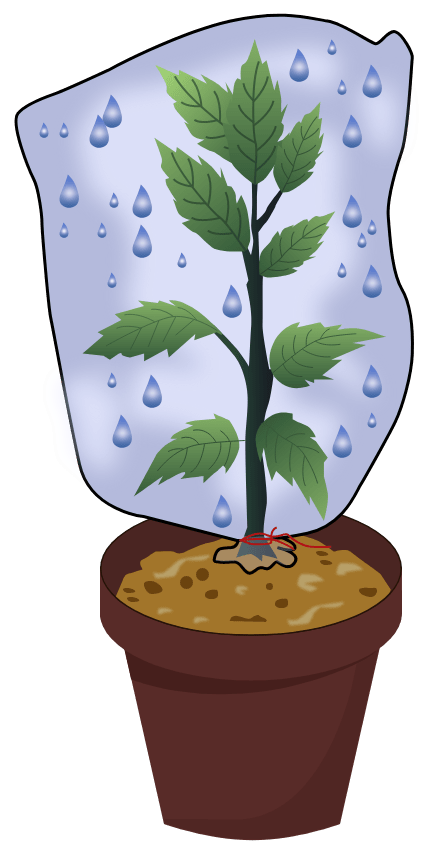
Cover the entire plant, including the pot, with the transparent polythene bag.
Tie the bag securely around the base of the stem to prevent water vapor from escaping.
Place the setup in a well-lit area and observe for a few hours.
Observations:
After a few hours, you will notice small droplets of water forming inside the polythene bag. This water comes from the plant through transpiration.
Conclusion:
This experiment demonstrates that plants lose water in the form of vapor through transpiration.