Osmoregulation
Osmotic pressure: pressure needed to offset movement of pure solutes across a semipermeable membrane.
The heart’s pressure gradient (sans plasma and capillaries leakage) causes it to pump better. We try to maintain osmotic pressure (+charges) in our body, and we see this in the red blood cells in different solutions.
Isotonic solution: equilibrium
Hypotonic solution: too much water inside of red blood cell, with osmotic movement of water towards inside of cell.
Hypertonic solution: too much solute on the inside, with osmotic movement of water outside of cell.
Electrolyte composition
When you have water loss, you need to make up for it (offset). Plasma makes up a lot of the osmotic gradient.
**add info on serum???
Nasal fluid in bird offset amount of salt they have.
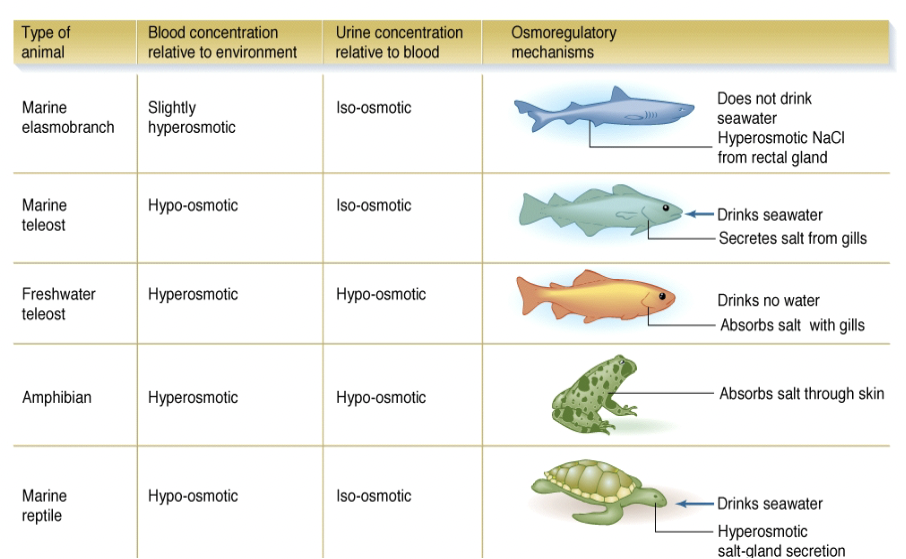
Marine Environment
Relatively high concentration, will have different ways of drinking or not drinking to fight against their type of urine and blood concentration. Can get environmental contaminants if they are taking a bunch of salts or things through the skin.
 Respiratory Evaporative Water Loss
When we inhale we are losing water because out lungs are more humid than the air (most common in cold dry air). Camels balance water via their nose. They dehumidify air as they exhale way better than us, and they are way better at holding onto the water they have. At warmer temperature, it impedes the amount of water you can hold, because it can hold more air, so warmer air doesn’t make it better.
Mammalian Kidney
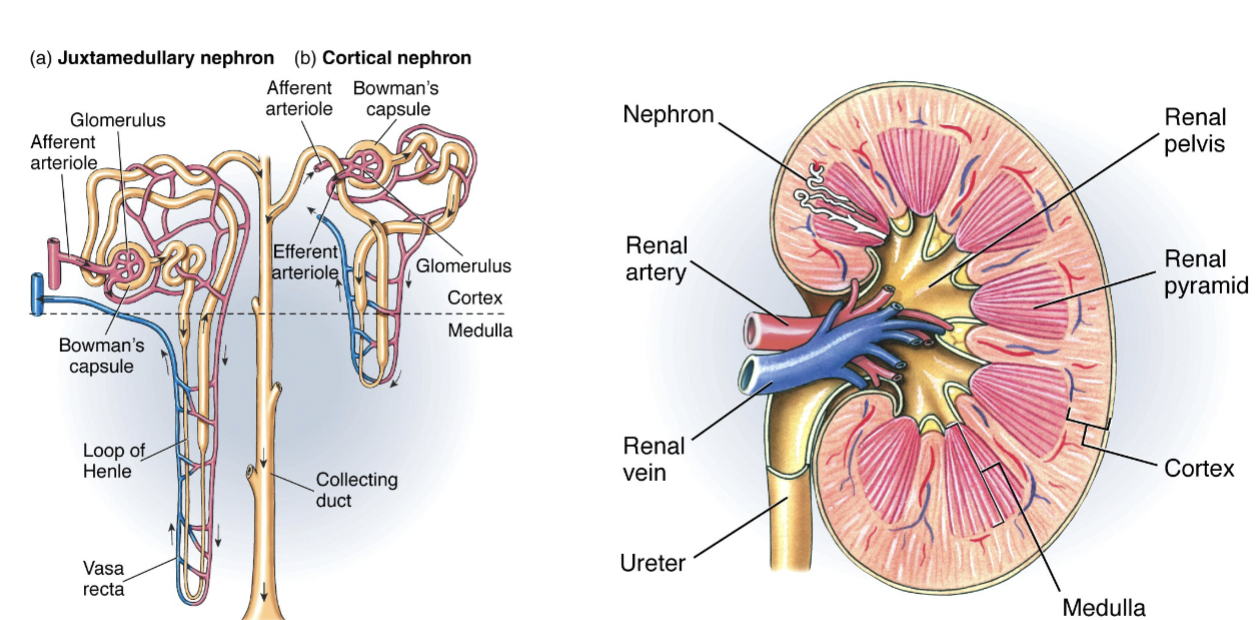
Osmoregulatory system of blood mostly. Diffusing waste product is fine in normal animals, but complex ones need help exchanging waste products. Kidney blood flow removes what shouldn’t be there, but keeps what should be there. Modification of filtrate and it is all dumped into urine and excreted that way.
Animals in different environments have different needs to release in urine. With more water, there are shorter and reduced medulla and loops. With less water, there are longer medulla and loops.
Kangaroo rats have very hot environments and are active at night and cooler phases of the day. They have pretty efficient nasal sinuses, but are still pretty good. We get metabolic water that comes from breaking up thing in the body. Not much better at this than us, but they can minimize the loss of it better.
Bird cutaneous water loss
Pretty low in birds compared to us. Sparrows have less water loss in less aeroadative places. Not a huge difference, so birds are good at limiting their water loss. Lipid acids make up cutaneous skin and ceramides have a relation.
Arid adapted birds limit (some) water loss
There are some water in the seeds they eat, but the also make a lot of metabolic water with protons quickly associating with oxygen. Lipids are hydrophobic, so it is not including lipid energy stores, as they have more energy per gram. Fat is a preferred store because of how energy dense they are. You need to unlock water during flight though..
Protein-for-water hypothesis
You bulk for migratory journeys, and muscles have a lot of energy. Same big engine, but not as much to fly with by minimizing body lipid content. Small amounts of non-lipid, lean-mass. They catalyze the lean mass well.
Benefits: proteins can replenish metabolic intermediates, anaplerosis, liberates bound water (freeing up myosin and actin-bound proteins)
Salmon does catabolizing of amino acid because they know they’re gonna die anyways. Greater degree of breakdown, just to get to spawn site.
Hummingbirds do not have issues with water
They drink all day long, with kidneys comparable to beavers. We don’t need to concentrate very much. At night, dilute urine production while fasting imposes dehydration danger.
Radioactive isotopes: track pee with a tracker, and the rate at which the presence decreases, urine is being diluted. We used L-glucose because it can’t be metabolized, not D-glucose.
During sleep there is no tracer dilution, and during day there is. Body minimizes water and urine production during sleep.
Shut off blood flow to kidneys will clamp a whole lot of issues.
Carb absorption in intestine
Sodium-linked. We don’t care about fructose reabsorption really, GLUT2 is not a sodium co-transporter.
Type 2 diabetes
Overwhelms kidneys ability to effectively reabsorbs the glucose
Blood pH regulation
There needs to be a net proton excretion in blood. CA catabolizes CO2 and H2O. Reactions happen spontaneously, but faster with carbonic anhydrase.
Chloride moves into cell to get bicarbonate back into blood and excluding protons (goes to tubular lumen). Acidification of lumen buffered by some of carbonate being turned back into dissolved CO2 and another thign….(find in lecture).
Charge difference plays a role. Electrical gradient enhances sodium’s chemical gradient (in order to couple reuptake of glucose from the tube).
Capacity of urine acidification
A buffer is need to absorb protons. We need to acknowledge ammonia as a buffer and how it should be gotten rid of??
Vasopressin - Regulation of Blood Pressure
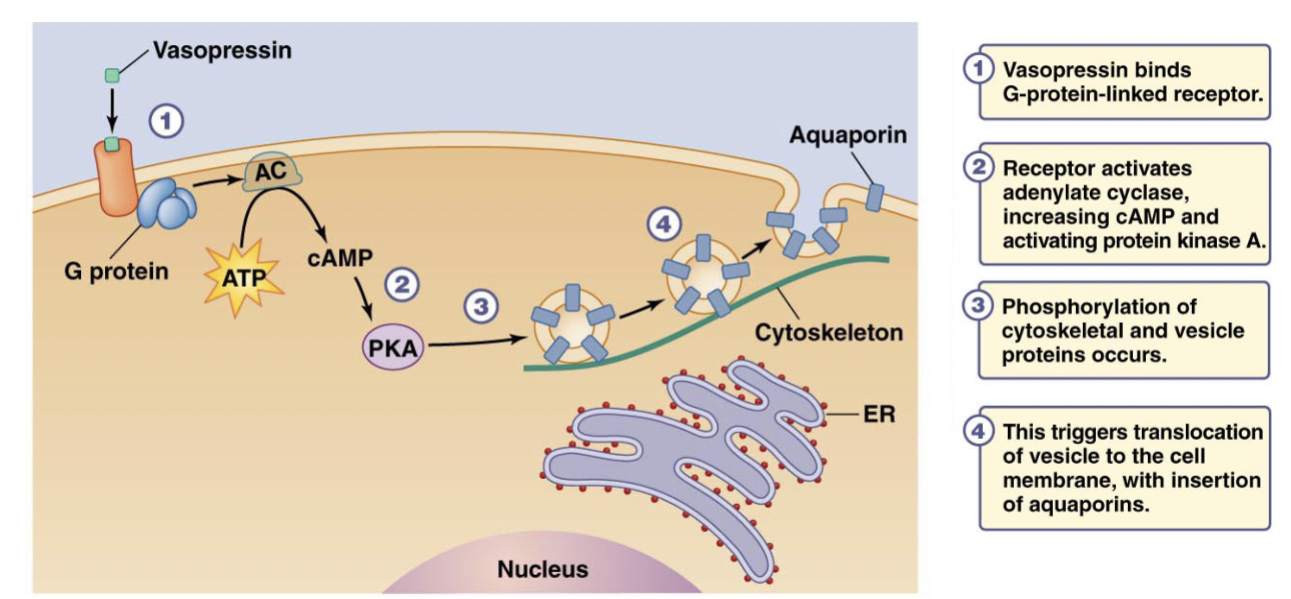
Kidneys really controls the volume of blood in our body, and they play a huge part in regulation. Antidiuretic hormones (ADH) increase water reabsorption for collecting duct and increasing number of aquaporins. Pores on kidney tubules (aquaporins), increase water, concentrating in the collecting duct. Retaining more volume, retaining more water in vascular system to raise blood pressure, combat too high plasma osmolarity.
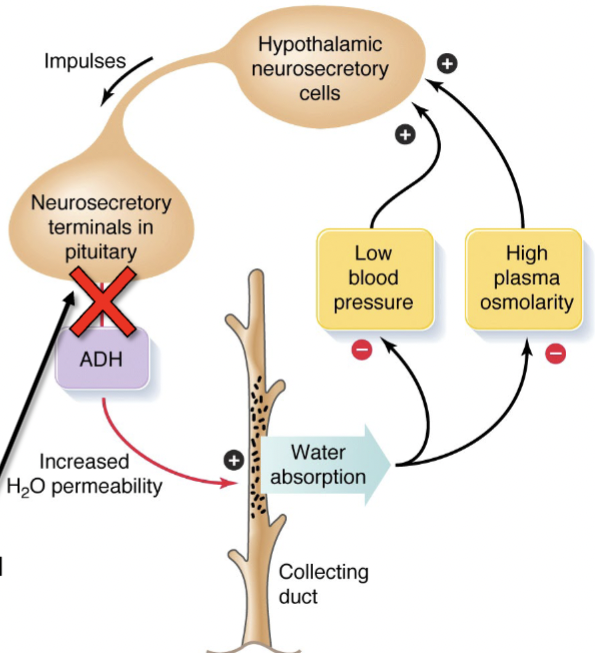 ADH release stimulated by increasing plasma osmolarity detected by osmoreceptors in the hypothalamus. Release is inhibited by increasing blood pressure detected by stretch receptors in atria and baroreceptors in carotid and aortic bodies.
Alcohol inhibits release of ADH by pituitary cells, and thus acts as a diuretic (promotes greater volume of dilute urine production).
Hypertension: chronic elevated blood pressure.
Too much sodium, we retain more water to balance osmolarity of the sodium. We respond appropriately, but that comes with issues of high blood pressure.
RAA pathway
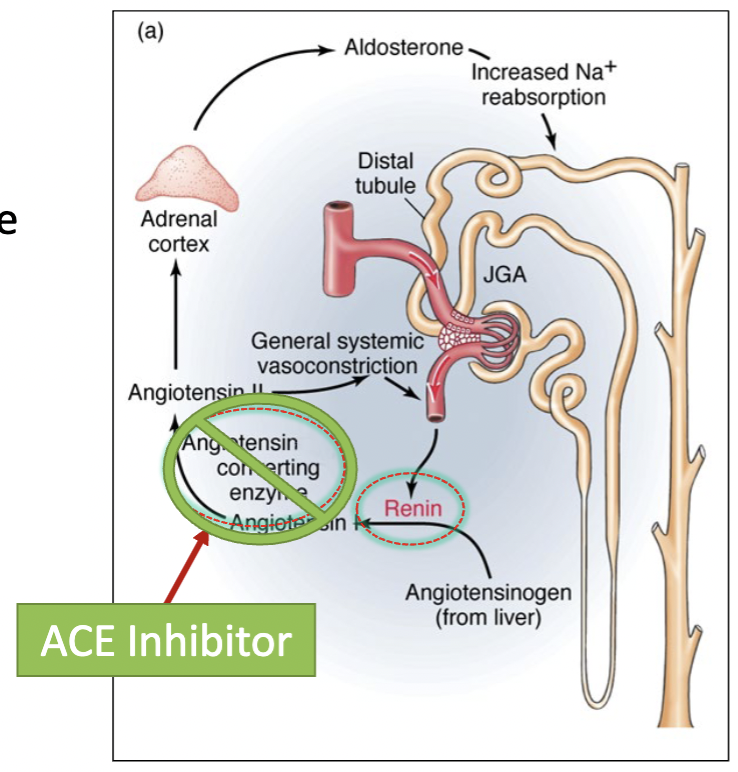
Juxtaglomerular cells. Sense composition of blood (right where filtration happened).
Baroreceptors - sense low blood pressure.
Sympathetic neurons - medulla oblongata triggers renin secretion in response to low BP
Macula densa cells - decrease in flow, release paracrine signals that induce cells to release renin
Basically, renin is secreted when blood pressure is lower than normal.
Renin changes angiotensinogen to angiotensin 1, activating it. Angiotensin creates tension, making it get stiffer. By increasing angiotensin, you can raise blood pressure back to normal.
Then an ACE (angiotensin converting enzyme), converts angiotensin 1 to angiotensin 2, which releases steroid hormones. This all stimulates reabsorption of water, and potassium excretion.