01 Focus of the Petroleum Industry
Worldwide demand for energy will increase steadily out to 2040 and beyond. If we relied only on existing fields (no new discoveries or other additions to current production), we would be down to about 40 MBDOE (million barrels per day oil equivalent) in 2040, about 13% of the projected demand. Energy companies have to replace the reserves they draw out of the ground each year PLUS add about 1.5% more to cover increasing energy demands.
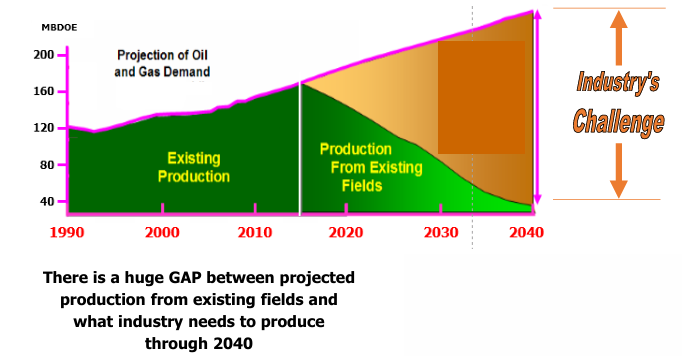
The huge GAP between projected production from existing fields and what industry needs to produce through 2040 can be filled in three ways;
1. Discover new oil & gas fields
2. Turn hydrocarbons (HCs) that we know about into oil and gas that we can produce. We need new technology to get more for less.
3. Probable is what we classify HC reserves after we make a discovery but before we are certain there is enough to make it a profitable project. Normally we do this by drilling several confirmation (delineation) well.
A field life cycle can be summarized as:
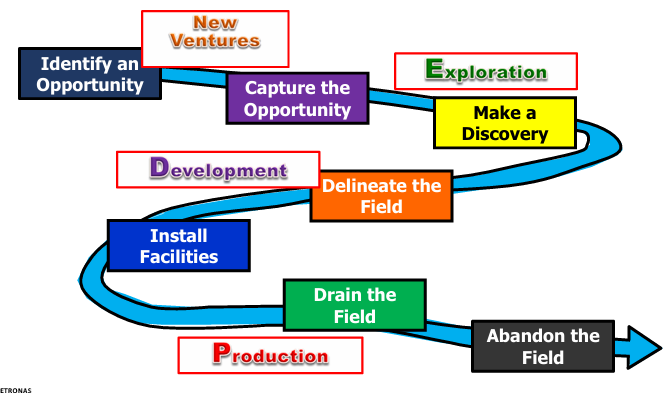
It begins with an opportunity such as obtaining an onshore or offshore lease to explore within a specific area.
Make a Discovery: Once we have acreage to explore, we need to make a discovery – drill a wildcat well that indicates enough oil and/or gas to be an economic success. Next we have to confirm our suspicions that there is adequate HC reserves by drilling one or more delineation (confirmation) wells.
Delineate the Field: Once we confirm the presence of hydrocarbons, we must delineate the field to map the extent of the reservoir and determine its characteristics, which involves conducting additional geological and engineering studies.
Install Facilities: At some point we have enough confirmation that management is ready to sign the check to develop the field – these days this could be over a billion dollars. The engineers take over and design, build and install facilities (e.g., an offshore platform.
Drain the Field: The field goes on production – extracting HCs from the reservoir and we slowly drain the field. We need geoscientists throughout the production period to help maximize recovery while minimizing costs.
Abandon the Field: when field can not make a profit and it is plugged and abandoned.