Ch.15 Evolution
BIOS 112 Fundamentals of Organismal Biology Study Guide – Chapter 15
Learning Outcomes:
At the end of this lesson students will be able to . . .
Visualize processes as a sequential series of steps
Describe the process by which an adaptation evolves, as presented in section 15.2
Evaluate the strength of the supporting evidence
15.1 History of Evolutionary Thought
Name the contribution that each of the following had on Darwin’s theory:
Carolus Linnaeus: Created a classification system for organisms, aiding in the understanding of biological diversity.
Georges Cuvier: Advocated for catastrophism, showing that extinctions occurred and supporting the idea of ancient life forms.
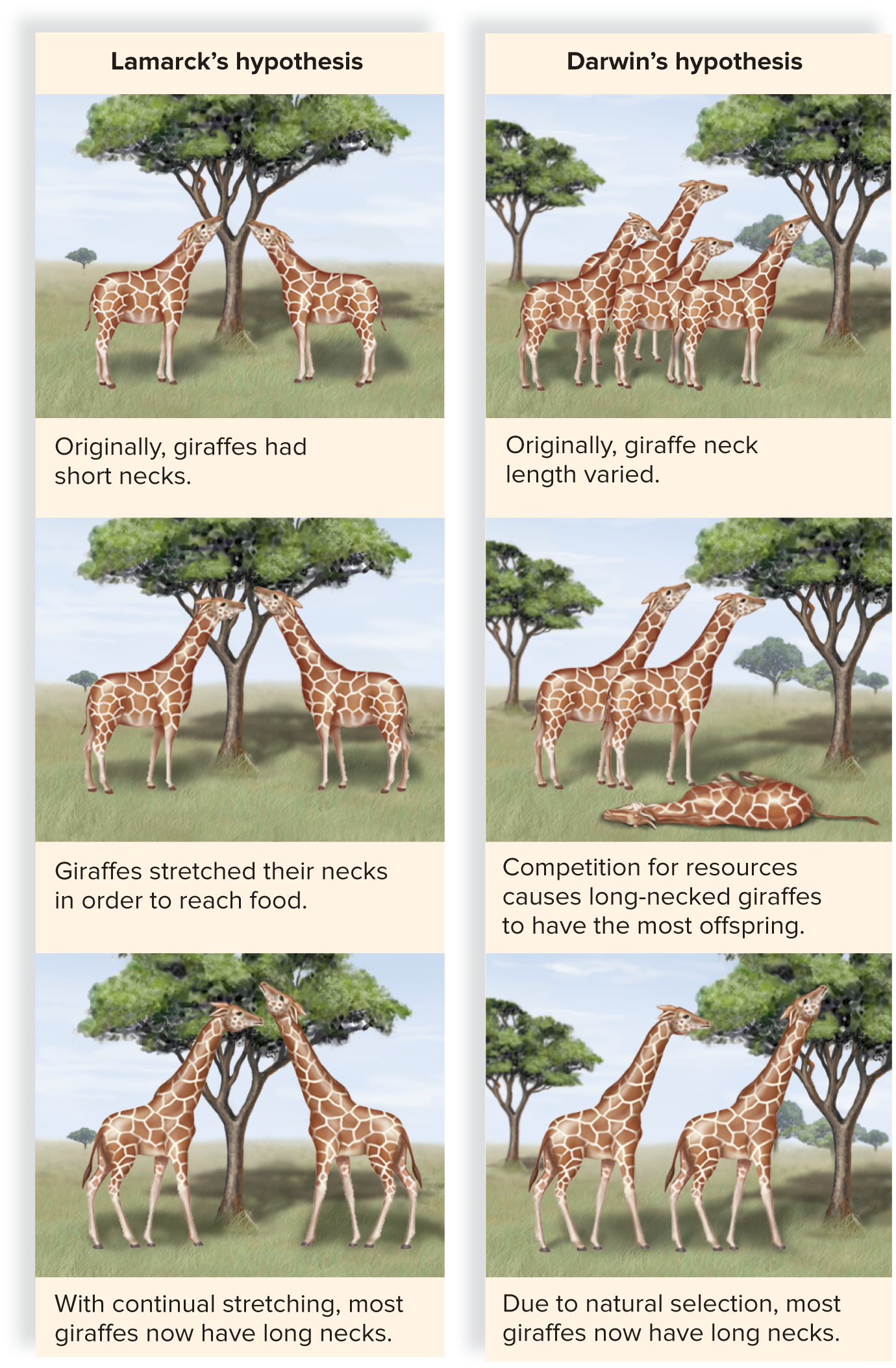
Jean-Baptiste de Lamarck: Proposed an early theory of evolution based on acquired characteristics; emphasized the idea that species change over time.
Charles Lyell: Introduced uniformitarianism, suggesting that the same geological processes have been shaping the earth over long periods, which supports an ancient earth view.
Thomas Malthus: Discussed population growth and resource limits, influencing Darwin's ideas on natural selection.
What is the difference between catastrophism and uniformitarianism?
Catastrophism asserts that the Earth's geology and life have been shaped primarily by sudden and violent events (like floods and volcanic eruptions)
Uniformitarianism argues that the same processes observed today (like erosion and sedimentation) have been occurring in the same manner throughout Earth’s history.
15.2 Darwin’s Theory of Evolution
How did Charles Darwin’s experience contribute to his theory of descent with modification?
His education: Received a diverse education in various sciences, laying the groundwork for his research.
HMS Beagle: His voyage on the Beagle allowed him to observe a wide variety of species and ecosystems.
Fossil observations: Noted similarities and differences between fossils and modern species, suggesting evolutionary change.
Biogeography: Studied species distribution and concluded that geographic isolation contributes to species diversity.
What are Darwin’s four observations about Natural Selection?
Organisms exhibit variation that can be passed from one generation to the next-that is, they have heritable variation
Organisms compete for available resources
Individuals within a population differ in terms of their reproductive success
Organisms become adapted to conditions as the environment changes
What evidence of selection is used to support Natural Selection?
Artificial selection: Human-directed breeding exhibiting rapid changes in species.
Galapagos finches (Grants): Observations showing rapid evolution of beak size in response to food availability.
Peppered moths: Color variation demonstrating natural selection during the Industrial Revolution.
Antibiotic resistance: Bacteria evolving to resist antibiotics, illustrating rapid selection.
15.3 Evidence for Evolution (Universal Common Descent)
Fossils
Fossil definition: Remains or traces of organisms from the past, typically preserved in rock.
Transitional fossils: Fossils that exhibit traits common to both an ancestral group and its derived descendant group.
Tiktaalik: A transitional fossil between fish and tetrapods, showcasing limb development.
Archaeopteryx: Intermediate between reptiles and birds, displaying both avian and dinosaur features.
Ambulocetus: A transitional form showing evolution from land mammals to whales.
Relative dating method: Determining the age of fossils based on their position in layers of rock.
Absolute dating method: Using radioactive decay to determine the specific age of fossils.
Biogeography
Marsupial history: Study of how marsupials are primarily found in Australia and the Americas, supporting evolution and dispersal patterns.
Anatomical Evidence
Homologous structures: Anatomical features that are similar due to shared ancestry.
Analogous structures: Features that serve similar functions but do not share a common evolutionary origin.
Vestigial structures: Body parts that have lost their original function through evolution (e.g., human appendix).
Biochemical (Molecular) Evidence
DNA & RNA homology: Similarities in genetic material across species indicating common ancestry.
Protein homology: Similarities in protein structures among different organisms.
Developmental Evidence
Hox genes: Genes that control the body plan of an embryo along the head-tail axis, indicating common ancestry.
Embryology: Study of embryonic development, revealing similarities among embryos of different species.
Criticisms of Evolution – “misconceptions” listed:
Misunderstanding of transitional fossils and their implications.
Suggestions that evolution is a linear process rather than a branching tree.
The assumption that all traits must be advantageous, ignoring neutral evolution.
Perception that evolution is just a theory lacking substantial evidence.