Lesson 1
Lesson 1: Ventilation
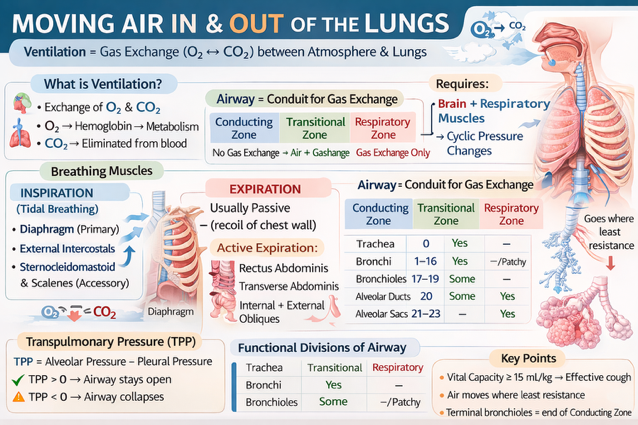
Gas exchange (O2 & CO2) between the atmosphere and lungs.
Requires brain and respiratory muscle coordination.
Diaphragm and external intercostals contract for inspiration.
Exhalation is passive, driven by chest wall recoil.
Breathing Muscles
Muscles of Inspiration
Diaphragm, external intercostals, sternocleidomastoid, scalene muscles.
Muscles of Expiration
Internal intercostals, rectus abdominis, external & internal obliques, transverse abdominis.
Active expiration needed for increased ventilation or in lung diseases.
Capacity for Coughing
Vital capacity of at least 15 mL/kg is necessary for effective cough.
Airway Zones
Conducting Zone:
No gas exchange (anatomic dead space).
Extends from nares/mouth to terminal bronchioles.
Transitional Zone:
Serves as air conduit and participates in gas exchange.
Respiratory Zone:
Gas exchange occurs; extends from respiratory bronchioles to alveolar sacs.
Transpulmonary Pressure (TPP)
TPP = Alveolar pressure - Intrapleural pressure.
Positive TPP keeps airways open, negative TPP causes collapse.
During tidal breathing: TPP is positive, intrapleural pressure is negative.
Summary of Pressures During Breathing
FRC: Airflow = None, TPP = +5.
During Inspiration: TPP increases, airflow in.
During Expiration: TPP decreases, airflow out, can become negative during forced expiration.