Science
Electricity
Charge and force
All matter is made of atoms that contain electrons, neutrons and protons.
Electrons have a negative charge
Protons have a positive charge
When an object has an equal number of protons and electrons, the object has no charge.
Metals are good conductors
Metalloids are semi conductors
Non-metals are insulators
Conductors are substances that allow ellectricity to pass through them. For example metals, such as coppor or iron, are good conductors of electricity.
Insulators do not conduct electricity and prevent people from getting electric shocks e.g: plastic, glass, silicon, cotton
Electrical current
An electrical current is caused by the flow of negatively charged electrons in a conductor.
Electrical current must flow in a circuit that is in a closed loop so the electrons can get to where they started. If they don’t, the source of the electrons (battery) runs out of electrons and instantly stops.
A circuit is the path along which the electrical current can flow.
Current is measured in units called amperes. The symbol is A.
Voltage
Voltage is the amount of electric energy needed to move electrons around a circuit.
Voltage is also known as potential difference because it measures the amount of electrical energy gained or loast as the electrons move through the circuit.
Voltage is measured in units called volts, represented by the symbol V.
Resistance
Resistance is a measure of the opposition to the glow of the current. It is measured in ohms (Ω).
Resistance makes wires get warm. This is used in many devices in daily life such as toasters, hair driers, light globes.
Electrical resistance occurs when a conductor opposes the flow of electrical current. This occurs because the electrons in the current collide with the atoms in the conductor and the flow of electricity is reduced.
Ohm’s Law
In an electric circuit, the current is proportional to the voltage. This means if you double the voltsge, the current becomes twice as great.
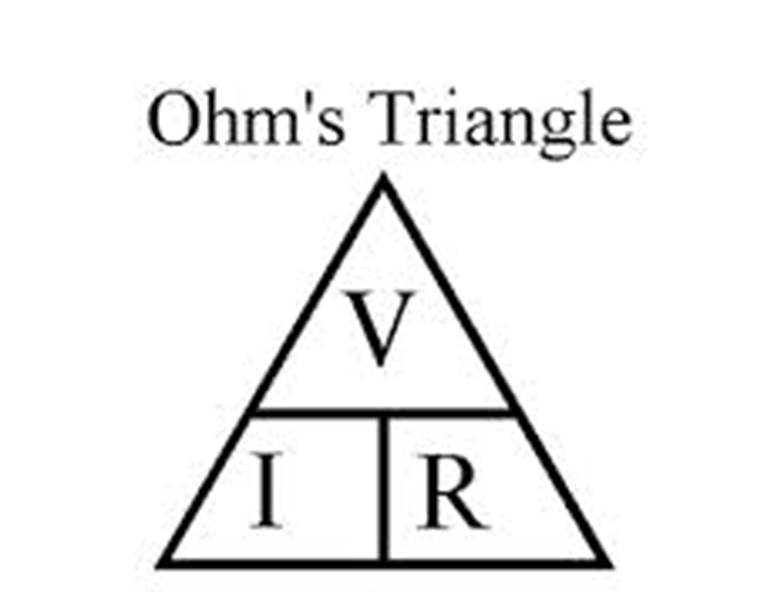
The equation is written as: voltage (V)= current (I) x resistance (R)
eg: What voltage is needed to make a current of 2 Amps flow through a 10Ω lamp?
V = I x R
= 2 x 10 = 20 Volts
How does electricity flow through a circuit
With copper wire as a conductor, the resistance in the wire causes the wire to heat and produce light.
The narrow tube under the lightbulb represents the tungsten in a lamp. The tungsten creates a resistance to the flow of electrons.
Types of Circuits
Series circuits:
All in a row
1 path for electricity
1 light goes out and the circuit is broken
If you add a resistor (another light), total reistance goes up still all the current must go through each resistor and current in the circuit will go down (lights dim).
Parallel circuits:
Many paths for electricity
1 light goes out and the others stay on
Has at least one point where current divides
Paths are also known as branches
If you add a resistor, total resistance goes down and total current goes up when you add another path.
Series Circuit | Parallel Circuit |
Electricity has only 1 path to flow through | Electricity can ‘split’ and follow multiple different paths |
If 1 part of the circuit breaks, no electricity flows at all. | If 1 part of the circuit breaks, the other sections of the circuit will still have electricity flowing. |
The voltage is split between the different loads in the circuit, and each gets a fraction. | The voltage is the same for each component in the circuit (although the current is split) |
Example: old style Christmas lights, very simple circuits. | Example: your phone, your house lights, streetlights, |
Batteries in series and parallel
Series: the voltage is increased
Parallel: No change in voltage; these batteries will last longer
Responding to the environment
Body systems
Every cell needs many things to survive:
Energy to do all the things
Nutrients to repair and make parts
Oxygen- bestway to make the energy work
Remove waste- some things we make can poison us, so we need to get rid of them
Be at the right temperature, not too hot or cold
Have enough water
Cells so particular things like:
join with similar cells to make tissues e.g. muscles form muscle tissue
several tissues form orhans to do a specific task
multiple organs work together as organ systems
Responding to the environment
The environment of an organism is all the things that are around it that can affect or influence it, such as living and non-living things such as temperature, sunlight, water, wind
Most organisms are carefully adapted to their local envrionment
To stay alive, organisms have to respind to these changes.
Adaptions vs Responses
Adaptions:
Changes that are ‘built in’ to the organsim, that it can only change over millions of years through of evolution.
e.g: Kangaroo coat colour, large legs for travelling
Eucalyptus leaf colour and their mild leaf poision.
Responses:
Things the organism can chose to actively do when their environment changes
e.g: Kangaroos running from predators, choosing to lick themselves when it’s hot.
Plants, like eucalyptus, usually react slowly to their environment, so their responses might be too late.
Some plants can detect when they are being eaten, and produce more of a poision or bitteering agent to discourage predators.
Many plants have tropisms, where the plant changes how it grows to creste something similare to movement.
Phototropism (response to light)
Hydrotropism (response to water)
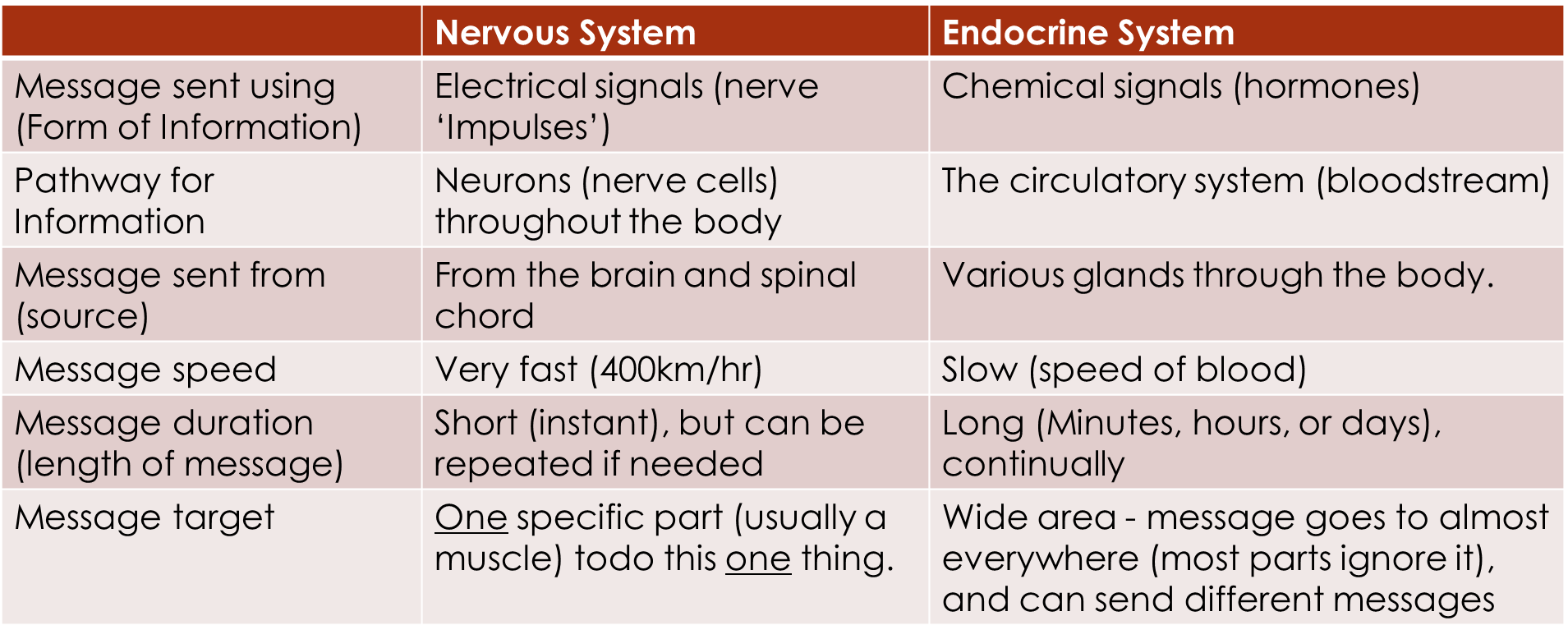
Nervous system (responding quickly)
To allow animals to respond to changing environments quickly they have a nervous system, a network of neurons (nerve cells) throughout the body that detects changes, works out how to respond to the brain.
Sends messages to all parts if the body that need to work together to respond to all the change.
The role of the nervous system is to coordinate an organism’s response to the changing environment:
to do this it must recieve messages from all over our body and then send other messages out to our muscles.
The nervous system has 2 main parts:
the Central nervous system ( the brain and spinal cord) that decides things
the Peripheral nervous system, which are the nerves cells that take messages in from our body and send signals out to our body so we respond.
The system is a coordination system that uses electrical signals that travel through specialised nerve cells in order to direct the body’s physical actions in response to stimuli.
Nerve cells carries signals called ‘impulses’.
Endocrine system (responding slowly)
Because not every response needs a quick response and plant’s don’t have nerves, they use a different system called the endocrine system.
This system sned messafes around an organism by releasing chemicals called hormones from glands, which tell the cells what to do.
In an animal these chemicals travel in the blood, in plant’s its through the sap.
Advantages:
the hormones stick around, so the message keeps being sent without you putting in effort - some lasts minutes or months.
one message can go to the whole body if needed or the chemical can be designed to only affect particular parts, which might be in different places in an organism.
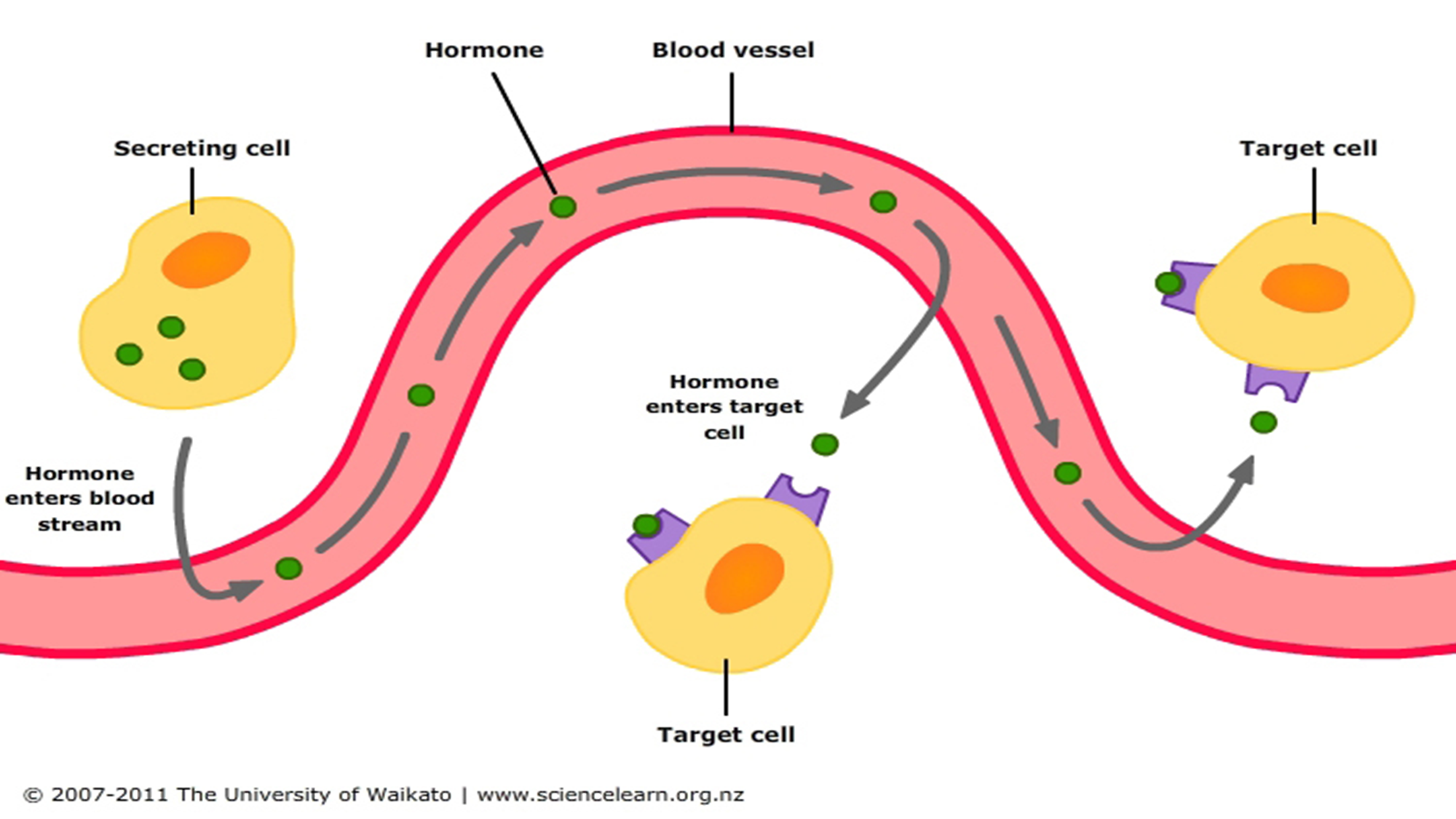
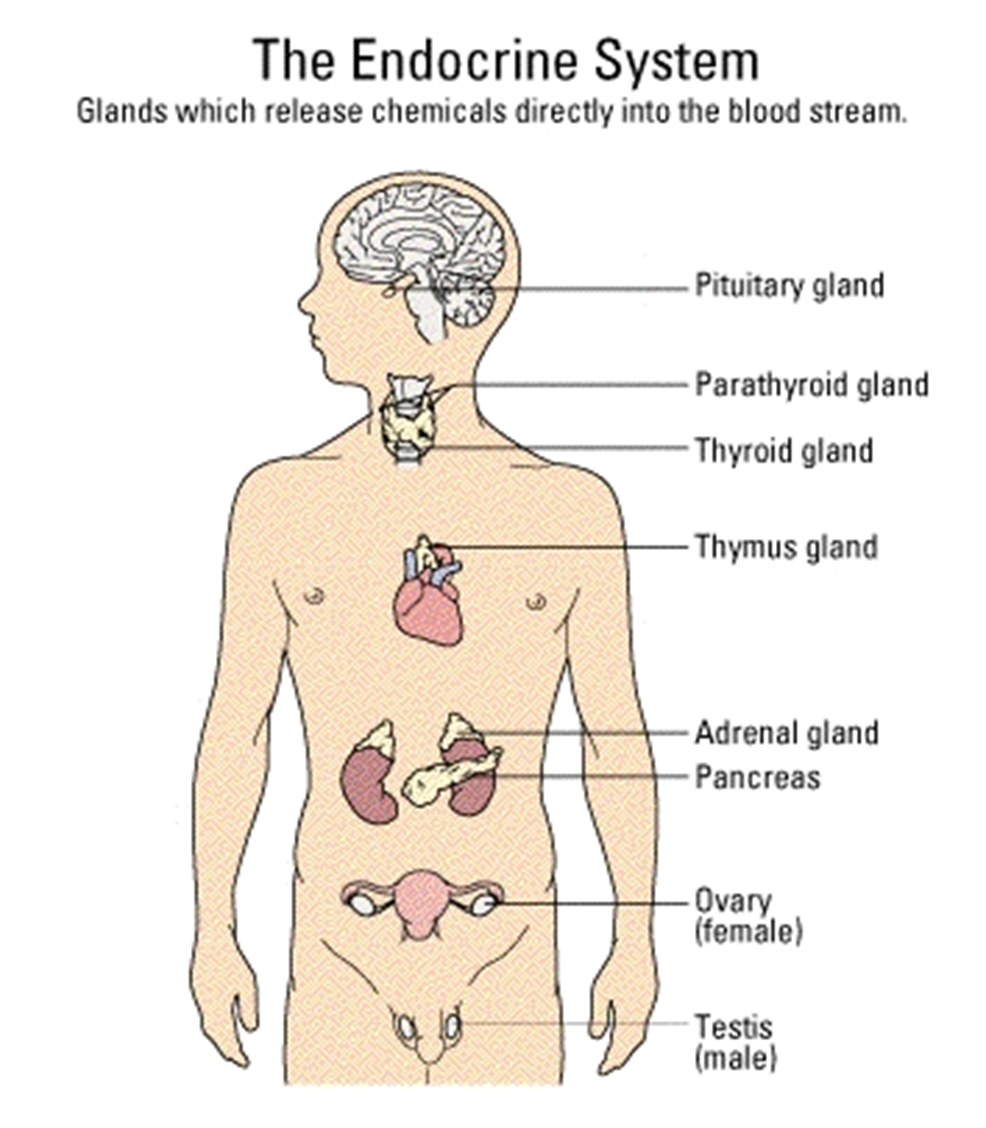
The endocrine system:
Pituitary gland
Hypothalamus
Thyroid gland
Adrenal glands
Pancreas
Gonads
Hormone control:
Testosterone: made in the testicles, causes males to be ‘male’, growing body hair, increasing muscles, deepening voices and causing aggression
Estrogen: from the ovaries, causes females to be ‘feminine’, growing breasts, widening hips, coordinating the menstrual cycle of the female reproductive system
Adrenaline: released from the adrenal gland on the kidneys when scared, speeds up heart and breathing, tenses muscles, focuses mind, sometimes makes you feel sick.
Insulin: hormone involved in controlling the level of glucose (sugar) in your blood, and is made in the pancreas. Glucose is the ‘energy’ that all your cells need and use to stay alive:
without insulin (diabetes) your body doesn’t realise it needs to release stored energy when you start to run low.
Insulin also tells your body there is alot of glucose in your blood so it can store it for later.
Too much glucose can poision you
Growth hormone: a chemical released by the pituitary gland and signals for the body to grow:
the Hypothalamus activates and controls the part of the nervous system that controls involuntary body functions and regulates sleep (serotonin) and stimulating appetite
Body system interaction
Oxygen is taken in by the respiratory system which transports oxygen from the air into the circulatory system to the muscles
The muscles then use both glucose and oxygen un respiration to create energy for movement
The respiration creates heat, so your nervous system sends signals to sweat glands to sweat.
Once you escape, your nervous system detects that you need food and water so it makes you feel hungry, and also releases hormones to help conserve water and energy
Infections and diseases
A disease is any condition that prevents or stops the body from working well e.g: measles, chickenpox, influenza
Infectious diseases: caused by microorganisms trying to live in you
influenza
chickenpox
ebola
measles
rabies
Non infectious diseases: caused by the environment, or your body going wrong
food poisoning
cancer
heart disease
asthma
diabetes
Pathogens: Single celled microbes that cause diseases
Bacteria: the most common, with heaps of different types that cause many diseases, e.g. tetanus, cholera, types of food poisoning, gonorreha, pneumonia
Fungi: single celled and have a hard cell wall (like plants), they only cause a few diseases, e.g: ringworm, tinea
Protists: big, single celled animals e.g: malaria, sleeping sickness
Viruses: not alive, justs packets of DNA that use our cells to copy themselves over and over, e.g: flu, chickenpox, mumps, measles, rabies
Defending against infection:
pathogens that get into our body may cause disease, but our bodies have methods to prevent us from getting sick:
first line defence: keeping the pathogen out of our body, by blocking it or killing it on the way in
second line defence: killing the pathogen once its inside the body, using ‘general’ attacks that affect most pathogens
third line defence: specifically targeted attacks against particular diseases.
First line of defence:
Physical barriers:
Skin:
barrier to microbers
protects internal organs from chemicals, water and sun’s radiation
Nasal hair and sticky mucus lining in windpipe:
acts as air filter
coughing shifts clogged mucus
Chemical barriers
Saliva and tears:
cleanse and flush particles
Stomach acids:
kill most microbes before reaching small intestines
Acidic mucus in vagina
chemical environment difficult for microbes to grow and multiply
Second line of defence:
Inflammation:
swelling in affected area and redness caused by bloodflow
‘hot’ blood can cook some pathogens
increased blood flow brings red and white blood cells
White blood cells surround and kill pathogens (called phagocytosis, or cell eating)
Lymphatic system
remove foreign materials and dead cells before it reaches the bloodstream
swollen glands are a sign of infection
glands part of a network of fine tubes running throughout the body
pale yellow fluid called Lymph, and glands are Lymph Nodes
Third line of defence:
Specific immunity:
particular white blood cells (lymphocytes) ‘learn’ what the disease is like
they trigger other lymphocytes to use very particular attacks against that specific pathogen
they remember these attacks for the next time the pathogen enters the body
Vaccines
Long ago people realised that if you catch a disease and survive, you usually don’t catch that same disease again- surviving it once made you immune.
The problem is that for serious diseases, catching the disease in the first place might kill you
Your white blood cells (the lymphocytes called B cells and T cells) can ‘remember’ what a disease ‘looks like’ after you have caught ut and fought it off.
Next time that disease comes into your body, your immune system can call it straight away, even before you get sick
Doctors realised that if we injected someone with a dead or very weak version of a disease germ, the B cells and T cells would ‘remember’ this version, and would kill the live version as soon as it got into your body
Occassionally (1 in a thousand) people have reactions to the shots - mild flu-like symptons, usually because their body takes the vaccine too seriously.
Energy conservation
Energy
Energy is the ability to make something change or happen
Energy can speed somethings up or slow it down or change it’s direction. It can heat it or cool it, light it, vibrate it, bend it or break it
All energy is measured using units called joules (J)
Namdd sfter physicist James Prescott Joule.
I kilojoule (1kJ)=1000J represents the amount of energy you are expected to gain on eating it.
Types of energy
Energy is not all the smae thing - there are lots of different types, and it can even be stored up in different ways
Active energy aka kinetic energy:
Light energy: The brighter a light is, the more energy it has
Heat energy: The energy of the movement of the particles that make up a substance. The hotter something is,or the more particles it has, the more heat energy it has.
Sound energy: the movement oc air particles that transmit the vibrations of sound from one place to another
Electrical energy: the movement of electrons from one place to another, along a ‘conductor’ ( a material that lets electrons flow easily).
Kinetic energy: movement energy. The faster you are moving, the more of this energy you have
Stored energy aka potential energy:
Chemical potential energy: type of energy that comes from chemicals ‘reacting’ with eachother. When mixing certain chemicals, the chemical potential energy can be converted into other types of energy that makes things happen
Gravitational potential energy: the energy that comes from being up so high. You can store energy as gravitational potential by lifting it up high - the energy you put in to lift up the object is stored.
Elastic potential energy: energy that is stored in a bend or a stretch or a squash in something that can spring back. Like a stretched rubber band
Nuclear potential energy: the energy from the nucleus of atoms. Comes from breaking up the atoms in certain rare substances, like uranium
Energy transformations
Energy transformations occur when one type of energy changes/transforms to a different type of energy for example:
electrical energy → light energy and heat energy
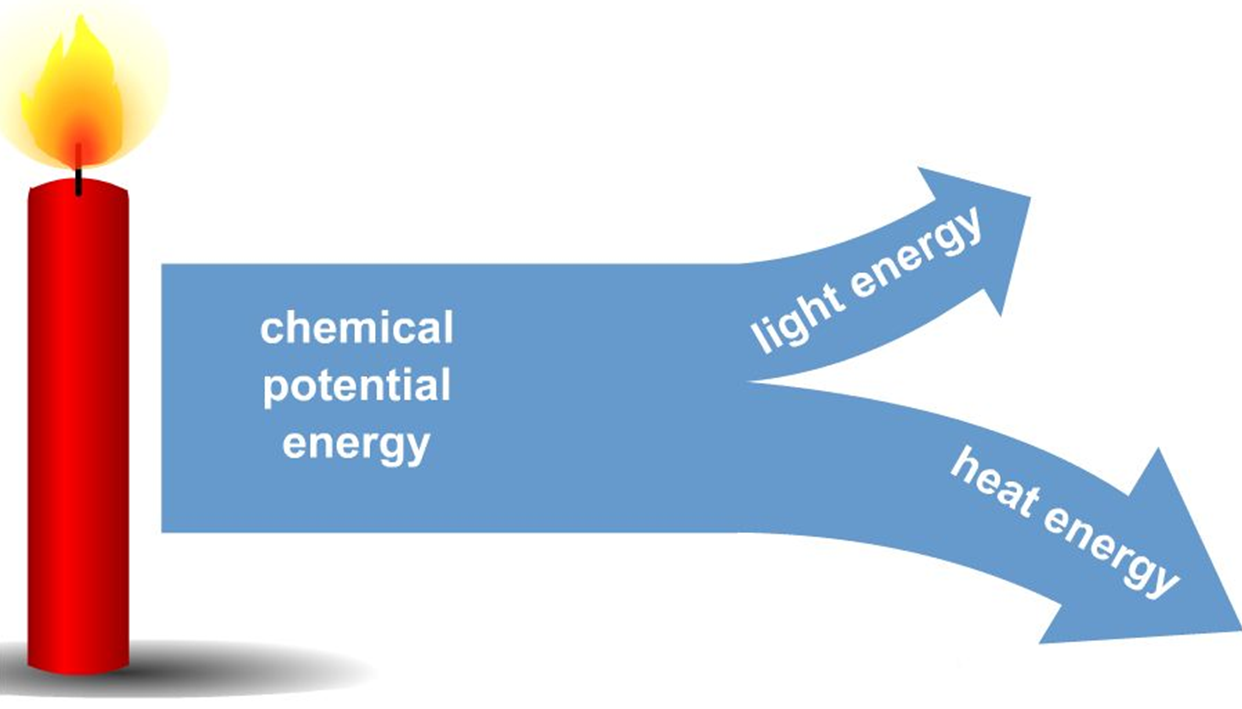
chemical energy → light energy and heat energy
elastic energy → kinetic energy
Energy conservation
Energy can never be created or destroyed. It can only be changes from one form to another. This is the law of conservation of energy
Sometimes it appears that energy is lost or destroyed, but when you look closer you find that the energy has gone into other forms, such as sound, heat or light
The amount (usually a percentage) of atotal energy input to a machine or system that is consumed in useful work and not wasted as ‘useless’ energy types
Method for showing energy efficiency is a Sankey diagram.

Energy efficient Lights:
Incandesent bulb:
consists of a glass enclosure containing a metal (tungsten) wire, called a filament
an electric current passes through the filament, heating it to a temperature of several thousand degrees, which produces light
electriciry is the input energy, the useful energy is light, and the waste energy is heat energy
Compact Fluorescent Lamp (CFL):
a thinner and twisted version of a fluorescent tube, designed to fit in the same space as an incandescent bulb
the tube contains mercury vapour (gas), and when an electric current is run through the gas, it gives off ultraviolet light
a special coating (containing phosphorous) on the inside of the glass changes this to visible light
electricity is the input energy, the useful energy is light anf the waste energy is the heat energy and a little ultraviolet light
Light Emitting Diode (LED)
two pieces of gallium (a semi-metal) with slightly different other elements are placed next to eachother.
when electricity is passed through them both, light is emitted at the join. Some LEDs use red, geen and blue light to make white, others use blue light and phosphorous
electricity is the input energy, the useful energy is light and the waste energy is heat energy
Renewable/Non-renewable Energy
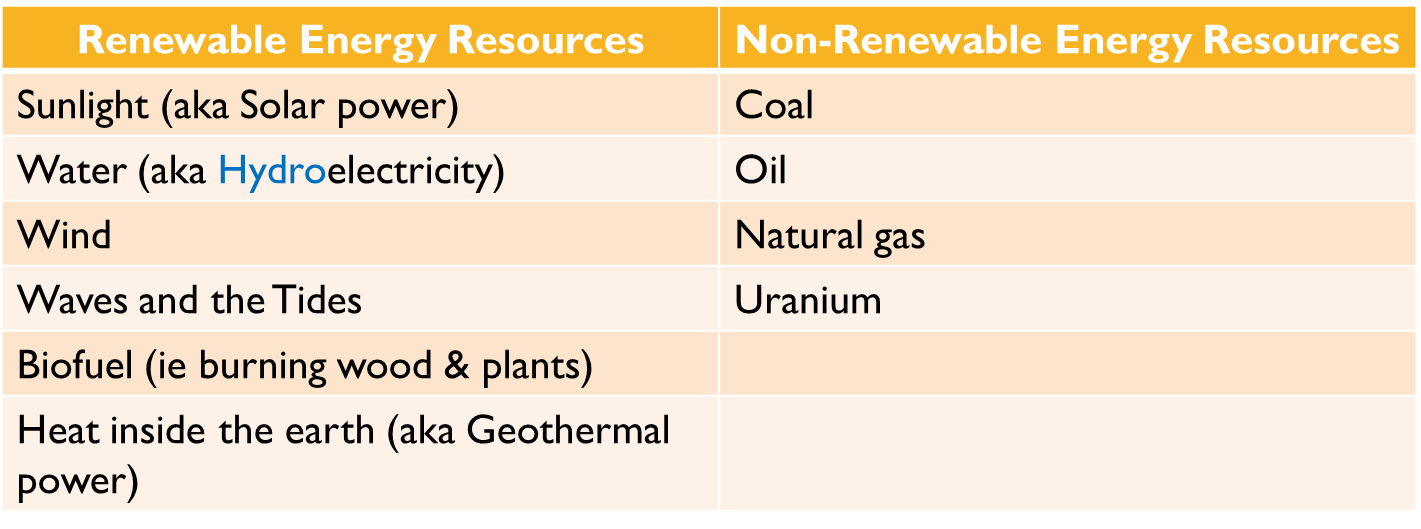
A renewable reasource os a reasource that can be used to provide humans with useful energy that will replace itself naturally, within a human lifetime
Something that humans take from the world around them to use for our benefit like:
wood ( for furniture, houses, paper)
oil ( for petrol, plastics)
iron ( for cars)
sunlight (to see with, to grow plants, make electricity)
oxygen (to breathe)
water ( grow crops, drink, wash, electricity)
Why is it important?:
If we run out of the reasources we get the energy from ( converting it into electricity), we wont be able to use the energy
Renewable energy reasources ‘re-new’ or replace themselves over time, so we won’t ever run out of them
Reliability:
its not always sunny, rainy or windy. Batteries and other storage options are needed to smooth out the unreliable supply, but theya re expensive, hard to build and have their own environmental problems
like lithium in batteries is limites and causes significant pollution when minded using current methods
Energy ‘density’:
how concentrated the energy is. For example, to power the average home, we would need way more than solar panels than the size of that home
batteries don’t hold anywhere near the same amount of energy per kilo as oil or coal
this means drastically changing not just how we power things but how we live our lives.
Expense:
renewable energy systems are coming down in price, but fossil fuel systems have been worked on for 100+ years, they are way cheap to build
In Australia, solar systems have become similar price to coal power ( in the country where land is cheap).
that doesnt include the issue of losing electricity when transporting it from the solar farms back to cities
wind power is getting better, but is only cheaper in very windy places.
Societal transformation:
society is being set up around fossil fuels and completely transforming renewables will have huge inpacts that need to be managed
Coal miners, and other workers who rely on the fossil fuel mining industry don’t know if they will keep their jobs or lose it due to things shutting down or replacing with electric