Module 5: Altered Consciousness
Altered consciousness is a clinical finding—not a diagnosis. It refers to a change in the mental state that can affect perception, cognition, and awareness. 70
First response to any change in consciousness approach;
Stop care: cease dental treatment immediately
Position & Assess: position the patient appropriately; assess responsiveness
Assess C-A-B: Circulation, Airway, Breathing
Definitive Management: Provide condition-specific care and activate EMS when indicated.
Diabetic Emergencies
The most likely altered-consciousness emergency you will encounter in the dental setting is hypoglycemia.
HYPOglycemia - low glucose; sudden onset, adrenergic signs, behavior change.
HYPERglycemia - high glucose; gradual onset, dehydration, systemic illness.
Insulin helps lower blood glucose - too much leads to hypoglycemia.
Glucagon helps raise blood glucose - the bodys natural counter-regulatory hormone.
The brain needs a steady glucose supply - too little causes rapid behavioral and consciousness changes.
Before Treatment: Ask Questions
When did you last eat - what did you last eat?
What is your usual glucose range?
Have you ever needed help for severe hypoglycemia?
When did you last take insulin or diabetes medication?
Do you use a CGM or have a glucometer with you?
Do you carry glucose tablets or prescribed glucagon?
Blood glucose below 70 mg/dL is considered low. Four common factors; medication, food, activity, alcohol / Illness.
Conscious Patient with Suspected Hypoglycemia
15-15 rule: administer 15 grams of fast-acting carbohydrates, wait 15 minutes, and then recheck blood glucose levels. If the blood glucose remains low, repeat the process.
Severe Hypoglycemia: Cannot Swallow or Unconscious
Activate EMS / Call 911
Support CBAs; provide BLS as needed
Administer oxygen per training/protocol
Use prescribed glucagon if trained or permitted
Monitor continuously until EMS assumes care
High glucose emergencies typically develop over hours to days - not minutes. Four common factors; Missed or insufficient insulin relative to glucose load, Illness, stress, carbohydrate intake.
Recognizing Significant Hyperglycemia (gradual onset + dehydration + systemic illness signs)
Increasing thirst (polydipsia) and frequent urination (polyuria)
Nausea, vomiting, abdominal discomfort may occur
Fruity/acetone breath - may indicate diabetic ketoacidosis (DKA)
Dry mouth/ dehydration signs; fatigue, weakness, blurred vision
Deep or labored breathing
Progressive confusion, drowsiness, or decreased consciousness = severe - activate EMS
Finding | HYPOglycemia | HYPERglycemia |
Onset | Usually sudden (minutes) | Usually gradual (hours to days) |
Skin | Cool / sweaty / pale | Warm / dry; dehydrated |
History clue | Medication + missed/delayed food | Missed insulin, illness, progressive symptoms |
Behavior | Rapid confusion / irritability | Progressive fatigue / drowsiness |
Priority | Fast carbohydrate if safe to swallow | Supportive care; EMS if severe |
Clinical Check: Diabetes
A patient with diabetes becomes shaky and confused 20 minutes into treatment. They took their usual insulin and ate only a few bites of breakfast. They are awake, sweating, trembling, irritable, and can swallow.
What emergency is most likely? Hypoglycemia: The patient's symptoms suggest a significant drop in blood sugar levels due to insufficient food intake relative to their insulin dosage.
What is your immediate treatment? Administer a rapid-acting source of glucose, such as oral glucose gel, or give the patient some juice or a sugar-containing snack to raise their blood sugar levels quickly.
What finding would change this to EMS-level? If the patient becomes unresponsive or unable to swallow, this could necessitate EMS-level intervention due to the risk of airway obstruction or severe hypoglycemia requiring intravenous glucose administration.
Thyroid Dysfunction
Severe hypothyroidism can lead to myxedema coma (profound slowing of all body systems)
Severe hyperthyroidism can lead to thyroid storm (dangerous acceleration of all body systems)
Signs of thyroid dysfunction may include unexplained weight fluctuations, cold intolerance, changes in energy levels, altered mood, and cognitive disturbances, which can further impact overall consciousness.
Myxedema Coma: Recognition
Altered mental status: confusion
Hypothermia (subnormal temperature)
Bradycardia
Hypotension
Slow / inadequate ventilation
Myxedema Coma: Response
Stop treatment; activate EMS immediately
Keep the patient warm; avoid unnecessary temperature extremes
Assess and support airway, breathing, and circulation
Monitor vital signs and level of responsiveness continously
Provide BLS and oxygen as indicated by training and protocol
Prepare for further deterioration while waiting for EMS arrival
Hyperthyroidism: What Might You Notice Before an Emergency?
Acceleration of body functions
Heat intolerance / sweating; tremor
Nervousness / irritability; tachycardia or palpitations
Weight loss despite appetite; frequent bowel movements
History of Graves disease or antithyroid medication
Increased sensitivity to heat and complaints of excessive sweating, often linked to hyperthyroid conditions.
Nausea, vomiting, diarrhea may occur
Possible heart failure, hypotension, or cardiovascular collapse
Thyroid Storm: Response
Stop dental treatment immediately
Activate EMS / Call 911
Assess and support ABC’s; oxygen/BLS as indicated
Position for comfort while maitaining airway and circulation
Monitor vital signs continously; collect emergency history
Transer for definitive medical management
Finding | MYXEDEMA COMA | THYROID STORM |
Temperature | Low (hypothermia) | High (hyperpyrexia) |
Heart rate | Often slow (bradycardia) | Markedly fast (tachycardia/arrhythmia) |
Mental status | Confusion → stupor/coma | Agitation/delirium → coma |
Body pattern | Profound slowing of all systems | Profound acceleration of all systems |
Action | EMS + warmth + supportive care | EMS + cooling + supportive care |
Clinical Check: Thyroid Emergency
A patient with Graves disease becomes acutley ill during treatment: very anxious, confused, HR 148/min, hot and sweaty skin, temperature of 103 F, nausea and increasing agitation.
Which thyroid emergency fits this pattern? This presentation is consistent with Thyroid Storm, a life-threatening condition characterized by severe hyperthyroidism and marked clinical symptoms.
What is your first action after stopping treatment? Contact EMS
What information should you give EMS? Patient's history of Graves disease and recent treatment, Current vital signs: heart rate (HR 148/min), temperature (103 F), Clinical symptoms: anxiety, confusion, hot and sweaty skin, nausea, and increasing agitation, Time of onset for current symptoms and any previous episodes if applicable.
Stroke / Cerebrovascular Accident
Sudden neurologic change; any abrupt focal deficit is a stroke until proven otherwise.
B.E.F.A.S.T.
Call 911
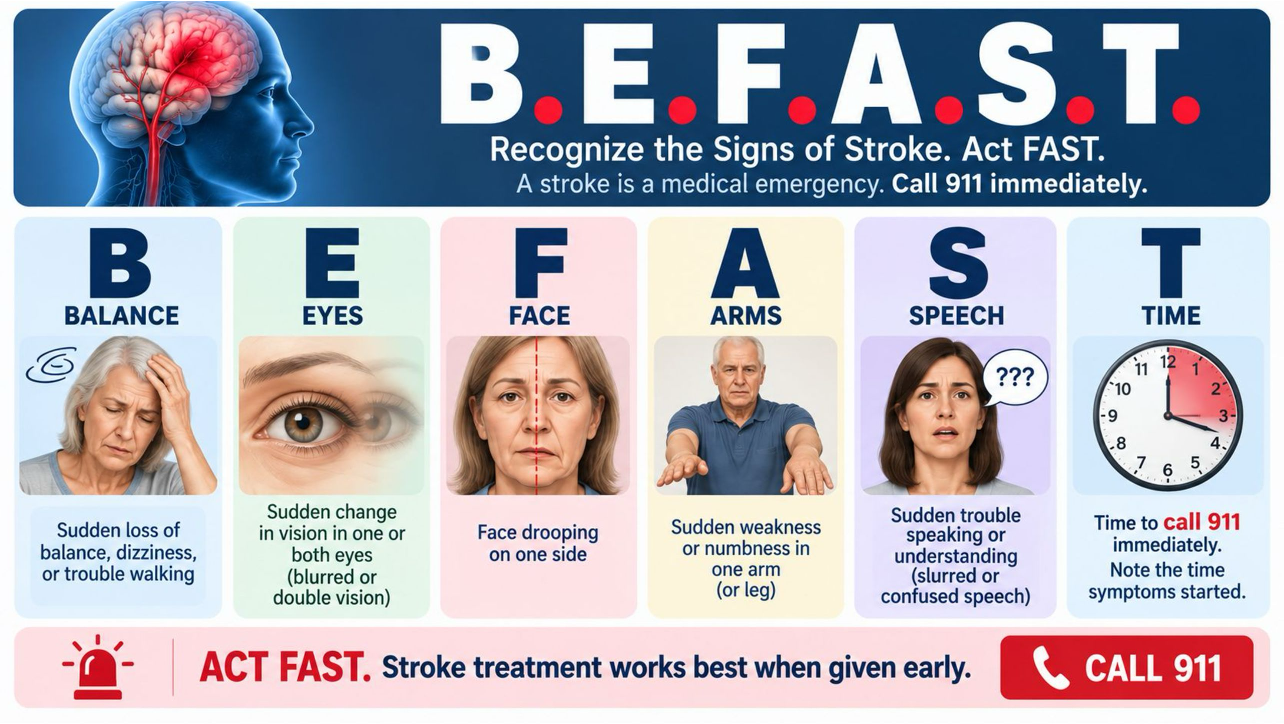
Stroke Clues
Face drooping: Ask the person to smile; does one side of the face droop?
Arm weakness: Ask the person to raise both arms; does one arm drift downward?
Speech difficulty: Ask the person to repeat a simple phrase; is their speech slurred or strange?
Suden severe headache
Sudden visual disturbance in one or both eyes
Sudden dizziness, trouble walking, or loss of coordination
Stroke Response
Stop treatment
Call 911
Time; document symptom onset or last known to be well
ABC’s: Assess airway, breathing, circulation
Position; mimimize unnecessary movement
Monitor vital signs and responsiveness, be ready for deterioration
*****Hypoglycemia can mimic a stroke*****
Clinical Pattern | Most Consistent With | Immediate Priority |
Sudden + sweaty + shaky + missed meal | Hypoglycemia | Fast carbohydrate if safe; escalate if severe |
Gradual + thirsty + dry + ill | Hyperglycemic crisis | Support + EMS if altered/severe |
Cold + slow + confused | Myxedema coma | EMS + warmth + supportive care |
Hot + very fast HR + agitated/confused | Thyroid storm | EMS + supportive care |
Sudden focal neurologic deficit | Stroke / TIA | 911 + document last known well |