Uniform Circular Motion
The motion of an object in a circle at constant speed
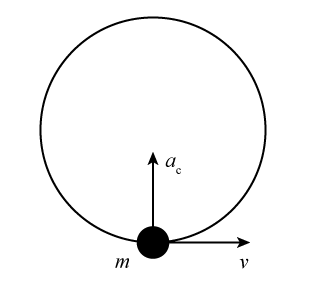
Uniform → acceleration is constant → speed is constant
Direction is constantly changing for there to be an acceleration
The direction of the resultant force must be towards the centre of the circle
Acceleration is therefore towards the centre of the circle
Force is a vector so acceleration is a vector in the same direction
Velocity is always tangent to the circle - perpendicular to the force at any moment
The magnitude of the work done by the force on the object is zero because the object never moves any closer to the centre of the circle
and so the work done is zero
The energy only goes to changing the direction of the object
The Force towards the centre is called the Centripetal force — Centripetal force is a force that keeps a body moving with a constant speed in a circular path

Angular Velocity () is the rate of change of angle for an object moving in a circular path
where is the angular displacement and its unit is radians
if the length of the arc and the radius are the same, then is 1 radian
a radian is the angle subtended by an arc with a length equal to the radius of the circle
the circumference of the circle is giving
Period T of circular Motion
When an object travels with constant speed in a circular orbit, the time it takes to complete on complete revolution is called the period, , of rotation.
The frequency, , is the number of rotations per unit time (per second)
speed is distance over time, distance is and time taken to complete one orbit is (in periods)
so speed
, so if is larger then is larger
If two moons have the same radius of orbit, but A has a period double that of B, state and explain which would have grater orbital speed.
Moon B would have a greater orbital speed as its velocity would be given by which would give a greater value than Moon A’s velocity which is given by which is the same as .
Angular velocity () is the rate of change of angle
since
As increases, increases but is always constant
in radians
in radians
a roundabout which completes 1 revolution in 30s has an angular velocity of
a spinning top with a time period of 0.10s has an angular velocity of
1.
Centripetal Acceleration is the acceleration of a body moving in a circle with a constant speed. It always acts towards the centre of the circle
When an object is travelling around in a circle, it is subject to Newton’s Laws in exactly the same way as any object travelling in a straight line. Newton’s Laws apply to all objects at all times unless they are travelling near the speed of light.
For a car negotiating a flat turn, the centripetal force is that of static friction from the road to the tires.
To find the maximum speed for a roundabout before slipping:
is the coefficient of static friction
By banking a curve at the optimum angle, the normal force, , can provide the necessary centripetal force without the need for a friction force
The direction of the frictional force depends on the speed of the car
slow speed: upwards friction
high speed: downwards friction
optimum angle/speed: no friction

Optimum banking angle =
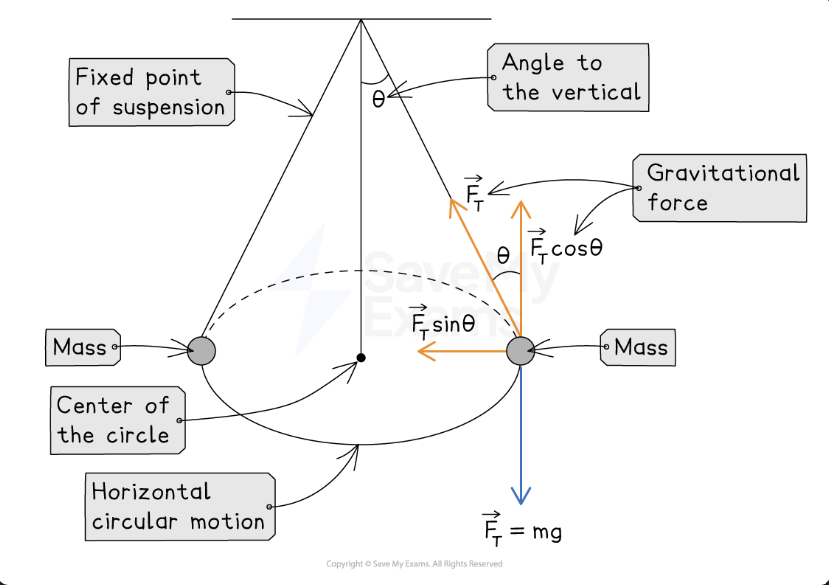
The horizontal component of tension provides the centripetal force

The horizontal component of the normal contact force () provides the centripetal force
friction is given by ( )
Part of riding a bicycle involves leaning at the correct angle when making a turn. To be stable, the forced exerted by the ground must be on a line going through the centre of gravity. The force on the bicycle wheel can be resolved into two perpendicular components — friction parallel to the road ( the centripetal force ) and the vertical normal force ( which must equal the systems weight )
by doing