Public Opinion in Campaigns
The Media
As noted earlier, money plays a significant role in the success of a campaign. The second item of influence in a campaign, and in an election as a whole, is the media. It is virtually impossible to go an hour without the media reporting something that concerns the American voter. Voters are constantly bombarded by media coverage, campaign ads, and public opinion polls. Podcasts, YouTube, Twitter, Facebook, and other forms of digital media are readily available sources of influence.
From the beginning of the American Revolution, the power of the press was recognized. The First Amendment guarantees freedom of the press, and the founders understood that American citizens needed to be adequately informed. We can see examples of this from early newspapermen such as Isaiah Thomas and authors such as Thomas Paine with his pamphlet Common Sense. This illustrates that the founders recognized the relationship between politics and the media.
Ever since the beginning of the American republic, officials have always tried to ensure that the media is on their side. In the early years of the nation, politicians and parties sponsored and controlled newspapers to further their agendas. This was possible because circulation was minimal, and newsprint was expensive. The Federalist Papers, which urged the ratification of the Constitution, were first published in New York newspapers. During George Washington's administration, the Gazette of the United States represented Alexander Hamilton and the Federalists. The Republicans, led by Thomas Jefferson, had their own newspaper, the National Gazette.
The development of high-speed presses and growing literacy rates led to publishers printing thousands of copies of newspapers cheaply and quickly. The invention of the telegraph in the 1840s meant that political news could be flashed across the country. The Associated Press was created in 1848, but because its stories were sent via telegraph, they had to be brief and could not afford to be partisan or biased. In the larger media audiences, the mass-readership newspaper was rarely nonpartisan. The way to attract readers was with sensationalism. This style of reporting became known as yellow journalism, a term that refers to sensationalized stories that are often untrue. The most well-known practitioner of this was William Randolph Hearst in his New York Journal.
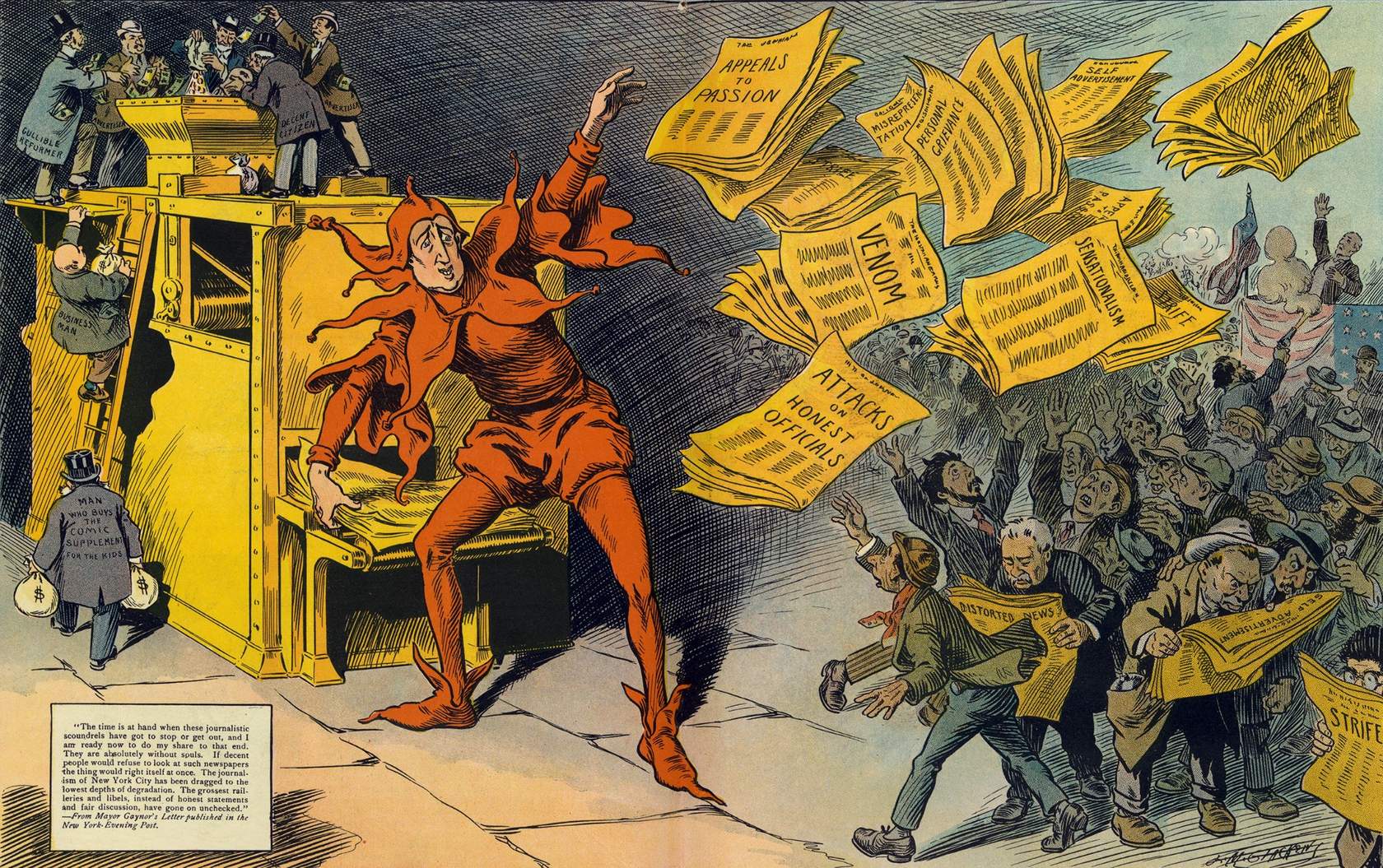
In this cartoon, William Randolph Hearst is depicted as a jester throwing out pieces of yellow journalism.
Yellow Journalism
William Randolph Hearst used his newspapers to promote war with Spain when the Cuban people rebelled against Spanish rule. At the time, conservative Republican leaders were opposed to a war. A steady flow of Hearst's newspaper stories about real and made-up Spanish brutalities changed public opinion in favor of American intervention. When the battleship USS Maine blew up in Havana Harbor, President McKinley bowed to popular pressure and declared war in 1898, even though there wasn't any concrete evidence that the Spanish were involved in the Maine's destruction. The public was convinced that the Spanish were involved due to the reports the people read in newspapers, and this forced McKinley to act. This type of yellow journalism continues today in both the tabloid press and some mainstream media.
Fireside Chats
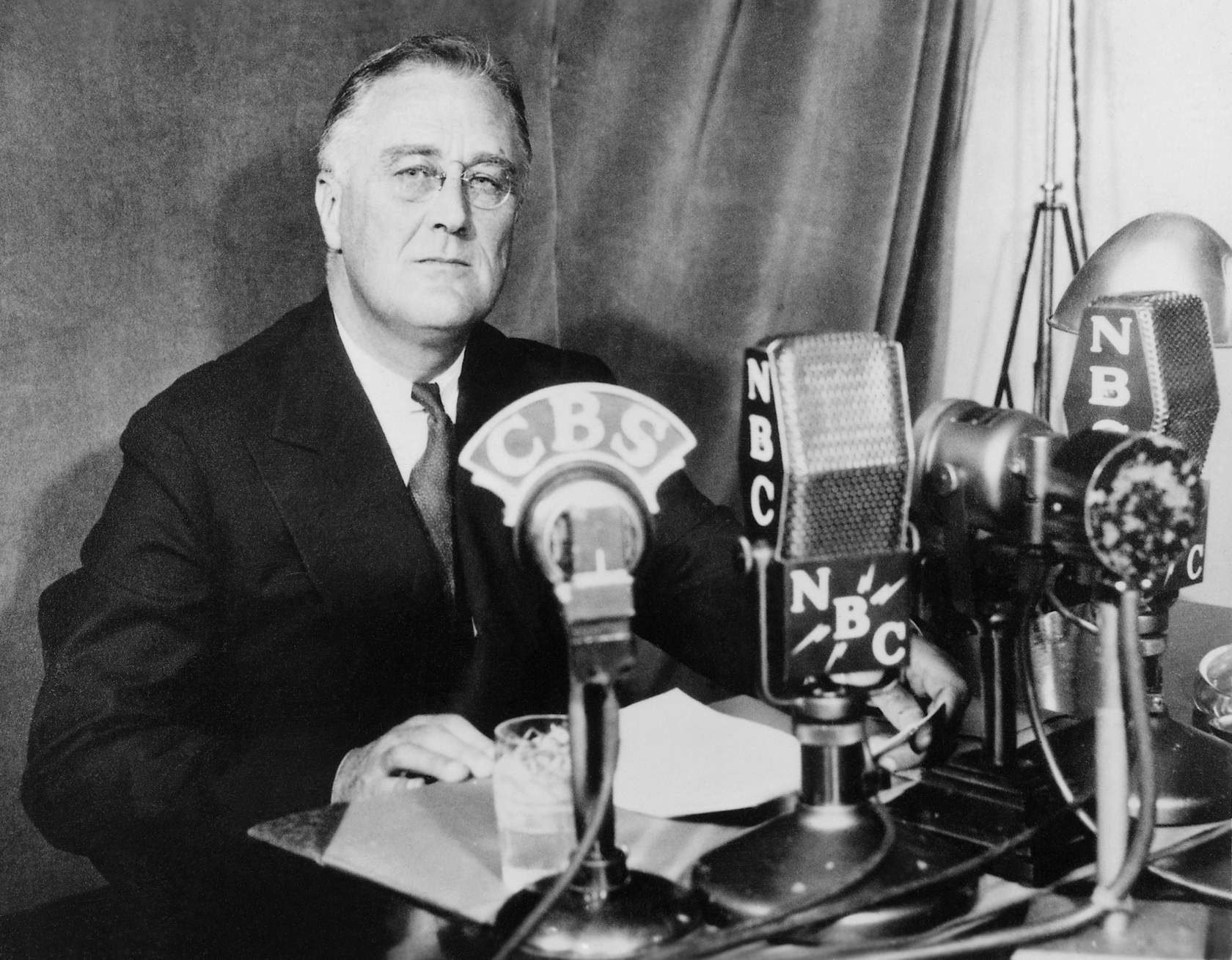
Franklin D. Roosevelt gives a fireside chat.
The mass media is the vehicle through which the government informs, explains, and tries to win support for its programs and policies. President Franklin Roosevelt's fireside chats used radio in this manner. These fireside chats were evening broadcasts that Roosevelt made over the radio. One thing is clear: most politicians crave the media spotlight. Politicians today have many sources other than newspapers at their disposal. They use radio, network news, cable news, early morning news, entertainment programs, and increasingly, social media.
Media Watchdogs
Another important function of the mass media is to act as media watchdogs. Media watchdogs bring evidence of corruption, abuse of power, and ineffective policies and programs to the attention of the American people. Many governmental scandals, such as Watergate, have come to light due to the work of investigative journalists. The national press plays a vital role in scrutinizing men and women who are seeking election to positions of authority and responsibility.
Is the National Media Biased?
Many studies, dating back to the early 1980s, have concluded that members of the national press are more liberal than the average citizen. In 1992, about 91% of the media personalities interviewed said they had voted for a Democratic candidate for president, even though only 43% of the public had voted for that candidate.
The media tends to not only be more liberal but also more secular. About 70% say they never or only rarely attend a religious service. As an offset, talk radio, which continues to grow in market share, is predominantly conservative. Almost half of the twenty-eight largest talk shows have been chaired by conservatives. There is always a possibility that bias in the media can be shown toward either party. Voters must learn the facts and form an opinion of their own before deciding who to support.
The Media's Influence on Government
The mass media, most significantly through its news, reporting, and analysis, affects what and how we learn about politics. Along with family, school, and church, the media becomes part of the process through which people learn society's values and norms. After the 1964 presidential election, one study suggested that, in the northern part of the US, a newspaper endorsement of Democratic candidate, Lyndon Johnson, added five percentage points to the vote he received. Editorial views of newspapers affect their news coverage, and news coverage affects public attitudes. Experiments conducted in New Haven, Connecticut, along with a study done in North Carolina, showed that what citizens believe about some policy questions reflects what the media says about those policy questions. Thus, the media will continue to have a direct influence on voters and politicians.Public Opinion
Politicians make many of their decisions based on the views held by the American public. This makes sense. If they want to get elected (or reelected), politicians must hold beliefs and take actions that the public agrees with. If no one agrees with a politician's views, that politician won't get voted into office.
Public opinion polls are used to measure public opinion. Politicians use the data from these polls to measure public attitudes and refine their campaign strategies. They can also use the data to create targeted advertisements. By learning what issues people care most about, politicians can focus their messaging on those issues.
The Internet
The Internet is playing an ever-increasing role in politics. When Howard Dean ran for the Democratic nomination for president in 2004, he raised most of his campaign funds through the Internet. When Barack Obama was running for president, he would send out email blasts at two in the morning, extensively use Twitter, and post to blogs. He did this to make voters feel unique and wanted. President Trump was an avid user of Twitter before and after the election. Today, every candidate for an important political office has a dedicated website and utilizes social media to spread his or her message. Facebook ads have been used to campaign for political offices, and many blogs exist to offer liberal and conservative perspectives.
The Internet is the ultimate free market of political news. Whether it contains facts, opinions, or nonsense, the Internet is nearly impossible to control or regulate. Even if certain websites restrict information on their specific domains, that doesn't prevent that news from being disseminated on other websites. This is true even in countries controlled by dictators. When revolutions broke out in both Egypt and Libya, the activists used the Internet to communicate and organize. Even when nations attempt to shut down Internet access, such as during the Malaysian military coup in early 2021, these shutdowns can often be circumvented through the use of Internet proxies or mesh networks. The Internet has profoundly affected politics by making it easier to raise money, organize people, assess opinion polls, and mobilize campaigners.

Howard Dean