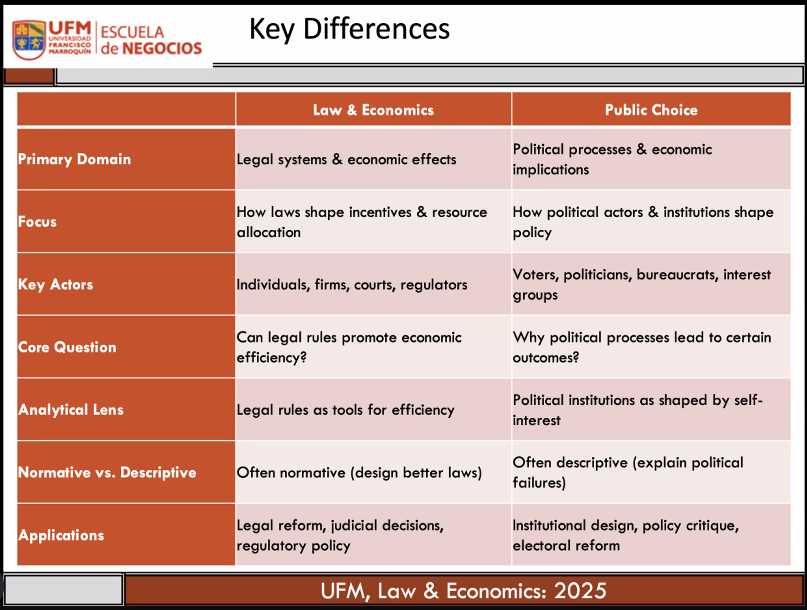
law and economic versus public choice
law and economics
systematic analysis of legal doctrines and jurisprudence base on economic (kind of mixing tools of economics)
economic reasoning of legal problems to reveal strengths and limitations of legislation and jurisprudence arguments
how legal rules and institutions influence economic behavior and outcomes; how economic principles inform legal design
property rights, contract, torts, criminal law, and antitrust law
microeconomics tools: (understanding how incentives influence the behavior of the actors)
cost-benefit analysis, incentives, efficiency to legal system
economic effects of legal rules: effect of liability rules on behavior; effect of property rights on resource allocation
coase theorem: legal rules and bargaining/transaction costs
public choice
apply economic tools to political processes: politicians, voters and bureaucrats as rational, self-interested actors (were investigating how “leaders” act upon self-interest"
topics:
voting behavior and systems
behavioral of political actors
collective decision-making and its inefficiencies
constitutional design and economic implications
government failures as opposed to market failures
overlaps
both use microeconomics theories and rational choice model
both analyze institutions (legal or political) shape incentives and outcomes, often focusing on inefficiency
public choice can inform L&E by explaining political processes to create legislation
L&E can inform public choice by analyzing legal frameworks of political behavior