(MKT305) Chapter 2 - Marketing Strategy Planning
The Marketing Management Process
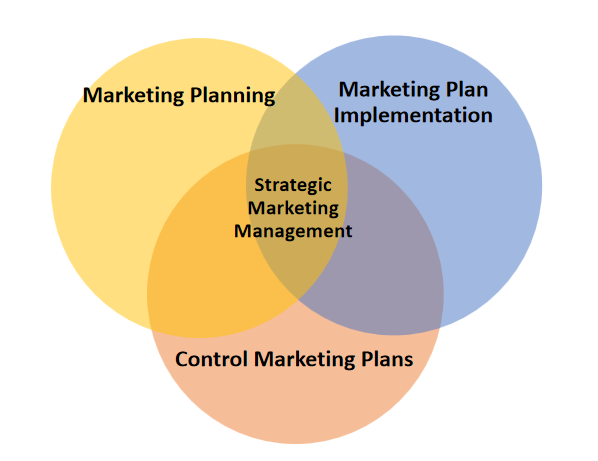
The marketing management process involves:
Marketing Planning: Creating the marketing plan.
Implementation: Putting the plan into action.
Control: Monitoring and adjusting marketing plans.
Strategic Marketing Management: Overseeing the entire marketing effort.
Relation of Strategy to Implementation: The Baby Shoe Example
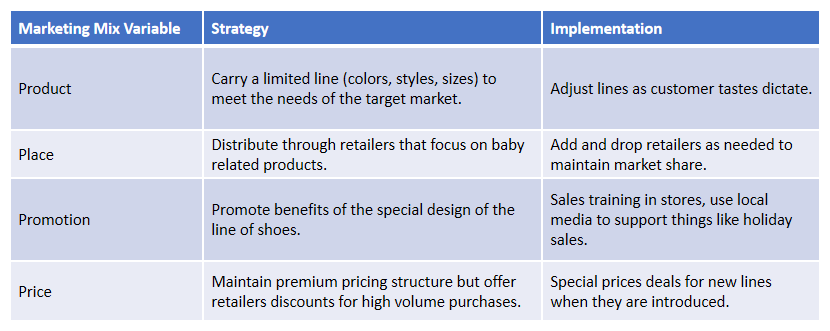
This example illustrates how strategy relates to implementation across the marketing mix variables.
Product:
Strategy: Carry a limited line (colors, styles, sizes) to meet the needs of the target market.
Implementation: Adjust lines as customer tastes dictate.
Place (Distribution):
Strategy: Distribute through retailers that focus on baby-related products.
Implementation: Add and drop retailers as needed to maintain market share.
Promotion:
Strategy: Promote benefits of the special design of the line of shoes.
Implementation: Sales training in stores, use local media to support things like holiday sales.
Price:
Strategy: Maintain premium pricing structure but offer retailers discounts for high-volume purchases.
Implementation: Special price deals for new lines when introduced.
A Firm's Marketing Program
Step 1: Identify the Target Market and define the Marketing Mix.
Target Market = The specific group of people you want to serve (e.g., teenagers, working moms, business travelers)
Marketing Mix = The 4Ps:
Product: What you're selling (features, benefits)
Price: How much it costs
Place: Where it's sold
Promotion: How you tell people about it
Step 2: Develop the Marketing Strategy, including specific details and control procedures.
Once you’ve chosen the target and designed the mix, you need a clear strategy to guide your efforts over time.
Includes:
Positioning: How your brand is different from competitors in the mind of customers.
Objectives: SMART goals (e.g., "increase market share by 10% in 12 months").
Tactics: Specific actions (e.g., launch a back-to-school campaign in August).
Control procedures: How you’ll measure results and adjust (e.g., use KPIs like sales growth, web traffic, customer feedback).
This turns your big-picture idea into a concrete action plan with measurable goals
This leads to the creation of the Marketing Plan.
The Marketing Mix
The cornerstone of basic marketing planning.
The elements (The 4 Ps):
Product: What you are offering
Place: Where you sell and how you deliver
Promotion: How you communicate with customers
Price: What the customer pays
Customer Lifetime Value (CLV)
Definition: The total profits a single customer contributes to a firm over the length of the relationship.
It helps answer this question:
👉 How valuable is this customer to us over the long run?Considerations:
Retention rates
This is the percentage of customers who stay with the company over time.
Higher retention = higher CLV, because long-term customers keep buying.
Acquisition costs
This is how much it costs to get a new customer (ads, promotions, sales time).
You want CLV to be much higher than the acquisition cost—otherwise, you lose money.
"Delivered" Customer Value
= Total Customer Values - Total Customer Costs.
Customer Values include:
Product Value: Does it solve their problem? Does it perform well?
Service Value: Extra benefits like delivery, warranties, tech support, easy returns
Personnel Value: Friendly, knowledgeable, and helpful staff or service agents
Image Value
Brand reputation, style, social status
Emotional appeal or alignment with customer identity
Customer Costs include:
Monetary Cost: The price paid (including fees, taxes, etc.)
Time Cost: Time spent researching, waiting, or using the product/service
Energy Cost: Physical or mental effort required (e.g., setting something up, dealing with customer service)
Psychic Cost: Mental or emotional stress, discomfort, or anxiety that a customer experiences before, during, or after a purchase decision.
Customer Equity
Definition: The expected earnings stream from a group of customers (current or prospective).
🔑 It’s the total expected profit from all customers throughout their relationship with your brand.
Customer Equity=∑(CLV of all customers)
Based on:
Estimating the cost of acquiring new customers.
The cost of retaining these customers.
Enhancing value by increasing these customers' purchases: Encouraging existing customers to:
Buy more often
Buy higher-value items
Stay loyal longer
The S.W.O.T. Analysis
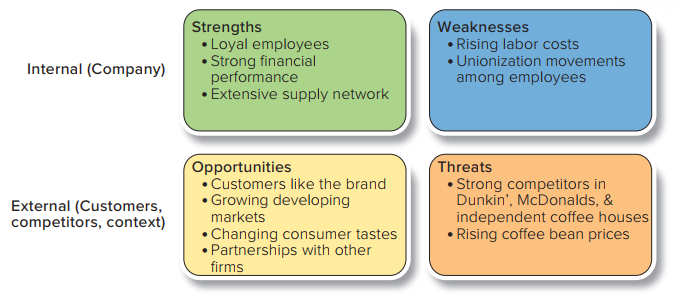
An important way to assess the marketing environment.
S - Strengths
What does the firm do well, and what resources are available?
W - Weaknesses
What does the firm not do well, and where are resources lacking?
O - Opportunities
Looking at customers and competitors to see where new or existing markets can be approached with new ideas/products.
T - Threats
Examining the external environment and competitors to see what might be challenges to face