24.3 Predator-Prey relationships
Another major biotic factor that has an influence on population size is the role or predation. -this is where an organism kills and eats another organism (its prey)
Predation - is a type of interspecific competition, operating between prey and predators species.
Predator adaptations - speed, stealth, fast reactions
Prey adaptations - camouflage, mimicry and mechanisms
Predator-Prey relationships
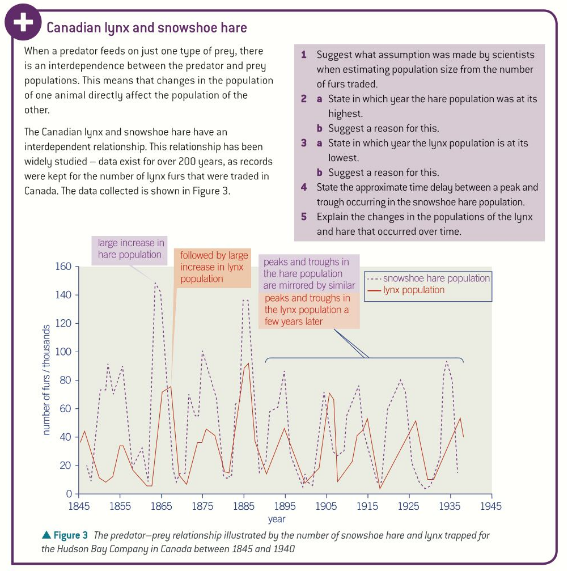
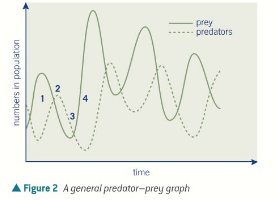
The sizes of predator and prey populations are interlinked. This results in fluctuations in the size of both populations.
In general, they follow the same patterns.
Stage 1 - An increase in the prey population provides more food for the predators, allowing more to survive and reproduce. This in turn results in an increase in the predator population.
Stage 2 - The increased predator populations eats more prey organisms, causing a decline in the prey populations. The death rate of the prey population is greater than its birth rate.
Stage 3 - The reduced prey population can no longer support the large predator population. Intraspecific competition for food increases, resulting in a decrease in the size of the predator population.
Stage 4 - Reduced predator numbers result in less or the prey population being killed. More prey organisms survive and reproduce, increasing the prey population - cycle begins again.
Other factors usually influence including the availability of the food plants of the prey or the presence of other predators. Fluctuations in numbers may also result from seasonal changes in abiotic factors.
Example is the Lynx and Hare.