Growth and Development
^^Growth^^
- Physical changes in the body
- Height
- Weight
- Motor sensory adaptation
- Development of sex organs
^^Development^^
- Increase in mental emotional and social capabilities
- Intellectual (cognitive) ability
- Variety in expression of emotions
- Ability to cope with complex situations
- Social and interpersonal skills
^^Key terms for development^^
- Physical development: Growth of body
- Psychosocial development: Psychological and social development
- Cognitive development: Intellectual processes
^^Key concepts^^
Human needs vary as individuals move through the life span. It is important for healthcare professionals to understand the developmental milestones of each stage of life, because they may provide care to individuals of all ages. It is important to understand that there are always exceptions and the no one individual follows the stages exactly. Generalizations cannot take the place of considering each patient as a unique individual.
^^Life stages^^
- Time frames for studying growth and development
- Start at conception and end with death
- Certain changes and needs characterize each stage
- Erik Erikson’s stages of psychosocial development
- The belief that psychosocial development occurs as the result of resolving specific types of conflicts encountered at each stage.
- Do not include physical aspects
- Resolving these conflicts advances person to next stage
- Psychosocial development can be delayed if conflict not resolved
- Process continuous over lifespan
- Stress can cause regression to earlier stage
- Baby Boomers
^^Prenatal^^
- Conception → Birth
- Begins with conception (fertilization of an ovum by a sperm) and ends with birth
- Zygote
- The cell formed when the two reproductive sex cells join is called a Zygote. The Zygote contains all the genetic information from both parents that determine gender and physical characteristics.
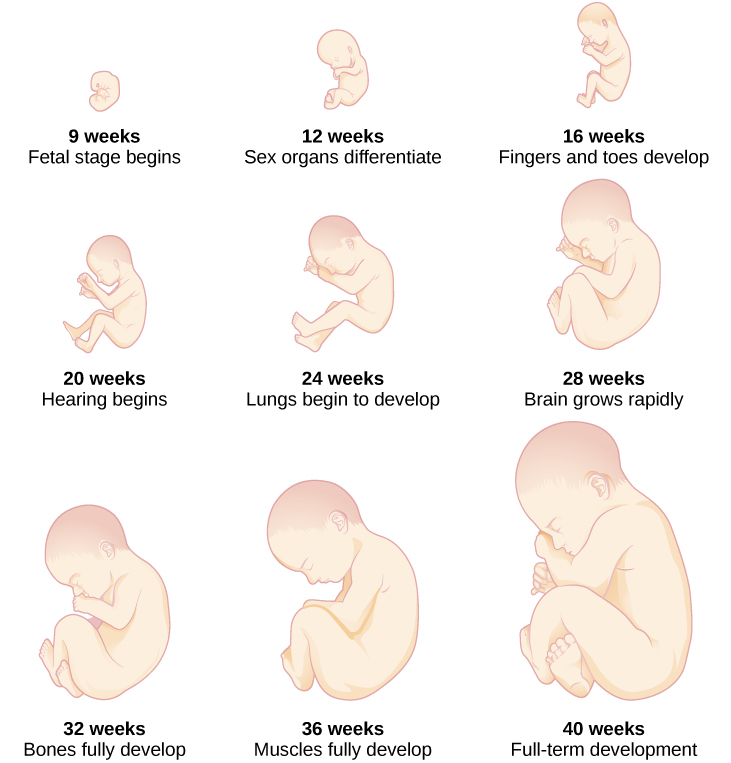
- Embryo Stage
- The fertilized ovum is implanted into the uterine wall, and rapid cell division and multiplication occur. The period from the second to the eighth week after fertilization called the embryo stage.
- Fetus
- From 8 weeks until birth the embryo is called a fetus
- Rapid Physical Growth
- makes developing human especially vulnerable to environmental factors. Congenital anomalies can occur if the mother inhales toxins or consumes alcohol, drugs, or nicotine.
- No psychosocial stage
^^Infancy^^
- During the first month of life, the newborn is often referred to as a neonate
- In this text Infant is used to describe the time frame from brith → to 1 year of age.
- Physical Growth
- A period of tremendous physical growth. The birth weight triples or quadruples to 21 to 27 pounds by age 1. Length will increase to between 29 and 30 inches. Teeth will erupt between ages 8 and 12 months.
- At first movements are primarily reflexive rather than being purposefully made by the infant. By 1 year many infants crawl, stand alone, and walk with assistance.
- Cognitive skills
- Cognitively vocalization progresses to several words. Infants learn by imitation. During first few months of life the learn to manipulate objects recognize familiar objects and persons and obey simple commands.
- Trust vs. Mistrust
- Erikson’s psychosocial stage for the infant. Infants are dependent on others for their physical and emotional survival. Those who receive consistent loving care the satisfies the need for food warmth and other physical comforts will develop trust in their caregivers. Inconsistent and inadequate care leads to mistrust others.
^^Toddler^^
- 1 → 3 years
- Physical changes
- Occur as the body grows and proportions change. Protruding abdomen is still present, head no longer looks oversized. By 3 years of age approximately 20 teeth are present and many toddlers especially females have achieved bowel and bladder control.
- Motor sensory ability
- progresses from walking independently to running, jumping, and climbing.
- Cognitive skills
- develop rapidly as they acquire language skills and begin to speak in sentences.
- Autonomy versus shame and doubt
- psychosocial stage for toddlers. Will develop confidence in their ability to care for themselves when they receive encouragement to explore their environment.
^^Preschooler^^
- 3 → 6 years
- physical changes
- become taller and thinner than toddlers. Self care skills increase able to independently dress themselves
- Cognitive skills
- can speak quite well in sentences. Developed awareness of other people who are not in their immediate environment.
- Initiative versus guilt
- Psychosocial stage for preschooler. can build confidence developed as a toddler to initiate their own learning. If their parents severely restrict this initiative, criticize, or scold them for their attempts a sense of guilt will develop. The feeling of guilt will diminish their natural enthusiasm for learning new motor and language skills.
^^School-Age Child^^
- 6 → 12 years old
- Physical Changes
- more pronounced development between 10 and 12 years with the beginning of puberty. The permanent teeth also begin to erupt at this stage of growth.
- Motor Sensory Ability
- become well-coordinated and the child develops grace and agility
- Cognitive Skills
- progressed to logical thinking and the ability to see things from different perspectives.
- Industry Versus Inferiority
- School-age children experience pleasure from the successful completion of projects and anticipate recognition for their accomplishments. If school-age children are not accepted by peers or cannot meet the expectations of family, a sense of inferiority and lack of slef-worth may develop.
^^Adolescence^^
- 12 → 20 years old
- Physical Changes
- maturation of the reproductive systems occurs
- Motor sensory ability
- motor skills improve, but awkwardness in the gross motor skills is evident. Adolescent may easily become fatigued with activity and requires adequate rest and sleep.
- Cognitive Skills
- able to acquire large quantities of knowledge and are able to use reasoning skills. They have the capacity for introspection and start to develop their philosophy of life and create their future occupational identity. Prone to stress.
- Identity versus role confusion
^^Young Adulthood^^
- Physical Changes
- \