Lecture 3 - Macronutrients (Proteins)
Proteins: Macronutrient Overview
Composition of Proteins
Proteins are one of the three major macronutrients.
They consist of smaller molecules called amino acids.
Amino acids are composed of carbon, hydrogen, oxygen, and nitrogen molecules.
There are 20 amino acids that make up our proteins.
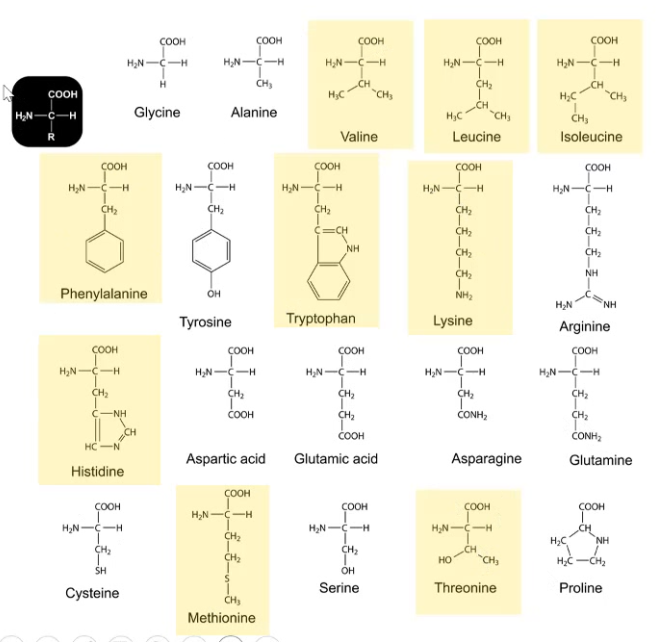
Structure of Amino Acids
All 20 amino acids share a common structure:
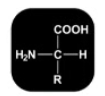
A central carbon molecule. (C)
A hydrogen atom attached to the central carbon. (H)
An amino group attached to the central carbon. (H_2 N)
A carboxyl group, which is an acidic group, attached to the central carbon. (COOH)
The unique feature differentiating amino acids is the R group or side chain.
Glycine, and leucine exemplify the common structure but differ in their R groups.
Glycine has a hydrogen ion as its R group.
Leucine has a long chain of atoms as its side chain.
Synthesis and Genetic Influence
The 20 amino acids can be combined in numerous ways to produce various proteins in the body.
The order of amino acids is determined by the genetic code (DNA).
Mutations or deletions in DNA can lead to the production of faulty proteins, causing diseases.
Essential vs. Non-Essential Amino Acids
The body can synthesize 11 amino acids through biochemical pathways.
The remaining 9 amino acids cannot be synthesized and must be obtained from the diet; these are called essential amino acids.
Vegetarians need to ensure they consume enough protein to obtain these essential amino acids.
Examples of essential amino acids are highlighted in yellow in the diagram.
Protein Sources and Complete Proteins
Proteins can be obtained from both plant and animal sources.
Vegetarians can obtain proteins from legumes, nuts, and seeds.
Foods containing all nine essential amino acids are called complete proteins.
Examples of complete proteins include eggs, meat, seafood, dairy products, soybean, quinoa, chia seeds, and hemp seeds.
Consuming complete proteins ensures intake of all essential amino acids.
Lysine, for example, is crucial for mood regulation.
Protein Structure
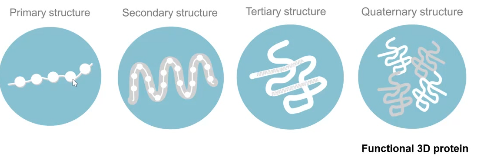
Dietary proteins have a quaternary structure.
During digestion, proteins are broken down into single amino acids.
Amino acids are reassembled based on the genetic code into a specific sequence, known as the primary structure.
A long chain of amino acids is called a polypeptide chain.
Polypeptide chains can form helices and other shapes, which are secondary and tertiary structures.
These structures result from bonding between atoms in the amino acids' R groups.
A fully functional protein is in its quaternary structure, formed by multiple polypeptide chains.
Mutations can prevent the formation of a functional 3D protein, leading to diseases.
Hemoglobin: A Functional Protein Example
Hemoglobin, found in red blood cells, carries oxygen molecules throughout the body.
Its quaternary structure consists of multiple polypeptide chains made of amino acids.
Proper formation of hemoglobin is crucial for oxygen transport and survival.
Functions of Proteins
An average healthy adult body is approximately 15% protein.
Collagen is the most abundant protein (more than a third of total proteins), providing structural support and aiding in wound healing.
Keratin forms nails and hair.
Titin is essential for muscle contraction.
Mucin is found in nasal mucus.
Proteins are essential for:
Building and repairing tissues, especially after intense exercise.
Specifically with resistance training where we are breaking the muscles which then need to be built back up again
Acting as enzymes to catalyze biochemical reactions.
Serving as or being derived into hormones for signaling.
Supporting immune system function, such as antibodies.
Transporting molecules throughout the body, such as hemoglobin for oxygen and albumin for fatty acids.
Maintaining fluid and pH balance (pH 7.4).
Serving as an energy source during starvation by converting the amino acid carbon skeleton into glucose.
Forming complex molecules when joined with carbohydrates and fats, aiding in cell communication.
Enzymes: Catalysts of Biochemical Reactions
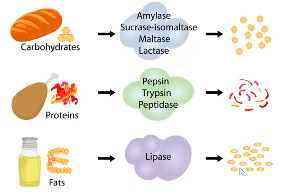
Enzymes are proteins that catalyze biochemical reactions, ensuring specificity and speed.
They accelerate reaction rates by factors of a million or more.
Many diseases result from mutations affecting enzyme production.
Enzymes break down large carbohydrates, proteins, and fats into smaller molecules for energy use and protein synthesis.
Examples include amylase, maltase, lactase, lipase, pepsin, and trypsin, peptidase.
Enzyme names often end in "-ase."
Mutations in enzymes like amylase can impair digestion of carbohydrates and cause discomfort.
Kwashiorkor: A Protein Deficiency Disease
Severe protein deficiency is rare in developed countries but is a leading cause of death in underdeveloped countries.
Kwashiorkor, first described in 1935, is a malnutrition form due to inadequate protein intake.
It primarily affects children weaned from breast milk and fed low-protein diets.
The name means "disease of the displaced child" in Ghana.
Symptoms include:
Edema (swelling) due to water accumulation in tissues caused by reduced albumin synthesis.
Essentially, the child is unable to maintain a balance between water in the capillaries versus in the organs so water will start rushing into the organs leading to a distended stomach.
Poor skin health.
Growth retardation. —> not develop properly
Low muscle mass.
Liver malfunction.
Without treatment, Kwashiorkor can lead to death.
Protein for Muscle Building
Muscles are primarily water (75%) and protein (25%).
Resistance exercise and protein intake aid in muscle building, especially when consumed before or after workouts.
Most active people should consume 1.4 to 2 grams of protein per kilogram of body weight.
Protein doses should contain leucine, ideally consumed in intervals of three to four hours.
The muscle-building effects of exercise last at least 24 hours but weaken over time.
Protein supplements are practical for athletes or those controlling calories, but generally unnecessary for ordinary individuals with balanced diets.
Excess protein is broken down and eliminated if not used, as it is not stored.
Consultation with a medical practitioner or dietitian is recommended to determine the necessity of protein powder, considering individual exercise programs and dietary intake.